Recently, I’ve been assisting several clients with their DNA matches from the DNA tests they’ve taken. As I wrote here, Ethnicity estimates shouldn’t define your family tree. Since I have either built or helped expand their family trees, we’ve had success connecting many of those matches to their trees. However, it’s frustrating for both my clients and me to encounter the large number of matches that either have no tree linked to their DNA test or only a small tree with just two or three people. This lack of information is not helpful for anyone involved. While some may be primarily interested in ethnicity reports, even they are missing out on the full story. Let me explain.
Why Link Your DNA Results to a Family Tree?
Using Ancestry.com as an example, linking your DNA results to a family tree is essential because it allows you to identify how you are related to your DNA matches. By comparing your genetic information to individuals in your family tree, you can gain valuable insights into your ancestry and discover new family connections through shared ancestors. Essentially, it bridges the gap between your genetic data and your known family history.
When you link your DNA results to a public tree on Ancestry.com, you activate shared ancestor hints, which appear in the ThruLines tool. The larger your linked tree, the better your chances of finding common ancestors. This connection allows you to:
Identify who in your tree is a DNA match.
See how you’re related to your matches.
Keep a record of these connections.
Determine which parts of your tree they can help with and which shared relatives they might have stories or information about.
Link Your DNA Results
At Ancestry, you need to link your test to “you” in a tree. If the DNA test belongs to your mother, link it to your mother in your tree. Note that your test can only be linked to one person in one tree at a time. If you decide to disconnect and reconnect to another tree, record everything first, as you will lose your current ThruLines. These will regenerate based on the new tree but may differ depending on the tree’s content and other factors.
To receive green document leaf hints, potential parent hints, and DNA hints such as ThruLines, you need to provide enough information for Ancestry’s system to connect the dots. This includes:
Birth and death dates
Birth and death locations
All spouses, not just the one you descend from
Children and their spouses
At least one additional generation of descendants
Every generation added gives Ancestry’s software more “info” to use for connecting the dots.
Best Practices for Hints and Trees
Never blindly accept hints or assume their accuracy. Early in my genealogy journey, I trusted information without verification, believing that older generations had everything correct. Today, we have more resources to validate information and acknowledge that errors can occur. In your family tree, the leaves represent document or record hints, not DNA matches. The leaves on your DNA match page indicate a common ancestor identified in the tree of your DNA match.
When reviewing a hint, use the “maybe” button to move it into an Undecided folder if you’re unsure. I try to keep my leaves organized so I can easily identify new hints. While I ignore Ancestry Member Trees as sources (because they are not a source!) in my tree, I use them as research starting points and messaging opportunities.
I also ignore DNA icon picture hints, as these images often represent personal identifiers rather than actual ancestor photos. And they make for useless hints you do receive. I also do not use them in my own trees for that very reason. Instead, use Ancestry’s MyTreeTags to organize your tree. Tags help label people as DNA matches, military veterans, direct ancestors, and more. Tags can be universal (e.g., “DNA” or “Common DNA Ancestor”) or custom (e.g., for unique family history needs).
Understanding ThruLines
ThruLines are calculated for a maximum of seven generations, counting your parents as generation one. (“seven generations” is equivalent to the “5th generation” when counting back through your ancestry.) The three requirements for ThruLines are:
You must have a tree.
Your DNA test must be linked to a person in that tree.
You must have DNA matches to other people with the same ancestor in their tree.
To maximize ThruLines, enter names of spouses and children for eligible generations. Feeding the machine with more data improves results.
Why Sharing Matters
I totally get why some folks might hold back from sharing their family trees; it can feel like you’re “giving away” a piece of your puzzle. But I like to think of it differently! Imagine if my efforts help someone stumble upon a long-lost ancestor’s photo or finally break down that stubborn brick wall in their research. Or what if I inspire someone to dive into Y-DNA or mitochondrial DNA testing? That’s what it’s all about! Collaboration in genetic genealogy can lead to amazing discoveries. Let’s come together and unlock these family stories—who knows what we might find!
Closing Thoughts
Genetic genealogy thrives on collaboration. By linking DNA results to detailed family trees and embracing tools like ThruLines and MyTreeTags, you can unlock powerful insights and connections. Sharing your research and findings enriches not only your own journey but also the broader genealogical community.
As an Amazon Associate, I earn from qualifying purchases.
Have you ever thought about how AI might have played a role in your family history research—perhaps without you even noticing? It’s possible that artificial intelligence (AI) has been quietly aiding your family history research all along! It’s fascinating to consider!
AI is revolutionizing the field of genealogy, and you might be surprised by how often you’ve encountered it. For instance, popular platforms like Ancestry.com leverage AI to recommend relevant records (those leafy “hints.”) and unearth potential matches in other family trees. Platforms like 23andMe, AncestryDNA, and MyHeritage use AI to identify potential relatives based on shared DNA.
MyHeritage even offers AI Biographer™, a tool that generates Wikipedia-style biographies of your ancestors using historical records and information from your family tree.
But AI’s contributions extend far beyond these well-known examples. Even if you’re a beginner in genealogy research, several AI tools can become your research companions:
Versatility Personified: ChatGPT – This multifaceted AI tackles general genealogy questions and assists you in crafting effective research strategies.
Your Genealogical Gemini: Google’s Gemini – Similar to ChatGPT, Gemini offers a helping hand with your genealogical inquiries.
The Genealogical Detective, Assistant, and Librarian: Perplexity – Don’t let the name intimidate you! Perplexity is another AI platform that can be your one-stop shop for family history research queries.
These AI tools act as virtual research assistants, prompting you with questions and guiding you through various aspects of genealogy. Additionally, there are AI tools designed specifically for genealogy research:
Open GeneaGPT: Your AI Research Assistant – Open GeneaGPT is a tailor-made AI assistant for family history researchers and genealogists.
Genealogy Eyes: Unveiling the Stories Hidden in Your Heirlooms – Genealogy Eyes helps you analyze images of documents, headstones, and other genealogical artifacts.
Tips to Kickstart Your AI-Powered Genealogy Journey
Embrace the Power of Questions: Begin by using AI platforms to ask basic questions about genealogical research methods.
AI-Driven Brainstorming: Let AI help you generate new ideas for uncovering information about your ancestors.
Demystifying Genealogy with AI: Don’t hesitate to ask AI to explain unfamiliar genealogical terms or concepts.
AI as Your Historical Interpreter: Utilize AI to gain insights into historical documents or understand the context of the time periods you’re researching.
While AI is a powerful tool, it’s crucial to remember that it should complement, not replace, traditional research methods. Always verify the information gleaned from AI with primary sources to ensure the accuracy of your family history.
I hope this revamped blog post, infused with the power of AI, empowers you to delve deeper into your family’s rich tapestry!
As family historians, we’re no strangers to challenges. Our work requires patience and dedication, often navigating through countless records in search of a missing piece to the puzzle. While it’s all part of the journey, there are a few common mistakes and oversights that can hinder progress for beginners and seasoned researchers alike. Let’s explore some of these pitfalls and how to sidestep them, making your genealogy journey smoother and more accurate.
1) Unsourced Family Trees One of the biggest challenges in online research is coming across family trees that lack sources. Without citations, notes, or records to back up the information, it becomes nearly impossible to verify the accuracy of those entries. To avoid this, always make a habit of adding sources—whether it’s a census record, a photo, or even a story passed down from relatives. It helps others (and yourself) to understand where the information originated.
2) Incoherent Information Mistakes happen, but spotting impossible scenarios—like a person giving birth after their death—can feel confusing. Double-checking dates and cross-referencing records can prevent these errors from slipping in. Always remember, consistency is key in genealogy.
3) Duplicate Children When researching large families, especially in the 1800s, it’s important to verify children’s birth dates and names. Variations in nicknames across records (like Maggie for Margaret or Polly for Mary) can cause confusion, so be mindful of these when reviewing census records.
4) Unresponsive Genealogy Contacts It’s always exciting to connect with distant relatives online, but don’t be disheartened if you don’t get an immediate response. While it can be frustrating, remember that people may have busy schedules. A gentle follow-up message is okay, and patience is key.
5) Recycling Unverified Facts It’s tempting to adopt information from other family trees, but it’s important to verify facts before incorporating them into your own. Always take a moment to check records and sources; this will ensure that your family tree remains accurate and reliable.
6) Unlabeled Photos Photographs of ancestors can be priceless treasures, but unlabeled images can cause confusion. When sharing family photos, be sure to include as much detail as possible—dates, names, and locations. Even if some details are unclear, adding context helps future researchers.
7) Irrelevant Records It’s easy to misinterpret a record that seems to match an ancestor, but always consider the geographical and chronological context. If your ancestor spent their life in one place, it’s unlikely they have records in a far-off country without explanation. Keep track of family movements to avoid such missteps.
8) Mythical Surname Coats-of-Arms Be cautious when it comes to purchasing coats-of-arms tied to your surname. Remember, coats-of-arms are granted to specific individuals, not entire families. It’s always worth researching the actual lineage behind such claims.
Genealogy is an exciting adventure, filled with moments of discovery and connection. While it’s natural to encounter challenges along the way, approaching your research with a discerning eye and a commitment to accuracy will ensure that the stories you uncover are as authentic as the ancestors who lived them. Whether you’re just starting out or diving deeper, keeping these common pitfalls in mind will help make your family history journey all the more rewarding.
As an Amazon Associate, I earn from qualifying purchases.
I want to emphasize that all the research mentioned below was conducted by other individuals, and I simply discovered their work. Fortunately, our relatives were very supportive and willing to share their findings with me.
James E. Kunkle, a retired US Navy officer who resided in Colorado, passed away in 2017 at the age of 90. I had been corresponding with him since 2012. He and Wallace M. Kunkel (also deceased) have compiled the following history of the Kunkel families, which is available at the Family History Library, among other works authored by James, and at the Library of Congress. I have put a link to it here. A gathering and mingling of early Kunkel families
Wallace’s grandmother began the genealogy work in the late 1940s, spending long hours at her typewriter. She created genealogy books for her seven grandchildren as Christmas presents in the 1960s. Wallace, his daughter Mary, and his grandchildren have continued this work. When Wallace was alive, he collaborated with James on this historical project. It’s poignant that yesterday (I originally wrote this blog on April 8, 2018.) marked the anniversary of his passing. Wallace was also known as “Mr. Sawdust,” a skilled furniture maker and the founder of the “Mr. Sawdust School of Professional Woodworking.”
“At least forty families of Protestant Kunkels immigrated to America from Germany between 1728 and 1770. Some of the Catholic families of Kunkels immigrated to the United States after the War of 1812. Many of the early Kunkel families settled in Pennsylvania. Today, Kunkels live in Pennsylvania, Maryland, Ohio, Wisconsin, Illinois, Indiana, Minnesota, and throughout the United States. The surname is spelled Kunkel, Kunkle, Gunkel, Gunkle, Konkel, Konkle, and other variant spellings.” -J.E. Kunkle & W.M. Kunkel, 1995 (415 pages of history).
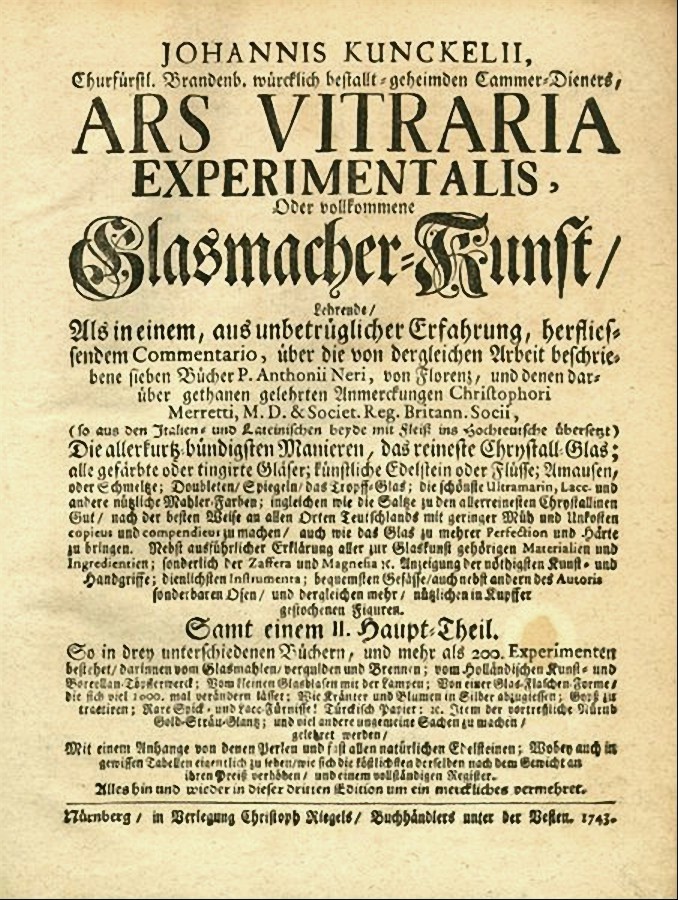
A gathering and mingling of early Kunkel families talks about our first notable figure, Baron Johann Kunckel von Löwenstern, a German chemist. Around 1678, he replicated Hennig Brand’s discovery of phosphorus isolation. Kunckel later managed the laboratory and glassworks in Brandenburg as a court chemist and apothecary.
Ars Vitraria ExperimentalisJohannes Kunckel, Ars Vitraria Experimentalis, 1679
The illustration by George Smith from his 1738 chapter “The art of blowing glass in miniature” (fig. 3) is not labeled alphabetically, but Johannes Kunckel’s 1679 engraving (fig. 4) is:
A — table around which four people may work at once
B — the lamp, filled with oil and a strong cotton wick
C—the hole where the tapered blowpipe is attached . . . so that the air is directed onto the acute and concentrated flame, producing a flame that will melt glass. Goldsmiths have a similar system for soldering metal.
D — bellows attached to pipes of tin that are hidden under the table
E — lever, attached to the foot pedal
F — ventilation hood
G — foot treadle for the bellows, pressed by the worker
Left: Probably engraved by Gottfried Spiller (1658–1728). Covered goblet with “Fruit Children,” before 1700. Gold ruby glass, H. 9 1/8 in. (23.1 cm). Focke-Museum, Bremer Landesmuseum für Kunst und Kulturgeschichte, Bremen (68.253). Center: Ruby glass flute with “AR” monogram, around 1715. German, Dresden. Gold ruby and transparent glass (blown, cut), H. 23 cm. Green Vault, Staatliche Kunstkammlungen Dresden (IV 228). Right:Covered goblet, 1725–35. German, Potsdam. Transparent dark gold ruby glass (blown, cut) 10 9/16 x 3 5/8 in. (26.9 x 9.2 cm). Corning Museum of Glass, Corning, New York, Bequest of Jerome Strauss (79.3.318) Gold ruby glass was perfected through alchemist and glassmaker Johann Kunckel’s experimentation under the patronage of Frederick William, Elector of Brandenburg, at the elector’s glassworks in Potsdam. Its name comes from the addition of colloidal gold to the glass before melting, a complex operation that required the skills of both alchemist and glassmaker. Displayed in a Kunstkammer, glass pieces served as signs of the alchemical knowledge required to produce them.
~ ~ ~ ~ ~ ~ ~ ~ ~ ~ ~ Continue Reading If You’re Interested in the Kunkle Line.
Our Kunkles trace back to my grandmother, Hilda Leonore Kunkle. However, I don’t have any personal stories to share as I didn’t know my dad’s family. I gained most of my knowledge later in life through my siblings, letters from my Aunt Elva (Hilda’s daughter), and documented facts and history shared by others.
Hilda married Glen Henry Logan in 1921 in Indiana County, Pennsylvania. Her father was Charles J. Kunkel. You’ll notice how the name is interchangeable with the -el and -le. He married Carrie Morrison in 1892. Charles lived most of his life in Westmoreland, Pennsylvania, until his wife died in 1937. He then moved to Michigan to live with his daughter, Hilda, and her family until his death in 1948 at the age of 82.
Charles’ father was Michael Kunkle. He also grew up in Westmoreland, Pennsylvania. In 1860, Michael married his neighbor, Esther “Hettie” Hawk. They were Lutherans, and Michael worked as a carpenter before becoming a farmer for the rest of his life. Michael passed away at the age of 80 in 1918 in Westmoreland.
Michael’s father was Daniel. They lived on Michaelsburg Plantation, a 336-acre estate owned by a family member. His family was among the First Families in Hempfield Township.
Some family stories were recorded in the History of Westmoreland County, Pennsylvania by Boucher, John Newton; Jordan, John W. (John Woolf), 1840-1921, joint editor. Publication date 1906. Publisher New York, Chicago, The Lewis publishing company. Contributor Allen County Public Library Genealogy Center
Daniel married Mary Elizabeth Kepple, and they had a son named Michael. They moved from Westmoreland to Indiana, Pennsylvania, where he worked as a railroad lock tender. Unfortunately, Elizabeth passed away about 10 years later. After her death, he married Catherine Iseman in 1844, but she died of cancer in 1850. In 1852, Daniel married Sarah, whose last name is unknown. It is still unknown when Daniel passed away, but it is confirmed that he was alive at least until 1870, as he is listed in the census at age 66 and still working for the railroad.
I’ve been putting off delving into the Kunkel family, but now things are more interesting. The first names in the family often begin with Johann for boys and Anna or Maria for girls. I’ve had to redo my Kunkle family tree twice because I initially followed the wrong line. However, thanks to the help of other researchers, Vernon Cook and James Kunkle, I am now back on track.
Daniel’s father is Johann Jacob Kunkel (Gunckel), Jr. It is in this generation that the Kunkel and Gunckel names are interchangeable. He married Elizabeth Schaeffer in 1789 and had 10 children. My records indicate that he was a farmer, and his cause of death was “gravel.” After researching old terms for the cause of death, “gravel” seemed to refer to the modern equivalent of kidney stones. He is buried in Brush Creek Evangelical Lutheran Church Cemetery.
Johann Jacob’s father is Johann Jacob Gunkel, Sr. His father is our immigrant ancestor of this family. He was born in Breitenburg, Germany in 1746, and they immigrated in 1749 when Jacob was only 3 years old.
Tom writes, One of the first known settlers in Pine Grove area after the French and Indian War, 1689-1763, Great Britain Battles France over unsettled territories in N. America, was Jacob Gunkel. He was located on the site of the Eagle Hotel in 1771. Here, he laid claim to a tract of two hundred acres of land, which he subsequently purchased from John and Richard Penn, proprietors of the Colony of Pennsylvania, which included the site of the present borough of Pine Grove. The convergence of several roads on Gunkel’s plantation made it an excellent location for a tavern, and soon after he purchased the land, he erected a log building, Gunkel’s Tavern, which he kept till 1810 and then he removed to a farm about a mile south from the borough were he died in 1813. His property was located next to the property of his daughter Eva and husband Johannes Loffler.
Another source states he “kept a house of entertainment, and in 1795 opened a store which he kept until 1810. (Source: History of Schuylkill Co, PA, by W. W. Munsell & Co, – 1881). On May 21, 1810, Jacob Gunckel of Pinegrove Township, Berks Co, PA, yeoman, and Susannah, his wife, sell to John Gunckel, yeoman, for 255 pounds, land containing 235 acres, part of the larger tract of land called “Gunckel’s Farm.” (Deed book 24, page 488).
Cemetery records for St. Peter’s (Gunkle’s) Union Church of Pinegrove Township, Schuylkill County include the following references: Jacob Gunkel; born September 28, 1746; died September 2, 1813 Eva Lefler; born Mar 25, 1809; died Jun 21, 1841 Johannes Leffler; born Jul 5, 1764; died Aug 16, 1849; son of Gottfried, Mahanoy Twp., Northumberland Co. Eva Lofler (nee Kunkle); w/John; died Jan 26, 1857; 83y 11m 15d
Gunkel’s Cemetery, located across the street from St. Peter’s Lutheran Church, contains a memorial plaque that reads: Site of the 1st Reformed-Lutheran Church 1782-1817 Donated by Jacob & Susanna Gunkel
Joh. Jacob’s father was Johann John Gunkel, born in 1722 in Breitenborn, Germany. John Gunckel married Anna Margarethe Lorentz and arrived in America in 1749 with his young son. In the book “Naturalizations of Foreign Protestants in the American Colonies,” there is the following: “John Gunckel of Bethel Twp., Berks County, Pennsylvania, became a citizen 20 September 1761.” These naturalizations were performed at the Philadelphia County, PA Courthouse. https://archive.org/stream/naturalizationso24grea#page/75/mode/2up/search/gunckel
Johann has often been confused with Johann Michael Gunkel, who was the same age. They were first cousins from Breitenborn and used similar names for their children. They also attended the same church. By the way, Johann (John) also had a brother named Johann Jacob. Talk about confusing!
John is also our Revolutionary War ancestor. His SAR Patriot number is P-171729. The John Gunckel of Bethel Township, who performed Revolutionary War service and from whom we are descended, was enrolled in 1777-1779 in the First Class, Captain Valentine Shoufler’s Seventh Company, First Battalion, Lancaster County Militia. He was assessed 26 pounds in fines, according to the evidence of an undated list of Class Fines. (Pennsylvania State Archivist, Military Accounts (Militia), Records of the Comptroller General, at the Division of Archives and Manuscripts) Larry Patrick Cornwell, 138085, has a SAR-approved supplemental under this John Gunckel. Larry served as the Genealogist General of the National Society, Sons of the American Revolution from 2011-2014 (www.sar.org)
John died in 1795 at the age of 73.
John’s father was Lorentz Gunkel, born in Breitenborn, Germany. He immigrated to the US in 1751 on the ship the “Duke of Bedford” with wife and one child, from Rotterdam, and last from Portsmouth, England. Port of entry was Philadelphia, PA, on a Saturday. Records show that Lorentz settled first in Northampton Co, PA, and later pioneered in Allegheny & Westmoreland Counties, PA. He was a Revolutionary War soldier and a pensioned veteran. *(Record Sources: 1804, pg 335 (Supp. 1983) aud 9041, pg 459 (From Flörsbach, Germany).
Lorentz wed Anna Catharina Gundlach in 1709. It’s uncertain who the “young child” who immigrated with them is. However, it could be our ancestor, Johann Jacob, as he was born in 1746.
Lorentz’s father was Hans Gunkel, who was born in Neuhütten, Spessart, Germany, in 1636. He was known as a Catholic man. He married Margareth N. and worked in a “glass house.” They later moved to Breitenborn, where Hans was invited by Heinrich Gundlach, the headmaster of the Breitenborn Works, to recruit glass makers from all over the country in the 1670s and 1680s.
When I originally published this post, a cousin replied, introducing himself. He also stated, “I do not believe that anyone actually lived in a “Glass House” I believe that this is simply a misinterpretation of the translation of Neuhutten. The Huts of glass were simply the buildings that were constructed… or the kilns… that were used to make the glass. These kilns were made of bricks so they could be brought to new areas where the resources (forests) were over-exploited to the point that they had to move to continue to be able to make glass. When they relocated to the area of NeuHutten they simply called it that “New Huts”.”
Hans Kunkel was a skilled glassblower, and many Kunkels were known for their glassblowing skills all over Europe at that time. Gundlach, an entrepreneur, made efforts to recruit the most talented glassblowers to come to Breitenborn. It is impressive that Hans Kunkel was still very productive in the 1680s. For instance, between January 4, 1684, and November 26, 1685, at around 50 years old, he produced 42,300 drinking glasses of various types and earned 91 fl. 16 alb (the equivalent of the dollar in those days). In addition to blowing glass, he occasionally attended the furnace, an important task for maintaining proper temperatures during the melting process.
During the winter months, the furnace stayed cold. The production period was 9 months per years – max. During the winter months, most of the works the people were also engaged in was cutting the firewood (beech and oak) for the furnace which did eat up a lot during the production period. So additionally they had another income. There were over 20 men permanently assigned to the fire wood cutting and handling, plus the seasonal ones. Hans Kunkel, for example, made 83-1/2 Clafter (7’x7’x3′) and earned 25 fl. additionally in 1689.
Despite all the hard work, Hans Kunkel lived to be nearly 100 years of age. There is a lot more similar data available, basically showing production figures, earnings, how they were paid (normally 50% cash, and the other in natural things, like grain, flour, etc. and the beverages, like beer and brandy were also brewing there.)
(Above Source: – “Heinrich P. Göbel” – Germany Researcher. (1994)
Hans’ father was Johann Michael, born in Glasshouse, Germany about 1600. He married Anna Katharine Naumann. He died in 1676. There is not much else known about him.
The Kunkels were already living in Neuhutten before the Thirty Years War. It seems that Neuhutten and that part of Germany were already in the Lutheran camp. The Kunkels all seemed to have been born, married, and died in “The Glasshouse” in Neuhutten.
Joh. Michael’s father was Johannes Jurg, born about 1565. He married Elisabeth Christina Houser.
The Kunkel family still live primarily in the Spessart Mountain range area, which is a mostly wooded region in the heart of Germany. There is a historical mention of an early Glasshouse in the Spessart area dating back to 22 August 1349. During that time, the area was under the jurisdiction of the Archbishop of Mainz.
The Union Letter (Bundesbrief) of 1537 (or the Federal Charter or Letter of Alliance) lists two KUNKELs, namely Jurge (George) and Hentze Kunkel, and in a later revision dated 24 February 1559, again two KUNKELs – George and Friedrich Kunkel. There are links, as glass-making was only carried down by the same families.–Janet and Robert Wolfe Genealogy, “Notes for Johann Jurg Kunkel and Elisabeth Christina Houser” Webpage: www.umich.edu/~bobwolfe/gen/mn/m6413x6414.htm Email address: JanetRobertWolfeGenealogy@gmail.com Go to the Genealogy Page for Johann Jurg Kunkel Go to the Genealogy Page for Elisabeth Christina Houser Go to the Kunkel surname index. Go to the Houser surname index. Go to the Home Page for Janet and Robert Wolfe Genealogy
Much research is still needed to fill out all the missing information; however, I have been told that genealogy records beyond this point are next to impossible to find due to all the wars that took place in this country. The Thirty Years War (1618-1648) destroyed many church records throughout Germany. So many records have been destroyed, and finding a cemetery with headstones that can be read after 500 years would be impossible.
All Kunkels do not accept the “dweller by deep water” definition of the name. Other research has yielded another possibility for its origin: It seems to derive from the Old High German name “KUHN,” meaning “wise.” (In this case, such a compliment would make it acceptable.) GUNKEL probably refers to living in deep water. In German, KUNKEL means the part of a spinning wheel called the distaff. A staff on which fibers such as flax or wool are wound before being spun into thread.
As you study the descendants of these families, you will find that intermarriages were rather common. Men had limited ways to meet eligible mates and could usually not go farther than they could walk or ride horseback to court. When there were family get-togethers, they met women who just happened to be related in one way or another. (James E. Kunkle- 2000)
Joh. Jurg’s father was Hans. Hans was born about 1530 in Glasshouse, Germany. He married Anna Catharina Wolfgang in 1554. Hans Kunkel of Neuhutten was called “Schwarzkoph” in the Parish records. Meaning “Black Forest.”
Some show Claus Kunkle, born 1490, as Hans’ father, and Conrad, born 1460, as Claus’ father, but I do not have sources to back these up.
The Coat-of-Arms of the Kunkel, Kunkle, etc., family is recorded in Rietstap’s Armorial General (Pg. 1144)
This link is one of James’ first works on the Kunkles and contains a lot of interesting information, from their Coat of Arms to their superstitions to their culture, customs, and rituals. Conkle/Kunkle File #1
While I couldn’t find exact Kunkel glass other than the original Johann’s, I did find some drawings of the glassblowers’ working areas in that century.
Glass blowing, from a Book of Trades, 1542 (engraving), German School, (16th century) / Private Collection / The Stapleton Collection / The Bridgeman Art Library
There is still much to learn about certain individuals in this family, and I hope to contribute to James and Wallace’s wonderful work. RIP, guys! You left a wonderful legacy for all of us.
Glass furnace, with workers. Georg Agricola (German, 1494–1555). In De re metallica [Berckwerck Buch, Frankfurt-am-Main, 1580, p. cccxc]. Rakow Research Library, The Corning Museum of Glass (66820). Photo: The Corning Museum of Glass. Read more at https://www.cmog.org/article/lamp.
If you need research assistance, do not hesitate to contact me.
Your Family
Tree Research Specialist
As an Amazon Associate, I earn from qualifying purchases.
I have been absorbed in genealogy/family history for a significant period, and I can attest that we all start as beginners. Even when revisiting older branches of my family tree, I still encounter what I call ‘rookie mistakes.’ It’s a journey we all embark on.
Here, I’ve outlined crucial mistakes that, if avoided, can significantly enhance your genealogy search, making it a more fruitful and enjoyable experience.
Pay attention to the wealth of information that your living relatives can provide. I regret not asking more questions of my grandparents, great-grandparents, great-aunts, and great-uncles. With the right encouragement, most family members are eager to share their memories, which can be invaluable for future generations.
Here’s a big one! Attaching other people’s trees to yours! If another person’s tree has an error, such as the wrong generation, attaching it to yours can add people who aren’t related.
Many families have stories and traditions passed down through generations. These family legends can be a goldmine for genealogy research, but it’s crucial to approach them with an open mind. Tales of famous ancestors, war heroes, surname changes, and the family’s nationality likely have factual origins. Your task is to sift through these stories, as ancestors may have added embellishments over time.
Many people are eager to explore their cultural roots and trace their family history back to their country of origin. However, it’s usually challenging to start researching genealogy in a foreign country without doing some preliminary research first. You need to know when they decided to move, where they originally came from, even their city or town.
When searching for ancestors, it’s important to consider variations in names and spellings. People often misspelled the names of our ancestors in official records for various reasons, and individuals may have used different names at different times. Researching surname origins and using genealogy databases can help in finding variations. (See my blog about Surnames.)
Avoid advertisements promising “a family history of enter surname here in America.” Many of these are for mass-produced coats of arms and surname books that do not provide specific family histories. Additionally, be careful when purchasing family crests and coats of arms from commercial sources, as these items are often not tied to particular surnames or families. Your best bet is to look for official clan groups. For instance, a couple in my family are Clan Logan Society International (https://www.clanlogansociety.org/) and Clan MacBean (https://clanmacbean.org/)
Genealogy is about much more than just adding names to your database. Instead of focusing on how many ancestors you’ve traced or how many names you have in your family tree, take the time to truly get to know your ancestors. What did they look like? Where did they live? Which historical events influenced their lives? Your ancestors had their own hopes and dreams, just like you do. While they might not have found their lives particularly exciting, you will usually find something interesting.
Just because a family genealogy or a record transcription has been written down or published does not necessarily mean it is correct. Vital information may be missing, transcription errors may occur, or invalid assumptions may be made in books containing transcriptions (cemetery, census, will, courthouse, etc.).
When using the Internet for genealogy research, approach online data with skepticism. If possible, verify and corroborate every detail yourself. Visit the source or retrace the researcher’s steps to ensure accuracy.
I’ve often looked back on an ancestor in my family tree only to find I needed a source for the information. A rookie mistake! There have been occasions when others have asked me about the information and where I found it, and embarrassingly, I’ve had to tell them, “I don’t know.” It’s essential to keep track of your genealogy sources to avoid redoing your research. Document and cite each source, and make copies if possible.
Family historians should remember to research their ancestors’ siblings. Doing so gives you a fuller understanding of your ancestors’ families. It’s unlikely that you descend from a long line of “only children,” so keeping your family history in context is necessary. (See my blog on Collateral Ancestors)
Genealogy is a deeply personal and enriching journey, marked by the excitement of discovery and the patience required to unravel complex family histories. By learning from the common pitfalls I’ve outlined, you can enhance your research process, making it more rewarding and accurate. Remember to engage with living relatives, approach family legends with a balanced perspective, and meticulously document your sources. Embrace the nuances of name variations and be cautious with information from online sources and other people’s trees. Ultimately, genealogy is not just about filling in names on a chart but about understanding the lives and stories of those who came before us. Every piece of information you uncover, every tale you validate, brings you closer to your ancestors, transforming your family tree into a vibrant tapestry of history and heritage.
📸Microsoft Designer AI
As an Amazon Associate, I earn from qualifying purchases.
There is a DNA match to me through ThruLines® (6th cousin) that shows Samuel Soper, Jr. being Abigail’s brother, my 4th great-granduncle. But, of course, this all depends on whether the person I match has an accurate tree. As I was researching her tree, I did find some things that didn’t make sense, but luckily it was not with the Soper line.
As I was looking through her Soper line, I ran into another sixth cousin who had the same line. This tree seemed to be more thoroughly researched. Although it shows us as a DNA match, it isn’t showing her through ThruLines®, but it may be that their algorithm doesn’t change automatically with my additions and changes.
Both of these matches have pretty much the same Soper line. I will continue along this line, proving my own sources, but I think we might have a winner! They have an England and a Canada connection which is interesting.
Wish me luck! Maybe Part 4 will be the finale!
I am a participant in the Amazon Services LLC Associates Program, an affiliate advertising program designed to provide a means for us to earn fees by linking to Amazon.com and affiliated sites.
Hello Followers. I wanted to check in with you since I have not written a blog in quite some time. The last real blog was March 19, so almost a month now. Like you, my family has been self-isolating. Not only from the virus but the crazier people who do not think it is a serious threat.
My son and I are both essential works so we have been working except for my Easter vacation. I am working four hours in the office and four hours at home. My son works all day in the warehouse. Neither of our companies allows outside visitors. We are both very careful as my mother, who is in her late 70s, lives with us.
Since I am working from home I have not had a lot of the extra family history time I see a lot of people talking about. But, I have tried to take advantage of the free sites and free records that have become available. It’s funny, some of the records I have run across have names that I could have used a couple of years ago. But, now I at least know I am on the right track.
I did have success with my 80 year old uncle’s tree. Back on Thanksgiving he was telling me about his brick wall with his grandparents on his mother’s side. Her father seems to have disappeared after deserting her and her brothers. The name he always went by with this family seems to actually be a nickname. In tracing the date of birth and his birthplace, we tracked down what we think is his real name.
With the help of the West Virginia Archives and History Library, we followed these coincidences and found all kinds of information on his family. But, until we find a document where he uses his nickname along with his real name, we cannot be 100% sure it is him. Or, until we can find some DNA matches. Once we entered his real name into our database, a whole slew of information and family members popped up. Including others on their public trees who seemed to have come to the same conclusion. And, here’s the kicker, it seems there is another family who this man deserted…under his real name. We hope to connect to this family to find some answers.
West Virginia Archives and History Photo Gallery
I’ve also been doing a lot of gardening, my other great passion. We had some umbrella palms start to take over so we had them pulled out, by the root balls. Little did I know a few years after I planted them, they would become evasive! They loved the wet clay soil, too much! I’ve since been filling the spaces in with some organic matter from my compost pile. I’ve also added a few pieces of cardboard and will mulch and soil over that. It’s like having a blank canvas to start planting in.
And, my flowers are blooming. Always a welcome sight and lifts the spirits. My garden is defintely a great boost for my mental health.
I cannot seem to concentrate enough to pull an ancestor story together for a blog, but I did want to check-in. I hope that you and your family are safe and well. As our ancestors did from their pandemics, this too shall pass.
As an Amazon Associate, I earn from qualifying purchases.
The last couple of weeks have been busy! Sure, I am busy working my full-time job, but my dabblings with my family history, as well as other’s family history, have kept me hopping.
However, this makes it all worthwhile.
This young girl is my true young protégé! She is so very excited, as are her mother and grandparents. Showing her documents and how to read them has been amazing. It helps that she is smart as a whip.
We use Zoom, video conferencing, where I can annotate, share our screens, and make notes on a whiteboard. She has genuinely picked up on chasing the leads and picking apart the information in the records.
Finding Abigail has proven to be a significant challenge. As I wrote in Finding Abigail… Part 1, her last name has been elusive. I have been tracking my research about her through the research logs, and here is what I have.
Date Contacted-Who Contacted-Why Contacted- Response
12/2/2019 City of Danbury, CT Abigail Soper They wrote back and said, “Certifiable records began in 1840.”
12/26/2019 Dorset Historical Society Proof of Abigail’s assumed last name of Soper My email: I was hoping you could please do a preliminary search and let me know if you have any information on the Soper family. My main search is for an Abigail Soper who married Daniel Logan, about 1780, my 4th great grandparents. It is stated, but not sourced that Abigail’s father was Samuel Soper. Supposedly a Hugh Logan married Abigail’s sister, Jemima, about 1784. And, Lucy Logan (Hugh’s sister) married their brother, William, about 1797. I have contacted a few county clerks, but they do not have these earlier records. Any help or direction is much appreciated.
12/27/2019 Dorset Historical Society His response: I checked through our archives and could not find any information to tie Samuel Soper to Abigail Soper Logan. I did find some tidbits which may be of use.
According to the History of Danby, Joseph Soper was the first settler of Danby, in 1765, and two of his (unnamed) brothers settled in Dorset. They came from Nine Partners, New York.
According to a genealogy of the Allen family, “Seth Allen was born 16 Jan 1733/34 in Dartmouth, Bristol, Mass., and died Aft. 1801. He married Anna Soper Abt. 1752 in Dutchess County, N.Y., daughter of Peletiah Soper and Martha Soper. She was born 06 Feb 1734/35 in Windsor, Hartford, Ct. and died after 1801.” Seth and Anna bought land in Danby in 1769, which they sold in 1770, when they were in Manchester. They bought land in Manchester in 1773 from Peletiah Soper. After that, things get murkier, but they probably lived in East Dorset around 1800, and in Bromley, Vt. after 1800 (Bromley later changed its’ name to Peru).
“The Marriage Records of John Strong” records the wedding on September 5, 1782 of Robert Allen and Patty Soper of Dorset.
Several records say that the Soper Tavern was in South Dorset, at the intersection of modern-day Route 30 and Cross Road. None of the records give the first names of people who operated the tavern.
The Dorset Church records record the baptism of “Mrs. Samuel Soper 1803-04.”
Last, Rev. Parsons Pratt, in his genealogical records, noted that other Soper family members settled in “Brandon and other northern [Vermont] towns.
Like I said, nothing specific to your request, but I hope some of this scattershot information proves useful in your quest.
Sincerely yours,
Jon Mathewson
Curator
12/25/2019 Random Acts of Genealogical Kindness https://raogk.org/ Any Soper info Raymond Toolan from RAOGK emailed me back (his words)
I have done some looking and have found at least one extended family of Sopers from the mid-18th century in the towns of Dorset and Manchester in Bennington County. Your Abigail creates a bit of a problem. Remember the brief history lesson I gave you? In 1765 the French and Indian Wars had only ended two years previous. This means that England had new land it needed to quantify. The colonies of New York and New Hampshire felt that each of their grants gave them most or all of this former French territory as part of their landholdings. Each colony sent surveyors in to lay out grants. An early Vermont land speculator, Ethan Allen and his brother Ira preferred to deal with the governor of New Hampshire and so they formed The Green Mountain Boys, an ad hoc group of vigilantes whose mission was to force the New York surveyors and tax collectors out in favor of New Hampshire. There is some argument as to how successful they may have been. History remembers this group regarding their taking over Ft Ticonderoga in NY. The point in this is that in 1765 those towns were most likely considered part of NY as Vermont, per se, did not exist at that time. Middlebury, Vermont, is a bit north in Addison County, also on the west side of the Green Mountains, and also was most likely considered part of NY before 1777. I will see if I can find anything that connects Abigail to this family in Dorset and Manchester. You might see if you can get the contact information for the town’s historical society in Dorset and Manchester, Vermont. Every town has a historical society, and some are more active than others.
12/24/2019 The period in history that is involved here is a tough one for research in Vermont. Initially, the area, including Vermont, was under French control. After the battle on the Plains of Abraham in Quebec [ending the French and Indian wars], the area became part of the English holdings. Both the colonies of New York and New Hampshire claimed all or part of the land between them. While they were still arguing, the War of Independence broke out in 1776. IN 1777, the residents of the land area between Lake Champlain and the Connecticut River declared themselves an independent republic. This lasted until 1791 when Vermont was admitted as the 14th state. All record-keeping was done at the office of the town clerk. It still is. The recording of births, marriages, and deaths varied from town to town and really was not codified until around 1865. Copies of the various records were not collected at a central archive until around 1911. I will see if I can find any sort of documentation for you, but, honestly, the odds are very slim.
FYI, the clerks of the courts cannot really assist you as other than records of divorces or other court-related issues they have no records. Births, deaths, and marriages are all with the town clerks and at the archive in Middlesex. There are 254 towns, cities, gores, and grants in Vermont, each with its own clerk.
12/26/2019 Manchester Historical Society Vermont Soper Emailed them, have not received a response as of 1/4/2020
1/18/20 Marlin Logan Emailed Marlin and asked if he had sources on his information for Soper.
1/19/20 Manchester Historical Society Vermont Soper and Logan Emailed them again
1/19/20 Dorset Historical Society Soper and Logan Emailed them on information for Soper
1/22/20 Email from Marlin Logan
Hi Marlee
Went back to all my old records and so sorry I don’t have anymore information than is on my Family Tree.
Tried unsuccessfully to check other resources also and I come up with a blank.
You have sparked my interest again so will keep your request as I update and find new information. Hopefully we can find a little more data than we have.
Good hunting.
Marlin
As you can see, I do not know much more than I did when I started. But, tracking my inquiries on this log will keep me from repeating quests.
I may look into the other Soper’s mentioned and see if I can find any Abigail’s in their lines.
As you can see, we all have brick walls in our family history. I may be able to help with yours. Contact me for your some virtual family history tutoring.
What is Virtual tutoring? * Individual screen shares- a virtual whiteboard to work on: * Family tree creation. * Records search for documenting your family history. * Get help to break down brick walls on a particular ancestor. http://loganalogy.com/genealogy-classes/
As an Amazon Associate, I earn from qualifying purchases.
It is the American Genealogical Biographical Index and one of the most essential printed genealogical sources in the United States. But I did not always know that. It was a hint, a source in Ancestry.com that would come up periodically on my New England ancestors. I never really understood it except for it to confirm a birth or some other fact. Ah, the ignorance of the early days!
Recently, I looked back at some older entries in my family tree to see if I could find new leads on some of my more elusive ancestors. One was Margaret Car(r), my 6th great-grandmother. She married John Logan, the ancestor who came to Connecticut through Massachusetts. Although I know John came from Ireland, I do not know anything about Margaret before she came to Connecticut. Although I know they married in Massachusetts.
One of the first clues I looked at again was the AGBI. In researching it, I came across a blog by Diane B. of OneRhodeIslandFamily.com. In it, she wrote, “The Boston Transcript was a Boston, Massachusetts newspaper that regularly carried a page of genealogical questions and answers. That feature ran for several decades in the late 1800s/early 1900s.” And, it is indexed in the AGBI!
Even more exciting was learning that I can order them and over 800 printed genealogies and other compiled sources from the Godfrey Memorial Library. From their website, “Godfrey Memorial Library is the owner and publisher of the American Genealogical Biographical Index (AGBI), which contains more than four million names, statistics, and sources for research, including local histories, church and vital records, military lists, and more. It also includes over two million records from the Boston Transcript. AGBI is the largest and most important genealogical reference set ever published, and clearly the best starting point to find any early New England settlers. This is an index to the books and periodicals on our shelves.”
This is what it looks like in Ancestry.com.
Did I just stumble upon a gold mine? We’ll soon find out, as I mailed out my request a couple of days ago. I printed out their order form, and for $10 each entry, I can soon find out what they know about my ancestor.
You, too, can access this gold mine at https://www.godfrey.org/agbi.html. Print and fill out the order form, then use the information from the AGBI index for each ancestor requested. I limited myself to three ancestors, including Margaret.
Another source attached to Margaret is regarding her marriage in Marshfield, Massachusetts, to John, titled “Mayflower Source Records.” Upon closer inspection, it was from the New England Historical and Genealogical Register called the “Mayflower Source Records: Primary Data Concerning Southeastern Massachusetts, Cape Cod, and the Islands of Nantucket and Martha’s Vineyard” by Gary Boyd Rogers. It’s a source of material where the majority of the descendants of the Mayflower Pilgrims settled by the end of the 18th century. Am I, or is Margaret, descended from a Mayflower passenger?
Exciting stuff! New revelations to dig up for sure.
Thanks for reading!
As an Amazon Associate, I earn from qualifying purchases.




![FIG. 39. Glass furnace, with workers. Georg Agricola (German, 1494–1555). In De re metallica [Berckwerck Buch, Frankfurt-am-Main, 1580, p. cccxc]. Rakow Research Library, The Corning Museum of Glass (66820). Photo: The Corning Museum of Glass.](https://i0.wp.com/i.pinimg.com/564x/4e/49/5e/4e495ec5a072d9bb33f6f130891e9660.jpg?w=840&ssl=1)


You must be logged in to post a comment.