

And the Alchemical Secrets of Gold Ruby Glass
I want to emphasize that all the research mentioned below was conducted by other individuals, and I simply discovered their work. Fortunately, our relatives were very supportive and willing to share their findings with me.
James E. Kunkle, a retired US Navy officer who resided in Colorado, passed away in 2017 at the age of 90. I had been corresponding with him since 2012. He and Wallace M. Kunkel (also deceased) have compiled the following history of the Kunkel families, which is available at the Family History Library, among other works authored by James, and at the Library of Congress. I have put a link to it here. A gathering and mingling of early Kunkel families
Wallace’s grandmother began the genealogy work in the late 1940s, spending long hours at her typewriter. She created genealogy books for her seven grandchildren as Christmas presents in the 1960s. Wallace, his daughter Mary, and his grandchildren have continued this work. When Wallace was alive, he collaborated with James on this historical project. It’s poignant that yesterday (I originally wrote this blog on April 8, 2018.) marked the anniversary of his passing. Wallace was also known as “Mr. Sawdust,” a skilled furniture maker and the founder of the “Mr. Sawdust School of Professional Woodworking.”
“At least forty families of Protestant Kunkels immigrated to America from Germany between 1728 and 1770. Some of the Catholic families of Kunkels immigrated to the United States after the War of 1812. Many of the early Kunkel families settled in Pennsylvania. Today, Kunkels live in Pennsylvania, Maryland, Ohio, Wisconsin, Illinois, Indiana, Minnesota, and throughout the United States. The surname is spelled Kunkel, Kunkle, Gunkel, Gunkle, Konkel, Konkle, and other variant spellings.” -J.E. Kunkle & W.M. Kunkel, 1995 (415 pages of history).
You can see some of Wallace’s work at https://mrsawdust.com/genealogy.
A gathering and mingling of early Kunkel families talks about our first notable figure, Baron Johann Kunckel von Löwenstern, a German chemist. Around 1678, he replicated Hennig Brand’s discovery of phosphorus isolation. Kunckel later managed the laboratory and glassworks in Brandenburg as a court chemist and apothecary.


The illustration by George Smith from his 1738 chapter “The art of blowing glass in miniature” (fig. 3) is not labeled alphabetically, but Johannes Kunckel’s 1679 engraving (fig. 4) is:
- A — table around which four people may work at once
- B — the lamp, filled with oil and a strong cotton wick
- C—the hole where the tapered blowpipe is attached . . . so that the air is directed onto the acute and concentrated flame, producing a flame that will melt glass. Goldsmiths have a similar system for soldering metal.
- D — bellows attached to pipes of tin that are hidden under the table
- E — lever, attached to the foot pedal
- F — ventilation hood
- G — foot treadle for the bellows, pressed by the worker


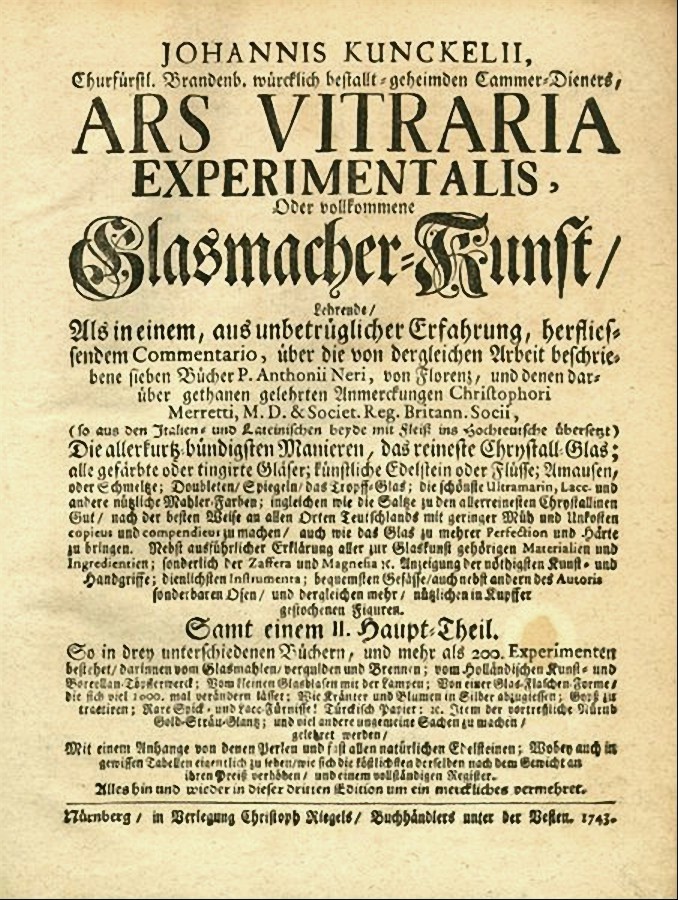
This link is a link to Johann Kunkel’s book. Vollständige Glassmacherkunst
~ ~ ~ ~ ~ ~ ~ ~ ~ ~ ~ Continue Reading If You’re Interested in the Kunkle Line.
Our Kunkles trace back to my grandmother, Hilda Leonore Kunkle. However, I don’t have any personal stories to share as I didn’t know my dad’s family. I gained most of my knowledge later in life through my siblings, letters from my Aunt Elva (Hilda’s daughter), and documented facts and history shared by others.
Hilda married Glen Henry Logan in 1921 in Indiana County, Pennsylvania. Her father was Charles J. Kunkel. You’ll notice how the name is interchangeable with the -el and -le. He married Carrie Morrison in 1892. Charles lived most of his life in Westmoreland, Pennsylvania, until his wife died in 1937. He then moved to Michigan to live with his daughter, Hilda, and her family until his death in 1948 at the age of 82.
Charles’ father was Michael Kunkle. He also grew up in Westmoreland, Pennsylvania. In 1860, Michael married his neighbor, Esther “Hettie” Hawk. They were Lutherans, and Michael worked as a carpenter before becoming a farmer for the rest of his life. Michael passed away at the age of 80 in 1918 in Westmoreland.
Michael’s father was Daniel. They lived on Michaelsburg Plantation, a 336-acre estate owned by a family member. His family was among the First Families in Hempfield Township.
Some family stories were recorded in the History of Westmoreland County, Pennsylvania by Boucher, John Newton; Jordan, John W. (John Woolf), 1840-1921, joint editor. Publication date 1906. Publisher New York, Chicago, The Lewis publishing company. Contributor Allen County Public Library Genealogy Center
[https://archive.org/details/historyofwestmor01bouc/page/n9/mode/2up]
Daniel married Mary Elizabeth Kepple, and they had a son named Michael. They moved from Westmoreland to Indiana, Pennsylvania, where he worked as a railroad lock tender. Unfortunately, Elizabeth passed away about 10 years later. After her death, he married Catherine Iseman in 1844, but she died of cancer in 1850. In 1852, Daniel married Sarah, whose last name is unknown. It is still unknown when Daniel passed away, but it is confirmed that he was alive at least until 1870, as he is listed in the census at age 66 and still working for the railroad.
I’ve been putting off delving into the Kunkel family, but now things are more interesting. The first names in the family often begin with Johann for boys and Anna or Maria for girls. I’ve had to redo my Kunkle family tree twice because I initially followed the wrong line. However, thanks to the help of other researchers, Vernon Cook and James Kunkle, I am now back on track.
Daniel’s father is Johann Jacob Kunkel (Gunckel), Jr. It is in this generation that the Kunkel and Gunckel names are interchangeable. He married Elizabeth Schaeffer in 1789 and had 10 children. My records indicate that he was a farmer, and his cause of death was “gravel.” After researching old terms for the cause of death, “gravel” seemed to refer to the modern equivalent of kidney stones. He is buried in Brush Creek Evangelical Lutheran Church Cemetery.
Tom Gunckel has conducted extensive research on the Gunckel family. You can view his research at http://www.gunckel.com/gunckela.pdf.
Johann Jacob’s father is Johann Jacob Gunkel, Sr. His father is our immigrant ancestor of this family. He was born in Breitenburg, Germany in 1746, and they immigrated in 1749 when Jacob was only 3 years old.
Tom writes, One of the first known settlers in Pine Grove area after the French and Indian War, 1689-1763, Great Britain Battles France over unsettled territories in N. America, was Jacob Gunkel. He was located on the site of the Eagle Hotel in 1771. Here, he laid claim to a tract of two hundred acres of land, which he subsequently purchased from John and Richard Penn, proprietors of the Colony of Pennsylvania, which included the site of the present borough of Pine Grove. The convergence of several roads on Gunkel’s plantation made it an excellent location for a tavern, and soon after he purchased the land, he erected a log building, Gunkel’s Tavern, which he kept till 1810 and then he removed to a farm about a mile south from the borough were he died in 1813. His property was located next to the property of his daughter Eva and husband Johannes Loffler.
Another source states he “kept a house of entertainment, and in 1795 opened a store which he kept until 1810. (Source: History of Schuylkill Co, PA, by W. W. Munsell & Co, – 1881). On May 21, 1810, Jacob Gunckel of Pinegrove Township, Berks Co, PA, yeoman, and Susannah, his wife, sell to John Gunckel, yeoman, for 255 pounds, land containing 235 acres, part of the larger tract of land called “Gunckel’s Farm.” (Deed book 24, page 488).
Cemetery records for St. Peter’s (Gunkle’s) Union Church of Pinegrove Township, Schuylkill County include the following references:
Jacob Gunkel; born September 28, 1746; died September 2, 1813
Eva Lefler; born Mar 25, 1809; died Jun 21, 1841
Johannes Leffler; born Jul 5, 1764; died Aug 16, 1849; son of Gottfried, Mahanoy Twp., Northumberland Co. Eva Lofler (nee Kunkle); w/John; died Jan 26, 1857; 83y 11m 15d
Gunkel’s Cemetery, located across the street from St. Peter’s Lutheran Church, contains a memorial plaque that reads:
Site of the 1st Reformed-Lutheran Church
1782-1817
Donated by Jacob & Susanna Gunkel
Joh. Jacob’s father was Johann John Gunkel, born in 1722 in Breitenborn, Germany. John Gunckel married Anna Margarethe Lorentz and arrived in America in 1749 with his young son. In the book “Naturalizations of Foreign Protestants in the American Colonies,” there is the following: “John Gunckel of Bethel Twp., Berks County, Pennsylvania, became a citizen 20 September 1761.” These naturalizations were performed at the Philadelphia County, PA Courthouse. https://archive.org/stream/naturalizationso24grea#page/75/mode/2up/search/gunckel
Johann has often been confused with Johann Michael Gunkel, who was the same age. They were first cousins from Breitenborn and used similar names for their children. They also attended the same church. By the way, Johann (John) also had a brother named Johann Jacob. Talk about confusing!
John is also our Revolutionary War ancestor. His SAR Patriot number is P-171729. The John Gunckel of Bethel Township, who performed Revolutionary War service and from whom we are descended, was enrolled in 1777-1779 in the First Class, Captain Valentine Shoufler’s Seventh Company, First Battalion, Lancaster County Militia. He was assessed 26 pounds in fines, according to the evidence of an undated list of Class Fines. (Pennsylvania State Archivist, Military Accounts (Militia), Records of the Comptroller General, at the Division of Archives and Manuscripts) Larry Patrick Cornwell, 138085, has a SAR-approved supplemental under this John Gunckel. Larry served as the Genealogist General of the National Society, Sons of the American Revolution from 2011-2014 (www.sar.org)

John died in 1795 at the age of 73.
John’s father was Lorentz Gunkel, born in Breitenborn, Germany. He immigrated to the US in 1751 on the ship the “Duke of Bedford” with wife and one child, from Rotterdam, and last from Portsmouth, England. Port of entry was Philadelphia, PA, on a Saturday. Records show that Lorentz settled first in Northampton Co, PA, and later pioneered in Allegheny & Westmoreland Counties, PA. He was a Revolutionary War soldier and a pensioned veteran. *(Record Sources: 1804, pg 335 (Supp. 1983) aud 9041, pg 459 (From Flörsbach, Germany).
Lorentz wed Anna Catharina Gundlach in 1709. It’s uncertain who the “young child” who immigrated with them is. However, it could be our ancestor, Johann Jacob, as he was born in 1746.
Lorentz’s father was Hans Gunkel, who was born in Neuhütten, Spessart, Germany, in 1636. He was known as a Catholic man. He married Margareth N. and worked in a “glass house.” They later moved to Breitenborn, where Hans was invited by Heinrich Gundlach, the headmaster of the Breitenborn Works, to recruit glass makers from all over the country in the 1670s and 1680s.
When I originally published this post, a cousin replied, introducing himself. He also stated, “I do not believe that anyone actually lived in a “Glass House” I believe that this is simply a misinterpretation of the translation of Neuhutten. The Huts of glass were simply the buildings that were constructed… or the kilns… that were used to make the glass. These kilns were made of bricks so they could be brought to new areas where the resources (forests) were over-exploited to the point that they had to move to continue to be able to make glass. When they relocated to the area of NeuHutten they simply called it that “New Huts”.”
Hans Kunkel was a skilled glassblower, and many Kunkels were known for their glassblowing skills all over Europe at that time. Gundlach, an entrepreneur, made efforts to recruit the most talented glassblowers to come to Breitenborn. It is impressive that Hans Kunkel was still very productive in the 1680s. For instance, between January 4, 1684, and November 26, 1685, at around 50 years old, he produced 42,300 drinking glasses of various types and earned 91 fl. 16 alb (the equivalent of the dollar in those days). In addition to blowing glass, he occasionally attended the furnace, an important task for maintaining proper temperatures during the melting process.
The Kunkels were already living in Neuhutten before the Thirty Years War. It seems that Neuhutten and that part of Germany were already in the Lutheran camp. The Kunkels all seemed to have been born, married, and died in “The Glasshouse” in Neuhutten.
Joh. Michael’s father was Johannes Jurg, born about 1565. He married Elisabeth Christina Houser.
The Kunkel family still live primarily in the Spessart Mountain range area, which is a mostly wooded region in the heart of Germany. There is a historical mention of an early Glasshouse in the Spessart area dating back to 22 August 1349. During that time, the area was under the jurisdiction of the Archbishop of Mainz.
The Union Letter (Bundesbrief) of 1537 (or the Federal Charter or Letter of Alliance) lists two KUNKELs, namely Jurge (George) and Hentze Kunkel, and in a later revision dated 24 February 1559, again two KUNKELs – George and Friedrich Kunkel. There are links, as glass-making was only carried down by the same families.–Janet and Robert Wolfe Genealogy, “Notes for Johann Jurg Kunkel and Elisabeth Christina Houser”
Webpage: www.umich.edu/~bobwolfe/gen/mn/m6413x6414.htm
Email address: JanetRobertWolfeGenealogy@gmail.com
Go to the Genealogy Page for Johann Jurg Kunkel
Go to the Genealogy Page for Elisabeth Christina Houser
Go to the Kunkel surname index.
Go to the Houser surname index.
Go to the Home Page for Janet and Robert Wolfe Genealogy
Much research is still needed to fill out all the missing information; however, I have been told that genealogy records beyond this point are next to impossible to find due to all the wars that took place in this country. The Thirty Years War (1618-1648) destroyed many church records throughout Germany. So many records have been destroyed, and finding a cemetery with headstones that can be read after 500 years would be impossible.
All Kunkels do not accept the “dweller by deep water” definition of the name. Other research has yielded another possibility for its origin: It seems to derive from the Old High German name “KUHN,” meaning “wise.” (In this case, such a compliment would make it acceptable.) GUNKEL probably refers to living in deep water. In German, KUNKEL means the part of a spinning wheel called the distaff. A staff on which fibers such as flax or wool are wound before being spun into thread.
As you study the descendants of these families, you will find that intermarriages were rather common. Men had limited ways to meet eligible mates and could usually not go farther than they could walk or ride horseback to court. When there were family get-togethers, they met women who just happened to be related in one way or another. (James E. Kunkle- 2000)
Joh. Jurg’s father was Hans. Hans was born about 1530 in Glasshouse, Germany. He married Anna Catharina Wolfgang in 1554. Hans Kunkel of Neuhutten was called “Schwarzkoph” in the Parish records. Meaning “Black Forest.”
Some show Claus Kunkle, born 1490, as Hans’ father, and Conrad, born 1460, as Claus’ father, but I do not have sources to back these up.
The Coat-of-Arms of the Kunkel, Kunkle, etc., family is recorded in Rietstap’s Armorial General (Pg. 1144)

This link is one of James’ first works on the Kunkles and contains a lot of interesting information, from their Coat of Arms to their superstitions to their culture, customs, and rituals. Conkle/Kunkle File #1
While I couldn’t find exact Kunkel glass other than the original Johann’s, I did find some drawings of the glassblowers’ working areas in that century.

There is still much to learn about certain individuals in this family, and I hope to contribute to James and Wallace’s wonderful work. RIP, guys! You left a wonderful legacy for all of us.
![FIG. 39. Glass furnace, with workers. Georg Agricola (German, 1494–1555). In De re metallica [Berckwerck Buch, Frankfurt-am-Main, 1580, p. cccxc]. Rakow Research Library, The Corning Museum of Glass (66820). Photo: The Corning Museum of Glass.](https://i0.wp.com/i.pinimg.com/564x/4e/49/5e/4e495ec5a072d9bb33f6f130891e9660.jpg?w=840&ssl=1)
If you need research assistance, do not hesitate to contact me.
Your Family Tree Research Specialist
As an Amazon Associate, I earn from qualifying purchases.
Discover more from Loganalogy- Your Family Historian
Subscribe to get the latest posts sent to your email.
I’m of Kunkel descent and also from Neuhutten (American born – 1st generation). I do not believe that anyone actuallly lived in a “Glass House” I believe that this is simply a misinterpretation of the translation of Neuhutten. The Huts of glass were simply the buildings that were contructed… or the kilns… that were used to make the glass. These kilns were made of bricks so they could be brought to new areas where the resources (forests) were over exploited to the point that they had to move to continue to be able to make glass. When they relocated to the area of NeuHutten they simply called it that “New Huts”.
Thank you for reading my blog. I agree with your comment. I used quotes when referring to a “glass house” as that is how the other researchers stated it.