Johann Henrich Heilig, my 6th great-grandfather, was born in 1700 and married Susanna De Wees Rittenhausen in 1729. Susanna’s family was prominent in early American industry, particularly in the Rittenhouse paper mills, which I’ve written about previously. If you’re a descendant or admirer of the Rittenhouse legacy, I recommend exploring the Rittenhouse Family Descendants and Friends Facebook page and learning about their efforts to preserve this rich history. The Rittenhouse Town Board of Directors actively maintains the historic Homestead House (built in 1707), the surrounding village, and a barn constructed during the WPA era.
Henrich’s origins remain debated among historians. Earlier accounts suggest he was born in Hannover, Germany, while newer research points to Baden-Wuerttemberg. What we do know is that Johann arrived in Philadelphia in 1720 aboard the Polly. Since passenger lists weren’t required until 1727, his exact journey is pieced together through indirect evidence.
By April 11, 1747, Johann was officially naturalized as a resident of Pennsylvania, meeting the colonial requirement of seven years’ residency. By this time, he was known as Henry—a clockmaker by trade. Clockmaking was a respected profession during the 18th century, vital for navigation, surveying, and precise timekeeping.
Henry and Susanna initially settled in Cheltenham but later purchased land on the borders of Pennsburg and Upper Hanover Townships in Montgomery County in 1749 and 1750. This property, acquired from surveyor William Parsons (an associate of the Penn family), remained in the family for generations. Passing from Henrich to his son George, and later to George Jr., the land was eventually sold to the Hoch family in the 1860s. Remarkably, the Hoch family still owns the house today—a living testament to centuries of stewardship.
Before 1684, the Lenape Indians roamed the hills and fished the streams of the land on either side of the Perkiomen Creek. In 1684, the Indians lost this land when William Penn purchased it for reportedly “two watch coats, four pairs of stockings and four bottles of cider.” In time, Pennsylvania Germans settled in the area. Around 1840, the area now known as Pennsburg began to appear like a village. The hub comprised a general store, a carpenter and blacksmith shop, and several houses. Most of the land was owned by the Heilig Brothers. They owned and resided in the oldest house in Pennsburg, located at Seminary and Fourth Streets. The Heilig Brothers took it upon themselves to refer to this village as “Heiligsville.” Residents had their ideas, and out of loyalty to the then Pennsylvania Senator, James Buchanan, wanted to name the area Buchanansville.
As the village grew, a meeting was held in 1843 at the Hilleg family store to decide on a permanent name and layout of boundary lines. After a week-long, bitterly contested battle, it was finally decided to name the village “Pennsburg” after William Penn.
i. Heinrich Heilig, b. 1722, ii. Jurg George Heilig, b. 1720; d. 1796, Upper Hanover Township., iii. Johannes Heilig (Source: Willbook I – 1796, 149-150.). iv. Anna Maria Heilig (Source: Willbook I – 1796, 149-150.), m. Michael Slonaker., v. Susanna Heilig (Source: Willbook I – 1796, 149-150.), b. 1726; m. Henry Deany.
Johannes or John changed the surname to Highley. The other children kept the German spelling of Heilig.
This notation appears on a locally sold postcard by Len Hillegass of the Heilig House: “The Heilig House at 313 W. 4th Street is considered the oldest house in Pennsburg. Wounded and ill Colonial Soldiers were cared for there by the very compassionate Heilig family during the Colonies’ fight for independence from British rule during the American Revolution.” Album by Reid Heilig You can see other pictures of the house at https://imageevent.com/heilig/heiligheritage/heilighousepennsburgpa?n=1&z=2&c=4&x=0&m=24&w=0&p=0.
Henry was a clockmaker. He passed down the art of his clockmaking skills to his children and nephews. One of the most famous was David Rittenhouse, an avid astronomer; he built complicated astronomical clocks and orreries, or planetary models, that kept time and predicted celestial events.
David Rittenhouse tall case clock. 1984.0416.007.
Henry is listed in the U.S., Craftperson Files, 1600-1995.
With hand made brass works in the German style, it consists of 19 bells, a wooden cylinder with pins that activate 19 hammers to play tunes, a bone wave to switch tunes. Iron frame is dovetailed together. You can read more about each piece on Reid Helig’s site at https://imageevent.com/heilig/hheiligclock/themusicmechanism
Henry was buried along with his wife in the mostly Rittenhouse family cemetery, Methacton Mennonite Cemetery. Click here for a partial list of burials with links to tombstone photographs. Henrich’s and Susannah’s are below. This cemetery is located in Worcester Township, Montgomery County, PA.
Henrich Heilig .. Died May 14, 1775 .. Aged 74 year 11 Mo 12 daysSusannah Rittenhouse .. Departed This Life December 13, 1769 .. Aged 71 YearsThe interesting thing about Susannah’s tombstone is that it shows her maiden name as “Rittenhouse.” However, this would be the correct person calculating the birth year by her age at death.
A wonderfully thorough history is written by Linton E. Love, a descendant of the Rittenhouse family. In it are the descendants of Henry and Susannah. Linton has created a database extending from the 17th century up to the 21st century from Claus to his 12,810 descendants as of March 2005!
Johann Henrich Heilig’s story is one of perseverance, skill, and enduring family ties. From his arrival in Philadelphia to the land that remains in familial care, his legacy is woven into the fabric of American history. Whether as a skilled clockmaker or as part of the Rittenhouse connection, his contributions remind us of the resilience and dedication of early immigrants. By reflecting on his life, we not only honor his journey but gain inspiration for preserving our own family stories for generations to come. Do you have a Heilig clock? You might!
As an Amazon Associate, I earn from qualifying purchases.
Some sources show that Hans de Neus was born in France in about 1670 and was a French Huguenot fleeing prosecution. However, the more research I do, the more I see that he seems to have been born in Germany.
His parents were Olletgen te Neuss and Nelis Wienands, both from Germany.
Hans founded the Nice family in Philadelphia, specifically in Nicetown, consisting of 725 acres. He is believed to have gone to Holland to seek refuge from religious (Mennonite) persecution. In Holland, he met and married his wife, Janneke Bloemen. It is said that they celebrated the construction of their house by breaking a bottle of schnapps over it, christening both the house and their plantation as Nicetown.
Wikipedia states “This original early 18th century structure burned in 1800. Hans and his brother Jan had emigrated from Amsterdam in 1698; Jan settled in Germantown. Both were Mennonite ministers and could read and write. Hans and his descendants were well known as zimmermen (builders of houses). One descendant was a member of the Carpenter’s Society of Philadelphia in the early 1800s. Another was Captain John Nice of Germantown, who led the charge at the Battle of Germantown during the Revolutionary War. Other authors provide varied suggestions for the origin of Nicetown. Finkel says that it was “[n]amed for de Neus, Dutch Huguenots who settled there about 1700”.[3] Other spellings seen for the same surname are Neiss, Neisse, and, of course, the Nice seen in the placename Nicetown. There are 19th-century headstones in nearby Germantown marked with the surname Nice.”
The “te Neues” family had lived near Krefeld, Germany, at Lürrip since at least 1296.1
In his 1911 book Colonial Families of Philadelphia, John W. Jordan stated that Hans was born in Crefeld, but he did not provide the source for this information. (Krefeld, also known as Crefeld until 1929, is a city in North Rhine-Westphalia, Germany). According to Mt. Airy scholar J.M. Duffin, the Krefelders were German-speaking and originally Dutch-speaking Germans who were Quakers. Krefeld is located on the border of the Netherlands and Germany, so it is understandable that they would be fluent in both languages.
Krefeld
Chronicle – the emigration
Krefeld · The Mennonites have their origins in the Anabaptist movement, which arose in Zurich around 1525. The movement spread to the Netherlands, where in 1536 Menno Simons took up the ideas of the Anabaptist movement and formed a consciously pacifist community with the moderate part, called “Mennonites”.
2Krefeld became a place of refuge for Mennonites who were persecuted in many places and for the religious community of Quakers who later joined them. But here too there were tensions with the long-established population. It just so happened that at that time the governor of Pennsylvania, William Penn, wanted to recruit settlers for his country. They should be God-fearing people who, like Penn, should also be Quakers. The German lawyer Franz Daniel Pastorius arrived, founded “Germantown” and acquired the 13 families. 328 years ago the Krefeld residents, Mennonites and Quakers, sailed from Holland to America . On July 24, 1683 the English sailing ship “Concord” set sail from the Dutch port of Gavesend. On October 6, 1683 they reached Philadelphia
Mennonites are a branch of the Christian church, with roots in the radical wing of the 16th century Protestant Reformation. Part of the group known as Anabaptists (because they rebaptized adult believers), the Mennonites took their name from Menno Simons, a Dutch Catholic priest who converted to the Anabaptist faith and helped lead it to prominence in Holland by the mid-16th century. 3
It is now known that the Nice family is one of the families in The Ancestry of the Thirteen Krefeld Emigrants of 1683, as mentioned in the 1956 article of the Franconia Mennonite Conference. The origins of the Franconia Conference are connected with the settlement of the Mennonites at Germantown near Philadelphia in 1683. The early Mennonite settlers of Germantown represented four distinct groups: (1) those from Krefeld who arrived in 1683 ff. and bore such names as Lensen, Op den Graeff, van Bebber, Telner, Umstat, Jansen, Neuss, Tyson, Sellen, and Hosters, William Rittenhouse, first Mennonite minister in America, H. Kasselberg, and Jacob Godshalk, the first American Mennonite bishop.
William Rittenhouse in the above article is my 8th great-grandfather.
In other sources I’ve read, Jacob Godshalk’s father served the Neuss family.
From the book Pennsylvania German Roots Across the Ocean,
His wife, Jenneken “Jane” Blomen, was born in Holland around 1670. Further research is needed on her family.
Hans’ brother, Jan, married Elisabeth Lucken, who was the sister of one of the 13 founders of Germantown in Philadelphia. Both brothers and their wives traveled to Philadelphia to seek religious freedom in William Penn’s colony, which was specifically established for that purpose. Below is written in Appendix C of William Penn and the Dutch Quaker Migration to Pennsylvania:
Evidently, Hans was naturalized as “Nous” in 1709, but the name did not stick.
In the following PDF link is accounts information and a black and white photo of a Silver Porringer made by Jan de Neuss. A Philadelphia Silver Porringer4
It is interesting to note the relationship of this family long ago with William Penn’s secretary, James Logan, especially considering that my grandmother Kunkle, whose family is the Neuss’, married a Logan.
Here is an excerpt from the diary of one of our Revolutionary War cousins, which is housed at the Historical Society of Pennsylvania. It even includes his resignation letter to General George Washington! The Diary of Captain John Nice, of the Pennsylvania Line5
“The Early History of the Germantown Congregation,” Germantown Meeting House History states, “…in 1690, the Germantown Mennonites chose William Rittenhouse as their minister, and Jan Neuss their deacon. For unknown reasons, Rittenhouse felt unable to supervise communication, so in 1702, Jacob Gottschalk and Hans Neuss were ordained ministers to assist him.”6
The last name is now spelled Neis in my branch. Bertolet’s Mennonite Church Cemetery was once Zachariah Neis’ farm. His daughter, Susanna Neis, married Michael Schlonecker, Jr., whose family came from Germany. They had Esther Slonaker, who married Conrad Hawk, who had Esther “Hettie” Hawk, who married Michael Kunkle, who had Charles, who had Hilda, my grandmother!
The story of Hans de Neus is a testament to the resilience and determination of those who sought a new life in America. From the bustling town of Krefeld to the quiet fields of Nicetown, Hans and his descendants played a significant role in shaping the early history of Philadelphia. Their journey is more than a tale of migration; it’s a narrative of faith, perseverance, and community-building. As we reflect on their legacy, we are reminded of the rich tapestry of cultures and histories that form the foundation of our nation, with the Neis family standing as a proud thread woven into that fabric.
Image created by OpenAI’s DALL-E, August 2024.
Hassan, Hazel Deter. The Nice Family History: Descendants of Henry Clemmer Nice, 1822-1892. 1965. ↩︎
“Krefeld: Chronicle: the Emigration.” Rheinische Post, 23 Mar. 2011, rp-online.de/nrw/staedte/krefeld/chronik-die-auswanderung_aid-13560923. Accessed 18 Aug. 2024. ↩︎
“170 A Philadelphia Silver Porringer The Historical Society of Pennsylvania.” The Pennsylvania State University, 1931, journals.psu.edu/pmhb/article/download/28223/27979. Accessed 18 Aug. 2024. ↩︎
Nice, J., & Burd, E. (1893). Extracts from the Diary of Captain John Nice, of the Pennsylvania Line. The Pennsylvania Magazine of History and Biography, 16(4), 399-411. https://www.jstor.org/stable/20083504↩︎
Katherine Schober is the CEO and Founder of Germanology Unlocked, translating client’s German documents to English. She also teaches her clients how to translate their own documents. In fact, in 2019, she launched “Reading the Old German Handwriting.” According to one of her posts, since then she has had:
*Over 1,200 excited and hardworking students
*Over 650 students in a course community Facebook group
*One new “German for Genealogists” course
*Multiple German handwriting workshops
*Countless brick walls are broken and ancestors discovered
I have been following Katherine for a while. I mean, I do have German ancestors everywhere! Recently, I’ve seen her posts about her work behind the scenes for one of my favorite shows, the PBS show Finding Your Roots with Dr. Henry Louis Gates. She has permitted me to post her blog about the process. It is quite interesting.
In fact, recently, she was able to meet one of the show’s guests, comedian Iliza Shlesinger, for whom she had translated German records of her ancestors’ records—you can read about that at I Met Iliza Shlesinger: Finding Your Roots Meets Beverly Hills. Katherine has also translated documents for guests Cyndi Lauper, Lena Dunham, Paul Ryan, Pamela Adlon, Nina Totenberg, and Isabella Rossellini.
Below is a snippet of her translating process for the PBS Show Finding Your Roots.
So, how does translating for the show work? As I have now translated documents for Seasons 5-10, I can speak from my own experience – Finding Your Roots is wonderful to work with. I usually receive a request from one of the McGee Media series producers an entire year or so before the planned episode will air – but they have a lot of future research to do on their end, so the translation turnaround times are usually tight!
In the e-mail, the producer sends me the document(s) they will need translated, but there is one thing I do not know – whose ancestors that document is for! I don’t find out that information until much later, about a week before the show airs…keeping me in as much suspense as all of you!
Nevertheless, I still need to ask my normal translator question: “Can you tell me any names of people, dates, and towns related to this document?” Since the documents are often hundreds of years old, the last names are often different enough that it doesn’t immediately give away whose ancestors I am dealing with. And knowing the context of the document, for any client, helps significantly in deciphering the mystery words in the handwriting. Although I always verify any information given, knowing where to start looking for any more difficult handwritten words provides a significant head start in my research.
And then I get to work! While these translations are exciting to do, they work the same as I would do for any client. I first transcribe the handwritten text into typed German, verifying the mention of any towns with Meyers Gazetteer and verifying any last names with Geogen or other last name tools.
In wrapping up, Katherine Schober’s contributions to both genealogical research and popular media underscore the importance of meticulous translation work. Her expertise not only helps individuals uncover their ancestral stories but also brings these histories to life on a larger stage through shows like Finding Your Roots. It’s inspiring to see how her passion for history and language continues to bridge the past and present, making it accessible and engaging for everyone. For those of us with German ancestry, Katherine’s work is a vital resource, and I look forward to seeing more of her translations and insights in the future.
Schober, Katherine. “Unlock the Stories of Your Family’s Past with German Genealogy Translations, Courses, Books, and More!” Germanology Unlocked, 4 Apr. 2024, germanologyunlocked.com/.
I want to emphasize that all the research mentioned below was conducted by other individuals, and I simply discovered their work. Fortunately, our relatives were very supportive and willing to share their findings with me.
James E. Kunkle, a retired US Navy officer who resided in Colorado, passed away in 2017 at the age of 90. I had been corresponding with him since 2012. He and Wallace M. Kunkel (also deceased) have compiled the following history of the Kunkel families, which is available at the Family History Library, among other works authored by James, and at the Library of Congress. I have put a link to it here. A gathering and mingling of early Kunkel families
Wallace’s grandmother began the genealogy work in the late 1940s, spending long hours at her typewriter. She created genealogy books for her seven grandchildren as Christmas presents in the 1960s. Wallace, his daughter Mary, and his grandchildren have continued this work. When Wallace was alive, he collaborated with James on this historical project. It’s poignant that yesterday (I originally wrote this blog on April 8, 2018.) marked the anniversary of his passing. Wallace was also known as “Mr. Sawdust,” a skilled furniture maker and the founder of the “Mr. Sawdust School of Professional Woodworking.”
“At least forty families of Protestant Kunkels immigrated to America from Germany between 1728 and 1770. Some of the Catholic families of Kunkels immigrated to the United States after the War of 1812. Many of the early Kunkel families settled in Pennsylvania. Today, Kunkels live in Pennsylvania, Maryland, Ohio, Wisconsin, Illinois, Indiana, Minnesota, and throughout the United States. The surname is spelled Kunkel, Kunkle, Gunkel, Gunkle, Konkel, Konkle, and other variant spellings.” -J.E. Kunkle & W.M. Kunkel, 1995 (415 pages of history).
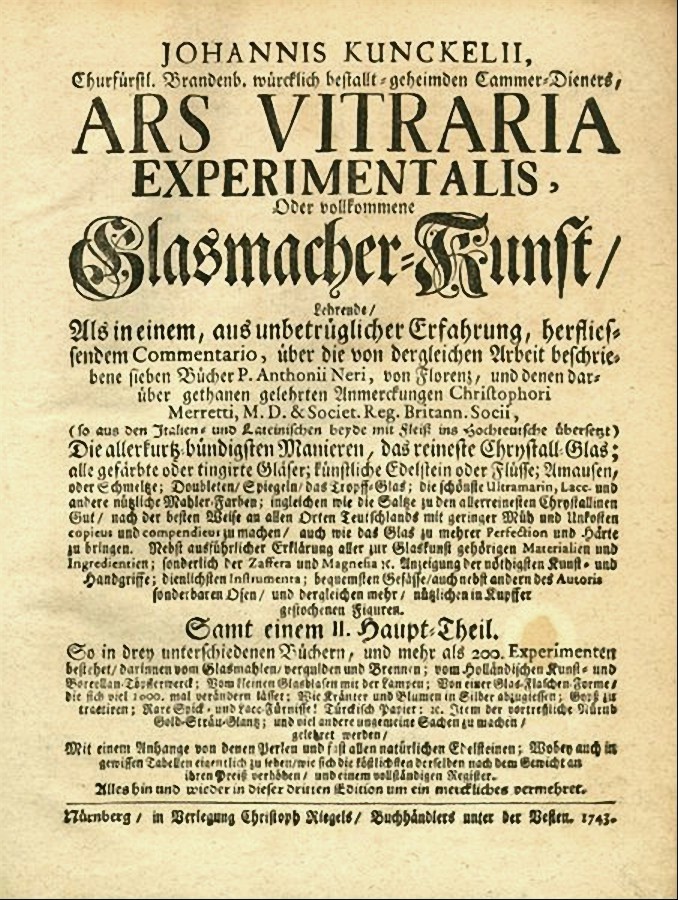
A gathering and mingling of early Kunkel families talks about our first notable figure, Baron Johann Kunckel von Löwenstern, a German chemist. Around 1678, he replicated Hennig Brand’s discovery of phosphorus isolation. Kunckel later managed the laboratory and glassworks in Brandenburg as a court chemist and apothecary.
Ars Vitraria ExperimentalisJohannes Kunckel, Ars Vitraria Experimentalis, 1679
The illustration by George Smith from his 1738 chapter “The art of blowing glass in miniature” (fig. 3) is not labeled alphabetically, but Johannes Kunckel’s 1679 engraving (fig. 4) is:
A — table around which four people may work at once
B — the lamp, filled with oil and a strong cotton wick
C—the hole where the tapered blowpipe is attached . . . so that the air is directed onto the acute and concentrated flame, producing a flame that will melt glass. Goldsmiths have a similar system for soldering metal.
D — bellows attached to pipes of tin that are hidden under the table
E — lever, attached to the foot pedal
F — ventilation hood
G — foot treadle for the bellows, pressed by the worker
Left: Probably engraved by Gottfried Spiller (1658–1728). Covered goblet with “Fruit Children,” before 1700. Gold ruby glass, H. 9 1/8 in. (23.1 cm). Focke-Museum, Bremer Landesmuseum für Kunst und Kulturgeschichte, Bremen (68.253). Center: Ruby glass flute with “AR” monogram, around 1715. German, Dresden. Gold ruby and transparent glass (blown, cut), H. 23 cm. Green Vault, Staatliche Kunstkammlungen Dresden (IV 228). Right:Covered goblet, 1725–35. German, Potsdam. Transparent dark gold ruby glass (blown, cut) 10 9/16 x 3 5/8 in. (26.9 x 9.2 cm). Corning Museum of Glass, Corning, New York, Bequest of Jerome Strauss (79.3.318) Gold ruby glass was perfected through alchemist and glassmaker Johann Kunckel’s experimentation under the patronage of Frederick William, Elector of Brandenburg, at the elector’s glassworks in Potsdam. Its name comes from the addition of colloidal gold to the glass before melting, a complex operation that required the skills of both alchemist and glassmaker. Displayed in a Kunstkammer, glass pieces served as signs of the alchemical knowledge required to produce them.
~ ~ ~ ~ ~ ~ ~ ~ ~ ~ ~ Continue Reading If You’re Interested in the Kunkle Line.
Our Kunkles trace back to my grandmother, Hilda Leonore Kunkle. However, I don’t have any personal stories to share as I didn’t know my dad’s family. I gained most of my knowledge later in life through my siblings, letters from my Aunt Elva (Hilda’s daughter), and documented facts and history shared by others.
Hilda married Glen Henry Logan in 1921 in Indiana County, Pennsylvania. Her father was Charles J. Kunkel. You’ll notice how the name is interchangeable with the -el and -le. He married Carrie Morrison in 1892. Charles lived most of his life in Westmoreland, Pennsylvania, until his wife died in 1937. He then moved to Michigan to live with his daughter, Hilda, and her family until his death in 1948 at the age of 82.
Charles’ father was Michael Kunkle. He also grew up in Westmoreland, Pennsylvania. In 1860, Michael married his neighbor, Esther “Hettie” Hawk. They were Lutherans, and Michael worked as a carpenter before becoming a farmer for the rest of his life. Michael passed away at the age of 80 in 1918 in Westmoreland.
Michael’s father was Daniel. They lived on Michaelsburg Plantation, a 336-acre estate owned by a family member. His family was among the First Families in Hempfield Township.
Some family stories were recorded in the History of Westmoreland County, Pennsylvania by Boucher, John Newton; Jordan, John W. (John Woolf), 1840-1921, joint editor. Publication date 1906. Publisher New York, Chicago, The Lewis publishing company. Contributor Allen County Public Library Genealogy Center
Daniel married Mary Elizabeth Kepple, and they had a son named Michael. They moved from Westmoreland to Indiana, Pennsylvania, where he worked as a railroad lock tender. Unfortunately, Elizabeth passed away about 10 years later. After her death, he married Catherine Iseman in 1844, but she died of cancer in 1850. In 1852, Daniel married Sarah, whose last name is unknown. It is still unknown when Daniel passed away, but it is confirmed that he was alive at least until 1870, as he is listed in the census at age 66 and still working for the railroad.
I’ve been putting off delving into the Kunkel family, but now things are more interesting. The first names in the family often begin with Johann for boys and Anna or Maria for girls. I’ve had to redo my Kunkle family tree twice because I initially followed the wrong line. However, thanks to the help of other researchers, Vernon Cook and James Kunkle, I am now back on track.
Daniel’s father is Johann Jacob Kunkel (Gunckel), Jr. It is in this generation that the Kunkel and Gunckel names are interchangeable. He married Elizabeth Schaeffer in 1789 and had 10 children. My records indicate that he was a farmer, and his cause of death was “gravel.” After researching old terms for the cause of death, “gravel” seemed to refer to the modern equivalent of kidney stones. He is buried in Brush Creek Evangelical Lutheran Church Cemetery.
Johann Jacob’s father is Johann Jacob Gunkel, Sr. His father is our immigrant ancestor of this family. He was born in Breitenburg, Germany in 1746, and they immigrated in 1749 when Jacob was only 3 years old.
Tom writes, One of the first known settlers in Pine Grove area after the French and Indian War, 1689-1763, Great Britain Battles France over unsettled territories in N. America, was Jacob Gunkel. He was located on the site of the Eagle Hotel in 1771. Here, he laid claim to a tract of two hundred acres of land, which he subsequently purchased from John and Richard Penn, proprietors of the Colony of Pennsylvania, which included the site of the present borough of Pine Grove. The convergence of several roads on Gunkel’s plantation made it an excellent location for a tavern, and soon after he purchased the land, he erected a log building, Gunkel’s Tavern, which he kept till 1810 and then he removed to a farm about a mile south from the borough were he died in 1813. His property was located next to the property of his daughter Eva and husband Johannes Loffler.
Another source states he “kept a house of entertainment, and in 1795 opened a store which he kept until 1810. (Source: History of Schuylkill Co, PA, by W. W. Munsell & Co, – 1881). On May 21, 1810, Jacob Gunckel of Pinegrove Township, Berks Co, PA, yeoman, and Susannah, his wife, sell to John Gunckel, yeoman, for 255 pounds, land containing 235 acres, part of the larger tract of land called “Gunckel’s Farm.” (Deed book 24, page 488).
Cemetery records for St. Peter’s (Gunkle’s) Union Church of Pinegrove Township, Schuylkill County include the following references: Jacob Gunkel; born September 28, 1746; died September 2, 1813 Eva Lefler; born Mar 25, 1809; died Jun 21, 1841 Johannes Leffler; born Jul 5, 1764; died Aug 16, 1849; son of Gottfried, Mahanoy Twp., Northumberland Co. Eva Lofler (nee Kunkle); w/John; died Jan 26, 1857; 83y 11m 15d
Gunkel’s Cemetery, located across the street from St. Peter’s Lutheran Church, contains a memorial plaque that reads: Site of the 1st Reformed-Lutheran Church 1782-1817 Donated by Jacob & Susanna Gunkel
Joh. Jacob’s father was Johann John Gunkel, born in 1722 in Breitenborn, Germany. John Gunckel married Anna Margarethe Lorentz and arrived in America in 1749 with his young son. In the book “Naturalizations of Foreign Protestants in the American Colonies,” there is the following: “John Gunckel of Bethel Twp., Berks County, Pennsylvania, became a citizen 20 September 1761.” These naturalizations were performed at the Philadelphia County, PA Courthouse. https://archive.org/stream/naturalizationso24grea#page/75/mode/2up/search/gunckel
Johann has often been confused with Johann Michael Gunkel, who was the same age. They were first cousins from Breitenborn and used similar names for their children. They also attended the same church. By the way, Johann (John) also had a brother named Johann Jacob. Talk about confusing!
John is also our Revolutionary War ancestor. His SAR Patriot number is P-171729. The John Gunckel of Bethel Township, who performed Revolutionary War service and from whom we are descended, was enrolled in 1777-1779 in the First Class, Captain Valentine Shoufler’s Seventh Company, First Battalion, Lancaster County Militia. He was assessed 26 pounds in fines, according to the evidence of an undated list of Class Fines. (Pennsylvania State Archivist, Military Accounts (Militia), Records of the Comptroller General, at the Division of Archives and Manuscripts) Larry Patrick Cornwell, 138085, has a SAR-approved supplemental under this John Gunckel. Larry served as the Genealogist General of the National Society, Sons of the American Revolution from 2011-2014 (www.sar.org)
John died in 1795 at the age of 73.
John’s father was Lorentz Gunkel, born in Breitenborn, Germany. He immigrated to the US in 1751 on the ship the “Duke of Bedford” with wife and one child, from Rotterdam, and last from Portsmouth, England. Port of entry was Philadelphia, PA, on a Saturday. Records show that Lorentz settled first in Northampton Co, PA, and later pioneered in Allegheny & Westmoreland Counties, PA. He was a Revolutionary War soldier and a pensioned veteran. *(Record Sources: 1804, pg 335 (Supp. 1983) aud 9041, pg 459 (From Flörsbach, Germany).
Lorentz wed Anna Catharina Gundlach in 1709. It’s uncertain who the “young child” who immigrated with them is. However, it could be our ancestor, Johann Jacob, as he was born in 1746.
Lorentz’s father was Hans Gunkel, who was born in Neuhütten, Spessart, Germany, in 1636. He was known as a Catholic man. He married Margareth N. and worked in a “glass house.” They later moved to Breitenborn, where Hans was invited by Heinrich Gundlach, the headmaster of the Breitenborn Works, to recruit glass makers from all over the country in the 1670s and 1680s.
When I originally published this post, a cousin replied, introducing himself. He also stated, “I do not believe that anyone actually lived in a “Glass House” I believe that this is simply a misinterpretation of the translation of Neuhutten. The Huts of glass were simply the buildings that were constructed… or the kilns… that were used to make the glass. These kilns were made of bricks so they could be brought to new areas where the resources (forests) were over-exploited to the point that they had to move to continue to be able to make glass. When they relocated to the area of NeuHutten they simply called it that “New Huts”.”
Hans Kunkel was a skilled glassblower, and many Kunkels were known for their glassblowing skills all over Europe at that time. Gundlach, an entrepreneur, made efforts to recruit the most talented glassblowers to come to Breitenborn. It is impressive that Hans Kunkel was still very productive in the 1680s. For instance, between January 4, 1684, and November 26, 1685, at around 50 years old, he produced 42,300 drinking glasses of various types and earned 91 fl. 16 alb (the equivalent of the dollar in those days). In addition to blowing glass, he occasionally attended the furnace, an important task for maintaining proper temperatures during the melting process.
During the winter months, the furnace stayed cold. The production period was 9 months per years – max. During the winter months, most of the works the people were also engaged in was cutting the firewood (beech and oak) for the furnace which did eat up a lot during the production period. So additionally they had another income. There were over 20 men permanently assigned to the fire wood cutting and handling, plus the seasonal ones. Hans Kunkel, for example, made 83-1/2 Clafter (7’x7’x3′) and earned 25 fl. additionally in 1689.
Despite all the hard work, Hans Kunkel lived to be nearly 100 years of age. There is a lot more similar data available, basically showing production figures, earnings, how they were paid (normally 50% cash, and the other in natural things, like grain, flour, etc. and the beverages, like beer and brandy were also brewing there.)
(Above Source: – “Heinrich P. Göbel” – Germany Researcher. (1994)
Hans’ father was Johann Michael, born in Glasshouse, Germany about 1600. He married Anna Katharine Naumann. He died in 1676. There is not much else known about him.
The Kunkels were already living in Neuhutten before the Thirty Years War. It seems that Neuhutten and that part of Germany were already in the Lutheran camp. The Kunkels all seemed to have been born, married, and died in “The Glasshouse” in Neuhutten.
Joh. Michael’s father was Johannes Jurg, born about 1565. He married Elisabeth Christina Houser.
The Kunkel family still live primarily in the Spessart Mountain range area, which is a mostly wooded region in the heart of Germany. There is a historical mention of an early Glasshouse in the Spessart area dating back to 22 August 1349. During that time, the area was under the jurisdiction of the Archbishop of Mainz.
The Union Letter (Bundesbrief) of 1537 (or the Federal Charter or Letter of Alliance) lists two KUNKELs, namely Jurge (George) and Hentze Kunkel, and in a later revision dated 24 February 1559, again two KUNKELs – George and Friedrich Kunkel. There are links, as glass-making was only carried down by the same families.–Janet and Robert Wolfe Genealogy, “Notes for Johann Jurg Kunkel and Elisabeth Christina Houser” Webpage: www.umich.edu/~bobwolfe/gen/mn/m6413x6414.htm Email address: JanetRobertWolfeGenealogy@gmail.com Go to the Genealogy Page for Johann Jurg Kunkel Go to the Genealogy Page for Elisabeth Christina Houser Go to the Kunkel surname index. Go to the Houser surname index. Go to the Home Page for Janet and Robert Wolfe Genealogy
Much research is still needed to fill out all the missing information; however, I have been told that genealogy records beyond this point are next to impossible to find due to all the wars that took place in this country. The Thirty Years War (1618-1648) destroyed many church records throughout Germany. So many records have been destroyed, and finding a cemetery with headstones that can be read after 500 years would be impossible.
All Kunkels do not accept the “dweller by deep water” definition of the name. Other research has yielded another possibility for its origin: It seems to derive from the Old High German name “KUHN,” meaning “wise.” (In this case, such a compliment would make it acceptable.) GUNKEL probably refers to living in deep water. In German, KUNKEL means the part of a spinning wheel called the distaff. A staff on which fibers such as flax or wool are wound before being spun into thread.
As you study the descendants of these families, you will find that intermarriages were rather common. Men had limited ways to meet eligible mates and could usually not go farther than they could walk or ride horseback to court. When there were family get-togethers, they met women who just happened to be related in one way or another. (James E. Kunkle- 2000)
Joh. Jurg’s father was Hans. Hans was born about 1530 in Glasshouse, Germany. He married Anna Catharina Wolfgang in 1554. Hans Kunkel of Neuhutten was called “Schwarzkoph” in the Parish records. Meaning “Black Forest.”
Some show Claus Kunkle, born 1490, as Hans’ father, and Conrad, born 1460, as Claus’ father, but I do not have sources to back these up.
The Coat-of-Arms of the Kunkel, Kunkle, etc., family is recorded in Rietstap’s Armorial General (Pg. 1144)
This link is one of James’ first works on the Kunkles and contains a lot of interesting information, from their Coat of Arms to their superstitions to their culture, customs, and rituals. Conkle/Kunkle File #1
While I couldn’t find exact Kunkel glass other than the original Johann’s, I did find some drawings of the glassblowers’ working areas in that century.
Glass blowing, from a Book of Trades, 1542 (engraving), German School, (16th century) / Private Collection / The Stapleton Collection / The Bridgeman Art Library
There is still much to learn about certain individuals in this family, and I hope to contribute to James and Wallace’s wonderful work. RIP, guys! You left a wonderful legacy for all of us.
Glass furnace, with workers. Georg Agricola (German, 1494–1555). In De re metallica [Berckwerck Buch, Frankfurt-am-Main, 1580, p. cccxc]. Rakow Research Library, The Corning Museum of Glass (66820). Photo: The Corning Museum of Glass. Read more at https://www.cmog.org/article/lamp.
If you need research assistance, do not hesitate to contact me.
Your Family
Tree Research Specialist
As an Amazon Associate, I earn from qualifying purchases.




![FIG. 39. Glass furnace, with workers. Georg Agricola (German, 1494–1555). In De re metallica [Berckwerck Buch, Frankfurt-am-Main, 1580, p. cccxc]. Rakow Research Library, The Corning Museum of Glass (66820). Photo: The Corning Museum of Glass.](https://i0.wp.com/i.pinimg.com/564x/4e/49/5e/4e495ec5a072d9bb33f6f130891e9660.jpg?w=840&ssl=1)
You must be logged in to post a comment.