John Logan was born in 1699 in Ahoghill, Antrim, Ireland1. (It is referenced that his father was from Restalrig, a suburb of Edinburgh, Scotland.) Restalrig is notable because my mother shared that my father named his ranch in Washington State “Restalrig.”
John Logan arrived in Boston, Massachusetts in 1717 and married Margaret Carr in 1723. Margaret, born in Massachusetts about 1703, remains a subject of ongoing research. The gap between John’s arrival and their marriage—six years—is a mystery still waiting to be unraveled. Together, they had eight children: seven sons and two daughters.
Service During the American Revolution
Two of their sons, John and Mathew, served under General George Washington during the battle for New York City in the American War for Independence. After the Continental Army became surrounded, Washington orchestrated a strategic nighttime evacuation to Philadelphia. John and Mathew likely endured the hardships of Valley Forge later on.2
Roots in Voluntown, Connecticut
John Logan founded the Logan family in Washington, Connecticut, and was descended from a lineage of Scotch barons. Their ancestral home, Logan, in Ayrshire, lent its name to the family. John immigrated with a group of Scotch Presbyterians led by Reverend Samuel Dorrance, a University of Glasgow graduate. After facing numerous challenges, the group traveled from Marblehead Harbor and Boston to Connecticut. There, they purchased Volunteer Grants in Voluntown and established the Presbyterian church on Ekonk Hill.3
The Scotch-Irish Influence in Connecticut
“John Logan, the founder of the Washington family, was descended from a long line of Scotch barons deriving their name, Celtic in origin, from the ancestral home, Logan, in Ayrshire. He came from the north of Ireland with the Gordons, Kassons, Keigwins, Parkes, Wylies, and other Scotch Presbyterians, under the leadership of Reverend Samuel Dorrance, a graduate of the University of Glasgow.
Their party, after experiencing a great many unusual difficulties, came from Marblehead Harbor and Boston to Connecticut, and buying up the Volunteer grants at Voluntown, forming the nucleus of the Presbyterian church Ekonk hill.”3
The Rising Sun Inn and the Logan Legacy
In 1748, John Logan built the Rising Sun Inn at 6 Romford Road in Washington, Connecticut. Originally a 1-1/2-story, five-bay lean-to house, it underwent significant renovations in the early 19th century. Matthew Logan, John’s son, expanded the house, adding three bays to the north, raising the roof to two stories, and incorporating a ballroom. The surrounding property features a historic barn, and photographs from the Sunny Ridge Historic District highlight additional barns that once stood behind the house.
A black-and-white postcard from July 1913 depicts the Logan Homestead—formerly the Rising Sun Inn—with its clapboard façade, dark trim, and multi-paned windows. The Gunn Historical Museum archives this image, offering a glimpse into the home’s storied past.5
Interesting Note: The Rising Sun symbol was associated with Edward III and appears in the arms of Ireland. It also served as a favorable omen for businesses and inns during that era.6
The Church on the Green: The First Two Centuries of the First Congregational Church at Washington, Connecticut
We are related to the Hollister family. A Hollister Logan lived at the Logan homestead. I have a letter from her (actually, a friend wrote it for her as she was in her 90s.)
The Church on the Green: The First Two Centuries of the First Congregational Church at Washington, Connecticut
Family Connections and Tragedy
John married Dorcas Root around 1771 after the death of his first wife, Margaret. Dorcas was previously married to John Royce; he died in 1760. Their daughter, Azubah, married John Logan, Jr. This makes John and Dorcas my double-sixth great-grandparents.
Dorcas died on 07 January 1777, at age 58. John Logan, Sr. passed away on 2 December 1777, at age 77, in Washington, Connecticut, during a year marked by a smallpox epidemic. His grandson, Matthew, also died that year at age 2. While it’s uncertain if smallpox caused their deaths, it remains a likely possibility.
The Logan Lineage
The Gunn Historical Museumin the Washington Green Historic District holds numerous Logan artifacts, photographs, and stories. My connection to John Logan was confirmed through DNA testing, initially via a Yahoo group and later through collaboration with a distant cousin—the President of the Clan Logan Society International. Together, we aim to uncover the link between John Logan and his Scottish origins.
Logan name variations include Loban, Lobban, Loben, Logan, Logane, Logen, Loggan, Loggane, Loggans, and Login.
Discover more about the Lowland Logans by clicking below:
With countless programs like FamilySearch and Ancestry offering quick hints and automated family trees, one is left to wonder: Why hire a genealogist or family history researcher when it seems so easy to trace your roots online? The answer lies not in the data itself, but in the stories, accuracy, and deeper connections that only an expert can uncover.
For one, they can help you find errors. These databases cannot always narrow in on your specific ancestor. Think about it: how many John Smith’s are there in the world? Reddit says there are 46,000 people named John Smith just in the U.S., while Whitepages.com says there are 33,031. Without some research, Ancestry or other databases cannot narrow it down to your one guy. A family history researcher or genealogist can also help you disprove details that you think are accurate but are actually incorrect.
Family history researchers can assist you in making sure your sources are reliable and reputable. Along with verifying the details in your tree, they can also assist you in finding the original source documents that support the facts for each member of your family, including parents, children, and dates and locations of birth and death.
In addition, because they have worked on numerous projects, genealogists are able to quickly determine the most effective strategy for your research. Through their access to specialized databases, professional colleagues, and personal libraries, they can also help you avoid wasting time and money on pointless research. This proficiency with available resources means we can quickly determine which repositories, collections, or databases are most likely to hold the answers you seek.
Genealogists and family history researchers can help you trace your ancestors, such as by discovering where your immigrant ancestors came from or researching a family line dating back to a specific time period. This can be helpful if you want to join a lineage society and need to prove that an ancestor participated in a historical event.
The majority of people who have dedicated time to researching their ancestry have at least one line that appears to be at an absolute dead end, or a “brick wall,” that they require assistance deciphering. Experienced researchers possess the knowledge and abilities needed to overcome challenging genealogical issues because they have experience solving them.
In order to confirm that the independent research you’ve done is accurate, you will want to engage the services of an expert. Perhaps the work of other family members has been passed down to you, or you’ve come across a lot of credible information online. but you’re simply unsure. An expert genealogist or family historian can examine your data, assess the reliability of your sources, and assist you in filling in any gaps in your records. If we identify a mistake in your tree, we can assist you in fixing it, so you don’t have to waste the next five years studying the incorrect line.
Once your family history narrative is complete, preserve your legacy. You can choose to have it presented in a binder or a custom hardbound book.
While online tools like FamilySearch and Ancestry offer a glimpse into your heritage, the depth, accuracy, and authenticity of your family history require the expertise of a seasoned genealogist. By hiring an experienced researcher, you’re not just piecing together names and dates; you’re uncovering the true stories, verifying the details, and connecting with your ancestors on a deeper level. A genealogist’s or family history researcher’s experience ensures that every branch of your family tree is accurately traced, every brick wall is meticulously examined, and your family’s legacy is preserved with the care and precision it deserves. When it comes to something as personal and meaningful as your heritage, entrusting it to a professional isn’t just an option—it’s the best decision you can make.
AI-generated image using Microsoft Designer with DALL-E 3.
A few weeks ago I wrote A Look at Time Management and Social Media Strategy. For the past couple of days, I’ve been giving my website a refresher. I searched for “how to rejuvenate a website” and “how to refresh the content of a website” and learned a lot about improving user experience and getting more traffic to my blog.
I have also been more engaged with my fellow family historians and genealogists on their websites, social media accounts, and other websites where others ask questions about their own ancestry and where or how to find something. It still amazes me how many people do not know about their families, even one generation back, or how tracking ancestry works. The number of people jumping to buy DNA tests, thinking they will give all the answers, is mind-boggling. One woman gave a review that her DNA test was terrible because it didn’t tell her who her father was. What?
However, another suggestion to improve my website traffic will have to be put on the back burner for now. It was suggesting a YouTube channel for my business. Not only am I not comfortable doing videos right now, but I just worked on my time management and do not want to add anything else to my plate. Did you know that according to SimilarWeb, YouTube is the 2nd most popular website on the planet? I actually have a YouTube channel. It has two videos on it from when I was teaching children about ancestry.
When visiting my website, you’ll notice a couple of new features. One is a sharing feature to the left of each page.
So, if you are reading something you think a friend or family member would be interested in, click on the icon on the left of your favorite share feature (email, Facebook, messenger, text, and others.) and share the content. Easy peasy!
Second, I have added a “Question or Comment” button. Here, you can quickly email me with questions about a particular blog post (this feature will only be on new blog posts) or a page on the website. You may even have a question about your ancestry. Every blog post currently has a comment feature already, but this box is highlighted on each page, so you can click on it whenever you think of something or see something not quite right about something I posted. Feel free to leave me some kudos, too!
Finally, I added an easy “Subscribe” button to each page. You will already be a subscriber if you receive this post in your email. However, if you are reading this post because you found me through a Google search, please Subscribe so you receive new posts as I publish them. Subscribers also get free access to my Free Resources page.
Sample
As I continue to refine my website and explore new strategies for enhancing user experience, I’m excited to share these updates with you. From repurposing older content to engaging more deeply with the genealogical community, these changes are all part of my ongoing journey to provide valuable and accessible content for fellow family historians. While some suggestions, like creating a YouTube channel, will have to wait, I’m thrilled about the new features that make it easier for you to connect, share, and stay informed. Whether you’re a long-time follower or new to my blog, I hope these updates make your experience even more enjoyable. Don’t forget to subscribe to stay in the loop, and feel free to reach out with any questions or feedback. Here’s to discovering the past together!
I want to emphasize that all the research mentioned below was conducted by other individuals, and I simply discovered their work. Fortunately, our relatives were very supportive and willing to share their findings with me.
James E. Kunkle, a retired US Navy officer who resided in Colorado, passed away in 2017 at the age of 90. I had been corresponding with him since 2012. He and Wallace M. Kunkel (also deceased) have compiled the following history of the Kunkel families, which is available at the Family History Library, among other works authored by James, and at the Library of Congress. I have put a link to it here. A gathering and mingling of early Kunkel families
Wallace’s grandmother began the genealogy work in the late 1940s, spending long hours at her typewriter. She created genealogy books for her seven grandchildren as Christmas presents in the 1960s. Wallace, his daughter Mary, and his grandchildren have continued this work. When Wallace was alive, he collaborated with James on this historical project. It’s poignant that yesterday (I originally wrote this blog on April 8, 2018.) marked the anniversary of his passing. Wallace was also known as “Mr. Sawdust,” a skilled furniture maker and the founder of the “Mr. Sawdust School of Professional Woodworking.”
“At least forty families of Protestant Kunkels immigrated to America from Germany between 1728 and 1770. Some of the Catholic families of Kunkels immigrated to the United States after the War of 1812. Many of the early Kunkel families settled in Pennsylvania. Today, Kunkels live in Pennsylvania, Maryland, Ohio, Wisconsin, Illinois, Indiana, Minnesota, and throughout the United States. The surname is spelled Kunkel, Kunkle, Gunkel, Gunkle, Konkel, Konkle, and other variant spellings.” -J.E. Kunkle & W.M. Kunkel, 1995 (415 pages of history).
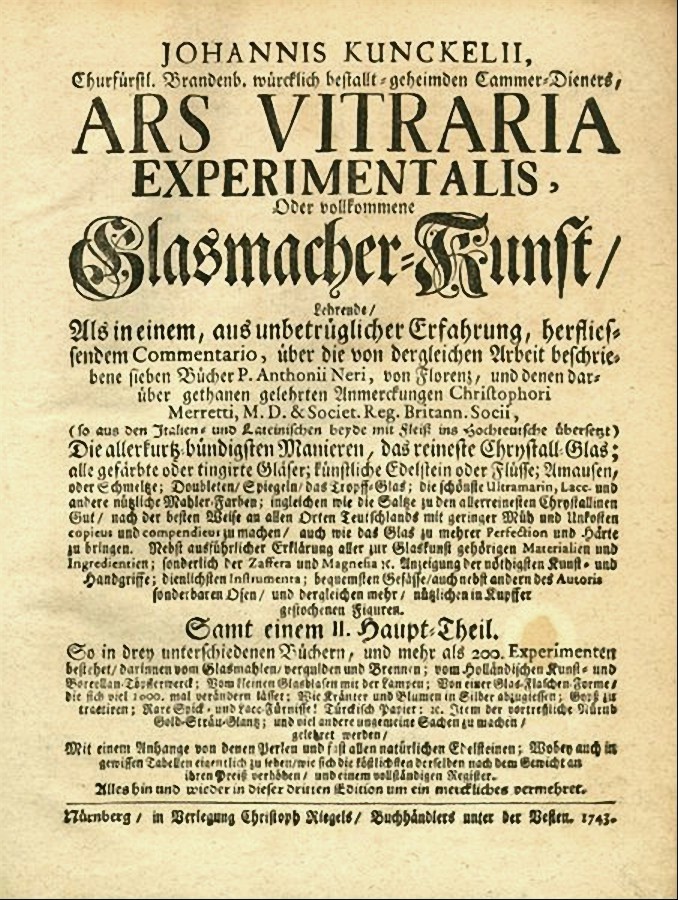
A gathering and mingling of early Kunkel families talks about our first notable figure, Baron Johann Kunckel von Löwenstern, a German chemist. Around 1678, he replicated Hennig Brand’s discovery of phosphorus isolation. Kunckel later managed the laboratory and glassworks in Brandenburg as a court chemist and apothecary.
Ars Vitraria ExperimentalisJohannes Kunckel, Ars Vitraria Experimentalis, 1679
The illustration by George Smith from his 1738 chapter “The art of blowing glass in miniature” (fig. 3) is not labeled alphabetically, but Johannes Kunckel’s 1679 engraving (fig. 4) is:
A — table around which four people may work at once
B — the lamp, filled with oil and a strong cotton wick
C—the hole where the tapered blowpipe is attached . . . so that the air is directed onto the acute and concentrated flame, producing a flame that will melt glass. Goldsmiths have a similar system for soldering metal.
D — bellows attached to pipes of tin that are hidden under the table
E — lever, attached to the foot pedal
F — ventilation hood
G — foot treadle for the bellows, pressed by the worker
Left: Probably engraved by Gottfried Spiller (1658–1728). Covered goblet with “Fruit Children,” before 1700. Gold ruby glass, H. 9 1/8 in. (23.1 cm). Focke-Museum, Bremer Landesmuseum für Kunst und Kulturgeschichte, Bremen (68.253). Center: Ruby glass flute with “AR” monogram, around 1715. German, Dresden. Gold ruby and transparent glass (blown, cut), H. 23 cm. Green Vault, Staatliche Kunstkammlungen Dresden (IV 228). Right:Covered goblet, 1725–35. German, Potsdam. Transparent dark gold ruby glass (blown, cut) 10 9/16 x 3 5/8 in. (26.9 x 9.2 cm). Corning Museum of Glass, Corning, New York, Bequest of Jerome Strauss (79.3.318) Gold ruby glass was perfected through alchemist and glassmaker Johann Kunckel’s experimentation under the patronage of Frederick William, Elector of Brandenburg, at the elector’s glassworks in Potsdam. Its name comes from the addition of colloidal gold to the glass before melting, a complex operation that required the skills of both alchemist and glassmaker. Displayed in a Kunstkammer, glass pieces served as signs of the alchemical knowledge required to produce them.
~ ~ ~ ~ ~ ~ ~ ~ ~ ~ ~ Continue Reading If You’re Interested in the Kunkle Line.
Our Kunkles trace back to my grandmother, Hilda Leonore Kunkle. However, I don’t have any personal stories to share as I didn’t know my dad’s family. I gained most of my knowledge later in life through my siblings, letters from my Aunt Elva (Hilda’s daughter), and documented facts and history shared by others.
Hilda married Glen Henry Logan in 1921 in Indiana County, Pennsylvania. Her father was Charles J. Kunkel. You’ll notice how the name is interchangeable with the -el and -le. He married Carrie Morrison in 1892. Charles lived most of his life in Westmoreland, Pennsylvania, until his wife died in 1937. He then moved to Michigan to live with his daughter, Hilda, and her family until his death in 1948 at the age of 82.
Charles’ father was Michael Kunkle. He also grew up in Westmoreland, Pennsylvania. In 1860, Michael married his neighbor, Esther “Hettie” Hawk. They were Lutherans, and Michael worked as a carpenter before becoming a farmer for the rest of his life. Michael passed away at the age of 80 in 1918 in Westmoreland.
Michael’s father was Daniel. They lived on Michaelsburg Plantation, a 336-acre estate owned by a family member. His family was among the First Families in Hempfield Township.
Some family stories were recorded in the History of Westmoreland County, Pennsylvania by Boucher, John Newton; Jordan, John W. (John Woolf), 1840-1921, joint editor. Publication date 1906. Publisher New York, Chicago, The Lewis publishing company. Contributor Allen County Public Library Genealogy Center
Daniel married Mary Elizabeth Kepple, and they had a son named Michael. They moved from Westmoreland to Indiana, Pennsylvania, where he worked as a railroad lock tender. Unfortunately, Elizabeth passed away about 10 years later. After her death, he married Catherine Iseman in 1844, but she died of cancer in 1850. In 1852, Daniel married Sarah, whose last name is unknown. It is still unknown when Daniel passed away, but it is confirmed that he was alive at least until 1870, as he is listed in the census at age 66 and still working for the railroad.
I’ve been putting off delving into the Kunkel family, but now things are more interesting. The first names in the family often begin with Johann for boys and Anna or Maria for girls. I’ve had to redo my Kunkle family tree twice because I initially followed the wrong line. However, thanks to the help of other researchers, Vernon Cook and James Kunkle, I am now back on track.
Daniel’s father is Johann Jacob Kunkel (Gunckel), Jr. It is in this generation that the Kunkel and Gunckel names are interchangeable. He married Elizabeth Schaeffer in 1789 and had 10 children. My records indicate that he was a farmer, and his cause of death was “gravel.” After researching old terms for the cause of death, “gravel” seemed to refer to the modern equivalent of kidney stones. He is buried in Brush Creek Evangelical Lutheran Church Cemetery.
Johann Jacob’s father is Johann Jacob Gunkel, Sr. His father is our immigrant ancestor of this family. He was born in Breitenburg, Germany in 1746, and they immigrated in 1749 when Jacob was only 3 years old.
Tom writes, One of the first known settlers in Pine Grove area after the French and Indian War, 1689-1763, Great Britain Battles France over unsettled territories in N. America, was Jacob Gunkel. He was located on the site of the Eagle Hotel in 1771. Here, he laid claim to a tract of two hundred acres of land, which he subsequently purchased from John and Richard Penn, proprietors of the Colony of Pennsylvania, which included the site of the present borough of Pine Grove. The convergence of several roads on Gunkel’s plantation made it an excellent location for a tavern, and soon after he purchased the land, he erected a log building, Gunkel’s Tavern, which he kept till 1810 and then he removed to a farm about a mile south from the borough were he died in 1813. His property was located next to the property of his daughter Eva and husband Johannes Loffler.
Another source states he “kept a house of entertainment, and in 1795 opened a store which he kept until 1810. (Source: History of Schuylkill Co, PA, by W. W. Munsell & Co, – 1881). On May 21, 1810, Jacob Gunckel of Pinegrove Township, Berks Co, PA, yeoman, and Susannah, his wife, sell to John Gunckel, yeoman, for 255 pounds, land containing 235 acres, part of the larger tract of land called “Gunckel’s Farm.” (Deed book 24, page 488).
Cemetery records for St. Peter’s (Gunkle’s) Union Church of Pinegrove Township, Schuylkill County include the following references: Jacob Gunkel; born September 28, 1746; died September 2, 1813 Eva Lefler; born Mar 25, 1809; died Jun 21, 1841 Johannes Leffler; born Jul 5, 1764; died Aug 16, 1849; son of Gottfried, Mahanoy Twp., Northumberland Co. Eva Lofler (nee Kunkle); w/John; died Jan 26, 1857; 83y 11m 15d
Gunkel’s Cemetery, located across the street from St. Peter’s Lutheran Church, contains a memorial plaque that reads: Site of the 1st Reformed-Lutheran Church 1782-1817 Donated by Jacob & Susanna Gunkel
Joh. Jacob’s father was Johann John Gunkel, born in 1722 in Breitenborn, Germany. John Gunckel married Anna Margarethe Lorentz and arrived in America in 1749 with his young son. In the book “Naturalizations of Foreign Protestants in the American Colonies,” there is the following: “John Gunckel of Bethel Twp., Berks County, Pennsylvania, became a citizen 20 September 1761.” These naturalizations were performed at the Philadelphia County, PA Courthouse. https://archive.org/stream/naturalizationso24grea#page/75/mode/2up/search/gunckel
Johann has often been confused with Johann Michael Gunkel, who was the same age. They were first cousins from Breitenborn and used similar names for their children. They also attended the same church. By the way, Johann (John) also had a brother named Johann Jacob. Talk about confusing!
John is also our Revolutionary War ancestor. His SAR Patriot number is P-171729. The John Gunckel of Bethel Township, who performed Revolutionary War service and from whom we are descended, was enrolled in 1777-1779 in the First Class, Captain Valentine Shoufler’s Seventh Company, First Battalion, Lancaster County Militia. He was assessed 26 pounds in fines, according to the evidence of an undated list of Class Fines. (Pennsylvania State Archivist, Military Accounts (Militia), Records of the Comptroller General, at the Division of Archives and Manuscripts) Larry Patrick Cornwell, 138085, has a SAR-approved supplemental under this John Gunckel. Larry served as the Genealogist General of the National Society, Sons of the American Revolution from 2011-2014 (www.sar.org)
John died in 1795 at the age of 73.
John’s father was Lorentz Gunkel, born in Breitenborn, Germany. He immigrated to the US in 1751 on the ship the “Duke of Bedford” with wife and one child, from Rotterdam, and last from Portsmouth, England. Port of entry was Philadelphia, PA, on a Saturday. Records show that Lorentz settled first in Northampton Co, PA, and later pioneered in Allegheny & Westmoreland Counties, PA. He was a Revolutionary War soldier and a pensioned veteran. *(Record Sources: 1804, pg 335 (Supp. 1983) aud 9041, pg 459 (From Flörsbach, Germany).
Lorentz wed Anna Catharina Gundlach in 1709. It’s uncertain who the “young child” who immigrated with them is. However, it could be our ancestor, Johann Jacob, as he was born in 1746.
Lorentz’s father was Hans Gunkel, who was born in Neuhütten, Spessart, Germany, in 1636. He was known as a Catholic man. He married Margareth N. and worked in a “glass house.” They later moved to Breitenborn, where Hans was invited by Heinrich Gundlach, the headmaster of the Breitenborn Works, to recruit glass makers from all over the country in the 1670s and 1680s.
When I originally published this post, a cousin replied, introducing himself. He also stated, “I do not believe that anyone actually lived in a “Glass House” I believe that this is simply a misinterpretation of the translation of Neuhutten. The Huts of glass were simply the buildings that were constructed… or the kilns… that were used to make the glass. These kilns were made of bricks so they could be brought to new areas where the resources (forests) were over-exploited to the point that they had to move to continue to be able to make glass. When they relocated to the area of NeuHutten they simply called it that “New Huts”.”
Hans Kunkel was a skilled glassblower, and many Kunkels were known for their glassblowing skills all over Europe at that time. Gundlach, an entrepreneur, made efforts to recruit the most talented glassblowers to come to Breitenborn. It is impressive that Hans Kunkel was still very productive in the 1680s. For instance, between January 4, 1684, and November 26, 1685, at around 50 years old, he produced 42,300 drinking glasses of various types and earned 91 fl. 16 alb (the equivalent of the dollar in those days). In addition to blowing glass, he occasionally attended the furnace, an important task for maintaining proper temperatures during the melting process.
During the winter months, the furnace stayed cold. The production period was 9 months per years – max. During the winter months, most of the works the people were also engaged in was cutting the firewood (beech and oak) for the furnace which did eat up a lot during the production period. So additionally they had another income. There were over 20 men permanently assigned to the fire wood cutting and handling, plus the seasonal ones. Hans Kunkel, for example, made 83-1/2 Clafter (7’x7’x3′) and earned 25 fl. additionally in 1689.
Despite all the hard work, Hans Kunkel lived to be nearly 100 years of age. There is a lot more similar data available, basically showing production figures, earnings, how they were paid (normally 50% cash, and the other in natural things, like grain, flour, etc. and the beverages, like beer and brandy were also brewing there.)
(Above Source: – “Heinrich P. Göbel” – Germany Researcher. (1994)
Hans’ father was Johann Michael, born in Glasshouse, Germany about 1600. He married Anna Katharine Naumann. He died in 1676. There is not much else known about him.
The Kunkels were already living in Neuhutten before the Thirty Years War. It seems that Neuhutten and that part of Germany were already in the Lutheran camp. The Kunkels all seemed to have been born, married, and died in “The Glasshouse” in Neuhutten.
Joh. Michael’s father was Johannes Jurg, born about 1565. He married Elisabeth Christina Houser.
The Kunkel family still live primarily in the Spessart Mountain range area, which is a mostly wooded region in the heart of Germany. There is a historical mention of an early Glasshouse in the Spessart area dating back to 22 August 1349. During that time, the area was under the jurisdiction of the Archbishop of Mainz.
The Union Letter (Bundesbrief) of 1537 (or the Federal Charter or Letter of Alliance) lists two KUNKELs, namely Jurge (George) and Hentze Kunkel, and in a later revision dated 24 February 1559, again two KUNKELs – George and Friedrich Kunkel. There are links, as glass-making was only carried down by the same families.–Janet and Robert Wolfe Genealogy, “Notes for Johann Jurg Kunkel and Elisabeth Christina Houser” Webpage: www.umich.edu/~bobwolfe/gen/mn/m6413x6414.htm Email address: JanetRobertWolfeGenealogy@gmail.com Go to the Genealogy Page for Johann Jurg Kunkel Go to the Genealogy Page for Elisabeth Christina Houser Go to the Kunkel surname index. Go to the Houser surname index. Go to the Home Page for Janet and Robert Wolfe Genealogy
Much research is still needed to fill out all the missing information; however, I have been told that genealogy records beyond this point are next to impossible to find due to all the wars that took place in this country. The Thirty Years War (1618-1648) destroyed many church records throughout Germany. So many records have been destroyed, and finding a cemetery with headstones that can be read after 500 years would be impossible.
All Kunkels do not accept the “dweller by deep water” definition of the name. Other research has yielded another possibility for its origin: It seems to derive from the Old High German name “KUHN,” meaning “wise.” (In this case, such a compliment would make it acceptable.) GUNKEL probably refers to living in deep water. In German, KUNKEL means the part of a spinning wheel called the distaff. A staff on which fibers such as flax or wool are wound before being spun into thread.
As you study the descendants of these families, you will find that intermarriages were rather common. Men had limited ways to meet eligible mates and could usually not go farther than they could walk or ride horseback to court. When there were family get-togethers, they met women who just happened to be related in one way or another. (James E. Kunkle- 2000)
Joh. Jurg’s father was Hans. Hans was born about 1530 in Glasshouse, Germany. He married Anna Catharina Wolfgang in 1554. Hans Kunkel of Neuhutten was called “Schwarzkoph” in the Parish records. Meaning “Black Forest.”
Some show Claus Kunkle, born 1490, as Hans’ father, and Conrad, born 1460, as Claus’ father, but I do not have sources to back these up.
The Coat-of-Arms of the Kunkel, Kunkle, etc., family is recorded in Rietstap’s Armorial General (Pg. 1144)
This link is one of James’ first works on the Kunkles and contains a lot of interesting information, from their Coat of Arms to their superstitions to their culture, customs, and rituals. Conkle/Kunkle File #1
While I couldn’t find exact Kunkel glass other than the original Johann’s, I did find some drawings of the glassblowers’ working areas in that century.
Glass blowing, from a Book of Trades, 1542 (engraving), German School, (16th century) / Private Collection / The Stapleton Collection / The Bridgeman Art Library
There is still much to learn about certain individuals in this family, and I hope to contribute to James and Wallace’s wonderful work. RIP, guys! You left a wonderful legacy for all of us.
Glass furnace, with workers. Georg Agricola (German, 1494–1555). In De re metallica [Berckwerck Buch, Frankfurt-am-Main, 1580, p. cccxc]. Rakow Research Library, The Corning Museum of Glass (66820). Photo: The Corning Museum of Glass. Read more at https://www.cmog.org/article/lamp.
If you need research assistance, do not hesitate to contact me.
Your Family
Tree Research Specialist
As an Amazon Associate, I earn from qualifying purchases.




![FIG. 39. Glass furnace, with workers. Georg Agricola (German, 1494–1555). In De re metallica [Berckwerck Buch, Frankfurt-am-Main, 1580, p. cccxc]. Rakow Research Library, The Corning Museum of Glass (66820). Photo: The Corning Museum of Glass.](https://i0.wp.com/i.pinimg.com/564x/4e/49/5e/4e495ec5a072d9bb33f6f130891e9660.jpg?w=840&ssl=1)
You must be logged in to post a comment.