Uncovering the Royal Connections of the Logan Clan from Medieval Scotland to Colonial America
Discovering Royal Lineage in Logan Family History
The Logan family genealogy reveals a fascinating connection to Scottish royalty that spans centuries. Through meticulous genealogical research, we’ve uncovered how Walter Seth Logan Sr. maintained “a close kinship” with James David Logan, William Penn’s trusted secretary. This connection has led us down a remarkable path of Logan family history that traces directly back to King Robert II of Scotland (1316-1390).
James David Logan: Penn’s Secretary and Royal Descendant
James David Logan’s maternal lineage creates an extraordinary genealogical bridge to Scottish nobility. As the 9th great-grandson of King Robert II of Scotland through his mother Isabel Hume, James represents a direct link between Colonial American history and Scottish royal bloodlines. His father, Patrick Logan, descended from the powerful Logan family of Restalrig, though the exact connection remains one of genealogy’s most intriguing puzzles.
The Logan Family of Restalrig: Medieval Scottish Nobility
Origins and Rise to Power
The Logan genealogy in Scotland centers around the historic Barony of Restalrig, near Edinburgh. The Logan family were wealthy landowners who possessed the Barony of Restalrig from the 14th Century and lived in Lochend Castle. Their rise began when Sir Robert Logan married Katherine de Lestalric, inheriting vast estates that would define the family’s legacy for generations.
The original Logan family castle stood on the site of what later became Lochend House, commanding views over Lochend Loch. This strategic position near Edinburgh made the Logans influential players in Scottish politics and society.
The Lestalric-Logan Connection
Before the Logans controlled Restalrig, the area belonged to the powerful Anglo-Norman Lestalric family, who arrived around 1166 during the Norman expansion into Scotland. When Sir John de Lestalric died in 1382, his daughter Katherine inherited the estate and married Sir Robert Logan from Ayrshire. This marriage united two significant Scottish families and established the Logan presence at Restalrig.
The Logan family had previously supported Robert the Bruce, a loyalty that cost them their Ayrshire lands when Edward I of England forfeited their properties. Dominus Walter Logan was captured by the English in 1306 and executed at Durham, demonstrating the family’s unwavering commitment to Scottish independence.
Robert Logan of Restalrig: The Monastery Founder
Sir Robert Logan (d. 1439) and his wife Dame Katherine made lasting contributions to Scottish religious life by founding the monastery of St Anthony near South Leith Parish Church. They also established a chapel at Arthur’s Seat in Holyrood Park, whose ruins still attract genealogists and historians today.
This Robert Logan also inherited Fast Castle and border lands as the “nephew” and heir of Elizabeth Martene, Lady Fastcastle, widow of Cuthbert Home who fell at the Battle of Flodden Field. By the 1570s, the Logan family controlled half of the Fastcastle lands, sharing ownership with Sir George Ogilvie of Dunlugus.
The Gowrie Conspiracy: A Dark Chapter in Logan Family History
The most dramatic episode in Logan family genealogy occurred in the early 1600s with the Gowrie Conspiracy. Sir Robert Logan of Restalrig (d. 1606) became posthumously entangled in accusations of plotting against King James VI of Scotland.
The Bizarre Trial of a Dead Man
In 1609, three years after Robert Logan’s death, suspicions arose about his involvement in the failed 1600 plot to assassinate King James VI. In an unprecedented legal proceeding, Logan’s body was exhumed from his tomb at South Leith Parish Church and brought before the court. Unable to defend himself, the deceased Logan was found guilty on questionable evidence, and his vast estates were forfeited to the Crown.
The trial’s circumstances suggest corruption, particularly involving the Earl of Dunbar, who owed the Logan estate substantial money and stood to benefit from the forfeiture that absolved his debts while allowing him to keep the Restalrig lands.
Impact on Logan Descendants
The forfeiture devastated the Logan family for years. Logan’s children faced severe restrictions – they couldn’t own land, hold office, or enjoy basic freedoms. The Crown seized nearly 30,000 pounds (equivalent to millions today) from the Logan estate. While the family name wasn’t officially outlawed, their social and economic status plummeted dramatically.
A Reversal of Attainder in 1616 allowed Robert’s minor children to resume normal lives, though they could inherit nothing from their father’s estate. The three eldest sons – Robert, George, and John – remained excluded from this clemency.
Later investigation revealed that Logan had been wrongly accused based on forgeries created by his secretary, George Sprott, vindicating the family’s reputation posthumously.
Connecting American and Scottish Logan Lines
The genealogical challenge lies in definitively connecting Walter Seth Logan Sr.‘s line with James David Logan’s Scottish ancestry. Both men lived in Colonial Pennsylvania, with only 25 years separating their births, suggesting a family relationship waiting to be documented.
Ongoing Genealogical Research
Contemporary Logan family researchers continue investigating these connections. The complexity arises from the multiple Robert Logans of Restalrig, each with numerous children from multiple marriages. Several Logan sons were exiled to Ireland following the Gowrie Affair, potentially explaining how the Logan line reached Colonial America.
Logan Family DNA and Modern Genealogy
Modern genealogical research benefits from DNA testing and digital records that weren’t available to earlier researchers. WikiTree currently tracks over 10,000 Logan family profiles, providing unprecedented resources for connecting Logan family branches worldwide.
Research Tips for Logan Family Genealogy
Key Records to Search:
Scottish parish records from Edinburgh and surrounding areas
Irish immigration records (post-1609)
Colonial Pennsylvania land records
Logan family wills and estate documents
Important Logan Family Locations:
Restalrig and Lochend, Edinburgh
Fast Castle, Scottish Borders
Ayrshire, Scotland
Chester and Philadelphia Counties, Pennsylvania
The Logan Legacy: From Medieval Scotland to Modern Times
The Logan family story exemplifies how genealogical research can uncover remarkable historical connections. From medieval Scottish nobility through political persecution to Colonial American success, the Logan family journey illustrates the broader patterns of Scottish emigration to America.
Understanding these connections helps modern Logan descendants appreciate their heritage while contributing to ongoing genealogical research. Each newly discovered document or DNA match brings us closer to solving the puzzle of how Scottish nobility became American pioneers.
Continuing the Research
Logan family genealogy remains an active field of research. Archives in Scotland, Ireland, and America continue yielding new information about family connections. Digital genealogy platforms make collaboration easier than ever, allowing researchers worldwide to share discoveries and theories.
The connection between Walter Seth Logan Sr. and James David Logan may still be waiting in an unexplored archive or family Bible. For Logan descendants and genealogy enthusiasts, the search continues, driven by the compelling evidence that these Colonial Pennsylvania Logans shared more than just a surname with Scottish royalty.
This post updates and expands on earlier Logan family research with current genealogical findings and digital resources. Have you discovered Logan connections in your family tree? Share your research in the comments below.
Sources and References 1. Scotclans.com – “The Logans of Restalrig”http://www.scotclans.com/the-logans-of-restalrig/ 2. Electric Scotland – “The History of Leith; The Logans”http://www.electricscotland.com/history/leith/5.htm 3. Scottish Places – “Famous Scots: Robert Logan of Restalrig”http://www.scottish-places.info/people/famousfirst1326.html 4. Historical Records of Scotland – Parish records and estate documents from Edinburgh Archives 5. Stephanie Logan Falls – Logan family researcher and genealogist (personal correspondence and research) 6. WikiTree – Logan Family Profiles and DNA Connectionshttps://www.wikitree.com 7. Scottish National Archives – Forfeiture documents and court records related to the Gowrie Conspiracy 8. Leith Parish Church Records – Burial and family records 9. Colonial Pennsylvania Land Records – Chester and Philadelphia County archives 10. Burke’s Peerage and Baronetage – Scottish noble families genealogy Image Credits: • St. Anthony’s Chapel photographs: Historical Scotland
Special Thanks: • James Logan (genealogical cousin) for ongoing Scottish archive research • Logan family researchers worldwide contributing to collaborative genealogy projects
Johann Henrich Heilig, my 6th great-grandfather, was born in 1700 and married Susanna De Wees Rittenhausen in 1729. Susanna’s family was prominent in early American industry, particularly in the Rittenhouse paper mills, which I’ve written about previously. If you’re a descendant or admirer of the Rittenhouse legacy, I recommend exploring the Rittenhouse Family Descendants and Friends Facebook page and learning about their efforts to preserve this rich history. The Rittenhouse Town Board of Directors actively maintains the historic Homestead House (built in 1707), the surrounding village, and a barn constructed during the WPA era.
Henrich’s origins remain debated among historians. Earlier accounts suggest he was born in Hannover, Germany, while newer research points to Baden-Wuerttemberg. What we do know is that Johann arrived in Philadelphia in 1720 aboard the Polly. Since passenger lists weren’t required until 1727, his exact journey is pieced together through indirect evidence.
By April 11, 1747, Johann was officially naturalized as a resident of Pennsylvania, meeting the colonial requirement of seven years’ residency. By this time, he was known as Henry—a clockmaker by trade. Clockmaking was a respected profession during the 18th century, vital for navigation, surveying, and precise timekeeping.
Henry and Susanna initially settled in Cheltenham but later purchased land on the borders of Pennsburg and Upper Hanover Townships in Montgomery County in 1749 and 1750. This property, acquired from surveyor William Parsons (an associate of the Penn family), remained in the family for generations. Passing from Henrich to his son George, and later to George Jr., the land was eventually sold to the Hoch family in the 1860s. Remarkably, the Hoch family still owns the house today—a living testament to centuries of stewardship.
Before 1684, the Lenape Indians roamed the hills and fished the streams of the land on either side of the Perkiomen Creek. In 1684, the Indians lost this land when William Penn purchased it for reportedly “two watch coats, four pairs of stockings and four bottles of cider.” In time, Pennsylvania Germans settled in the area. Around 1840, the area now known as Pennsburg began to appear like a village. The hub comprised a general store, a carpenter and blacksmith shop, and several houses. Most of the land was owned by the Heilig Brothers. They owned and resided in the oldest house in Pennsburg, located at Seminary and Fourth Streets. The Heilig Brothers took it upon themselves to refer to this village as “Heiligsville.” Residents had their ideas, and out of loyalty to the then Pennsylvania Senator, James Buchanan, wanted to name the area Buchanansville.
As the village grew, a meeting was held in 1843 at the Hilleg family store to decide on a permanent name and layout of boundary lines. After a week-long, bitterly contested battle, it was finally decided to name the village “Pennsburg” after William Penn.
i. Heinrich Heilig, b. 1722, ii. Jurg George Heilig, b. 1720; d. 1796, Upper Hanover Township., iii. Johannes Heilig (Source: Willbook I – 1796, 149-150.). iv. Anna Maria Heilig (Source: Willbook I – 1796, 149-150.), m. Michael Slonaker., v. Susanna Heilig (Source: Willbook I – 1796, 149-150.), b. 1726; m. Henry Deany.
Johannes or John changed the surname to Highley. The other children kept the German spelling of Heilig.
This notation appears on a locally sold postcard by Len Hillegass of the Heilig House: “The Heilig House at 313 W. 4th Street is considered the oldest house in Pennsburg. Wounded and ill Colonial Soldiers were cared for there by the very compassionate Heilig family during the Colonies’ fight for independence from British rule during the American Revolution.” Album by Reid Heilig You can see other pictures of the house at https://imageevent.com/heilig/heiligheritage/heilighousepennsburgpa?n=1&z=2&c=4&x=0&m=24&w=0&p=0.
Henry was a clockmaker. He passed down the art of his clockmaking skills to his children and nephews. One of the most famous was David Rittenhouse, an avid astronomer; he built complicated astronomical clocks and orreries, or planetary models, that kept time and predicted celestial events.
David Rittenhouse tall case clock. 1984.0416.007.
Henry is listed in the U.S., Craftperson Files, 1600-1995.
With hand made brass works in the German style, it consists of 19 bells, a wooden cylinder with pins that activate 19 hammers to play tunes, a bone wave to switch tunes. Iron frame is dovetailed together. You can read more about each piece on Reid Helig’s site at https://imageevent.com/heilig/hheiligclock/themusicmechanism
Henry was buried along with his wife in the mostly Rittenhouse family cemetery, Methacton Mennonite Cemetery. Click here for a partial list of burials with links to tombstone photographs. Henrich’s and Susannah’s are below. This cemetery is located in Worcester Township, Montgomery County, PA.
Henrich Heilig .. Died May 14, 1775 .. Aged 74 year 11 Mo 12 daysSusannah Rittenhouse .. Departed This Life December 13, 1769 .. Aged 71 YearsThe interesting thing about Susannah’s tombstone is that it shows her maiden name as “Rittenhouse.” However, this would be the correct person calculating the birth year by her age at death.
A wonderfully thorough history is written by Linton E. Love, a descendant of the Rittenhouse family. In it are the descendants of Henry and Susannah. Linton has created a database extending from the 17th century up to the 21st century from Claus to his 12,810 descendants as of March 2005!
Johann Henrich Heilig’s story is one of perseverance, skill, and enduring family ties. From his arrival in Philadelphia to the land that remains in familial care, his legacy is woven into the fabric of American history. Whether as a skilled clockmaker or as part of the Rittenhouse connection, his contributions remind us of the resilience and dedication of early immigrants. By reflecting on his life, we not only honor his journey but gain inspiration for preserving our own family stories for generations to come. Do you have a Heilig clock? You might!
As an Amazon Associate, I earn from qualifying purchases.
For most of us, Pennsylvania played an important role in our ancestors’ history. Pennsylvania has been a destination for a wide range of immigrants, including Europeans, African Americans, and others. These individuals were drawn to the state because of its significant role in the nation’s development and its diverse industries. During the colonial period, Pennsylvania’s religious freedom attracted various ethnic and religious groups, such as Quakers, Mennonites, and Amish. Welsh Quakers settled in what are now Montgomery, Chester, and Delaware counties, while German immigrants developed their own dialect and eventually became known as the Pennsylvania Dutch.
Pennsylvania experienced substantial industrial growth, particularly in steel production, coal mining, and oil fields. This led to a large influx of European immigrants seeking employment, including individuals from Ireland, Germany, Italy, Poland, Scandinavia, Russia, and Slovakia. Moreover, the state played a pivotal role in the Civil War and served as a primary entry point for many immigrants.
The Pennsylvania Historical & Museum Commission was created in 1945 and is responsible for the collection, conservation, and interpretation of Pennsylvania’s historic heritage. Not only do they oversee the state archives, which you can visit in person or online, but they also have a wonderful museum section. These museums encompass Daniel Boone (he was born in Pennsylvania), the lumber industry, the mining industry, the railroads, and many others. They even have a “village & farming” museum. You can visit these in person or online as well.
In addition, check out PA History 2 G0, a series of videos produced by the PHMC, with funding from the Institute of Museum and Library Services. These short videos introduce you to Pennsylvania’s state-owned historic sites and museums as they explore the varied stories that make up the commonwealth’s rich history. Still, they have an online collection of historical objects, archaeological artifacts, and natural history specimens.
Pennsylvania’s rich history is deeply intertwined with the stories of our ancestors, who found in this state a place of opportunity, freedom, and growth. From the religious sanctuaries of the colonial era to the booming industries that shaped the nation, Pennsylvania has been a beacon for diverse communities and a witness to pivotal moments in American history. As we explore the state’s historic sites, museums, and archives, whether in person or online, we not only honor our heritage but also gain a deeper understanding of the challenges and triumphs that have shaped the lives of those who came before us. The Pennsylvania Historical & Museum Commission continues to preserve and share these stories, ensuring that the legacy of our ancestors remains alive for generations to come.
Image Depicting Pennsylvania’s Rich History and Industrial Heritage. OpenAI, 2024.
I want to emphasize that all the research mentioned below was conducted by other individuals, and I simply discovered their work. Fortunately, our relatives were very supportive and willing to share their findings with me.
James E. Kunkle, a retired US Navy officer who resided in Colorado, passed away in 2017 at the age of 90. I had been corresponding with him since 2012. He and Wallace M. Kunkel (also deceased) have compiled the following history of the Kunkel families, which is available at the Family History Library, among other works authored by James, and at the Library of Congress. I have put a link to it here. A gathering and mingling of early Kunkel families
Wallace’s grandmother began the genealogy work in the late 1940s, spending long hours at her typewriter. She created genealogy books for her seven grandchildren as Christmas presents in the 1960s. Wallace, his daughter Mary, and his grandchildren have continued this work. When Wallace was alive, he collaborated with James on this historical project. It’s poignant that yesterday (I originally wrote this blog on April 8, 2018.) marked the anniversary of his passing. Wallace was also known as “Mr. Sawdust,” a skilled furniture maker and the founder of the “Mr. Sawdust School of Professional Woodworking.”
“At least forty families of Protestant Kunkels immigrated to America from Germany between 1728 and 1770. Some of the Catholic families of Kunkels immigrated to the United States after the War of 1812. Many of the early Kunkel families settled in Pennsylvania. Today, Kunkels live in Pennsylvania, Maryland, Ohio, Wisconsin, Illinois, Indiana, Minnesota, and throughout the United States. The surname is spelled Kunkel, Kunkle, Gunkel, Gunkle, Konkel, Konkle, and other variant spellings.” -J.E. Kunkle & W.M. Kunkel, 1995 (415 pages of history).
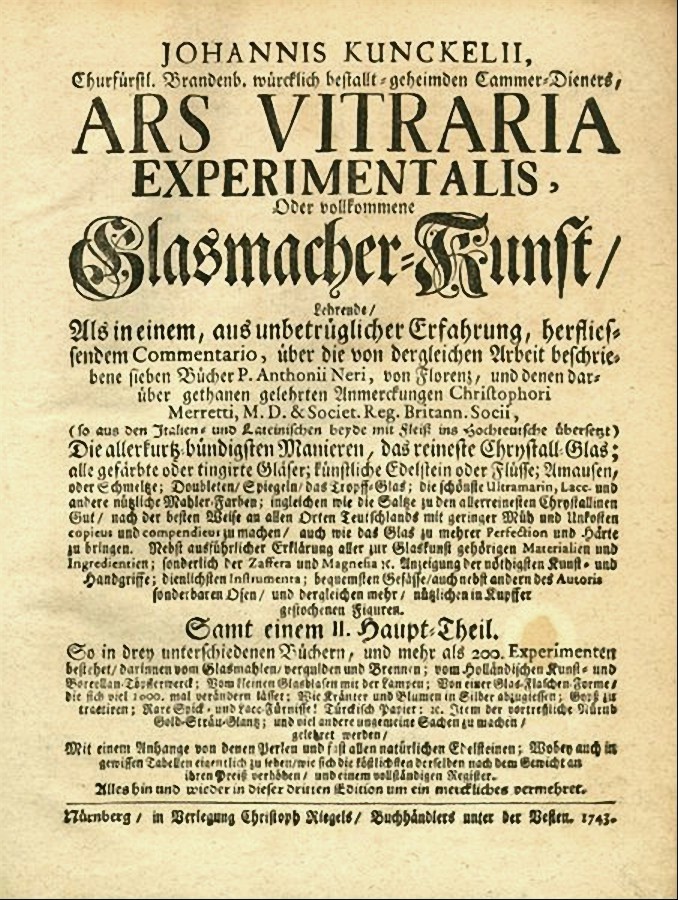
A gathering and mingling of early Kunkel families talks about our first notable figure, Baron Johann Kunckel von Löwenstern, a German chemist. Around 1678, he replicated Hennig Brand’s discovery of phosphorus isolation. Kunckel later managed the laboratory and glassworks in Brandenburg as a court chemist and apothecary.
Ars Vitraria ExperimentalisJohannes Kunckel, Ars Vitraria Experimentalis, 1679
The illustration by George Smith from his 1738 chapter “The art of blowing glass in miniature” (fig. 3) is not labeled alphabetically, but Johannes Kunckel’s 1679 engraving (fig. 4) is:
A — table around which four people may work at once
B — the lamp, filled with oil and a strong cotton wick
C—the hole where the tapered blowpipe is attached . . . so that the air is directed onto the acute and concentrated flame, producing a flame that will melt glass. Goldsmiths have a similar system for soldering metal.
D — bellows attached to pipes of tin that are hidden under the table
E — lever, attached to the foot pedal
F — ventilation hood
G — foot treadle for the bellows, pressed by the worker
Left: Probably engraved by Gottfried Spiller (1658–1728). Covered goblet with “Fruit Children,” before 1700. Gold ruby glass, H. 9 1/8 in. (23.1 cm). Focke-Museum, Bremer Landesmuseum für Kunst und Kulturgeschichte, Bremen (68.253). Center: Ruby glass flute with “AR” monogram, around 1715. German, Dresden. Gold ruby and transparent glass (blown, cut), H. 23 cm. Green Vault, Staatliche Kunstkammlungen Dresden (IV 228). Right:Covered goblet, 1725–35. German, Potsdam. Transparent dark gold ruby glass (blown, cut) 10 9/16 x 3 5/8 in. (26.9 x 9.2 cm). Corning Museum of Glass, Corning, New York, Bequest of Jerome Strauss (79.3.318) Gold ruby glass was perfected through alchemist and glassmaker Johann Kunckel’s experimentation under the patronage of Frederick William, Elector of Brandenburg, at the elector’s glassworks in Potsdam. Its name comes from the addition of colloidal gold to the glass before melting, a complex operation that required the skills of both alchemist and glassmaker. Displayed in a Kunstkammer, glass pieces served as signs of the alchemical knowledge required to produce them.
~ ~ ~ ~ ~ ~ ~ ~ ~ ~ ~ Continue Reading If You’re Interested in the Kunkle Line.
Our Kunkles trace back to my grandmother, Hilda Leonore Kunkle. However, I don’t have any personal stories to share as I didn’t know my dad’s family. I gained most of my knowledge later in life through my siblings, letters from my Aunt Elva (Hilda’s daughter), and documented facts and history shared by others.
Hilda married Glen Henry Logan in 1921 in Indiana County, Pennsylvania. Her father was Charles J. Kunkel. You’ll notice how the name is interchangeable with the -el and -le. He married Carrie Morrison in 1892. Charles lived most of his life in Westmoreland, Pennsylvania, until his wife died in 1937. He then moved to Michigan to live with his daughter, Hilda, and her family until his death in 1948 at the age of 82.
Charles’ father was Michael Kunkle. He also grew up in Westmoreland, Pennsylvania. In 1860, Michael married his neighbor, Esther “Hettie” Hawk. They were Lutherans, and Michael worked as a carpenter before becoming a farmer for the rest of his life. Michael passed away at the age of 80 in 1918 in Westmoreland.
Michael’s father was Daniel. They lived on Michaelsburg Plantation, a 336-acre estate owned by a family member. His family was among the First Families in Hempfield Township.
Some family stories were recorded in the History of Westmoreland County, Pennsylvania by Boucher, John Newton; Jordan, John W. (John Woolf), 1840-1921, joint editor. Publication date 1906. Publisher New York, Chicago, The Lewis publishing company. Contributor Allen County Public Library Genealogy Center
Daniel married Mary Elizabeth Kepple, and they had a son named Michael. They moved from Westmoreland to Indiana, Pennsylvania, where he worked as a railroad lock tender. Unfortunately, Elizabeth passed away about 10 years later. After her death, he married Catherine Iseman in 1844, but she died of cancer in 1850. In 1852, Daniel married Sarah, whose last name is unknown. It is still unknown when Daniel passed away, but it is confirmed that he was alive at least until 1870, as he is listed in the census at age 66 and still working for the railroad.
I’ve been putting off delving into the Kunkel family, but now things are more interesting. The first names in the family often begin with Johann for boys and Anna or Maria for girls. I’ve had to redo my Kunkle family tree twice because I initially followed the wrong line. However, thanks to the help of other researchers, Vernon Cook and James Kunkle, I am now back on track.
Daniel’s father is Johann Jacob Kunkel (Gunckel), Jr. It is in this generation that the Kunkel and Gunckel names are interchangeable. He married Elizabeth Schaeffer in 1789 and had 10 children. My records indicate that he was a farmer, and his cause of death was “gravel.” After researching old terms for the cause of death, “gravel” seemed to refer to the modern equivalent of kidney stones. He is buried in Brush Creek Evangelical Lutheran Church Cemetery.
Johann Jacob’s father is Johann Jacob Gunkel, Sr. His father is our immigrant ancestor of this family. He was born in Breitenburg, Germany in 1746, and they immigrated in 1749 when Jacob was only 3 years old.
Tom writes, One of the first known settlers in Pine Grove area after the French and Indian War, 1689-1763, Great Britain Battles France over unsettled territories in N. America, was Jacob Gunkel. He was located on the site of the Eagle Hotel in 1771. Here, he laid claim to a tract of two hundred acres of land, which he subsequently purchased from John and Richard Penn, proprietors of the Colony of Pennsylvania, which included the site of the present borough of Pine Grove. The convergence of several roads on Gunkel’s plantation made it an excellent location for a tavern, and soon after he purchased the land, he erected a log building, Gunkel’s Tavern, which he kept till 1810 and then he removed to a farm about a mile south from the borough were he died in 1813. His property was located next to the property of his daughter Eva and husband Johannes Loffler.
Another source states he “kept a house of entertainment, and in 1795 opened a store which he kept until 1810. (Source: History of Schuylkill Co, PA, by W. W. Munsell & Co, – 1881). On May 21, 1810, Jacob Gunckel of Pinegrove Township, Berks Co, PA, yeoman, and Susannah, his wife, sell to John Gunckel, yeoman, for 255 pounds, land containing 235 acres, part of the larger tract of land called “Gunckel’s Farm.” (Deed book 24, page 488).
Cemetery records for St. Peter’s (Gunkle’s) Union Church of Pinegrove Township, Schuylkill County include the following references: Jacob Gunkel; born September 28, 1746; died September 2, 1813 Eva Lefler; born Mar 25, 1809; died Jun 21, 1841 Johannes Leffler; born Jul 5, 1764; died Aug 16, 1849; son of Gottfried, Mahanoy Twp., Northumberland Co. Eva Lofler (nee Kunkle); w/John; died Jan 26, 1857; 83y 11m 15d
Gunkel’s Cemetery, located across the street from St. Peter’s Lutheran Church, contains a memorial plaque that reads: Site of the 1st Reformed-Lutheran Church 1782-1817 Donated by Jacob & Susanna Gunkel
Joh. Jacob’s father was Johann John Gunkel, born in 1722 in Breitenborn, Germany. John Gunckel married Anna Margarethe Lorentz and arrived in America in 1749 with his young son. In the book “Naturalizations of Foreign Protestants in the American Colonies,” there is the following: “John Gunckel of Bethel Twp., Berks County, Pennsylvania, became a citizen 20 September 1761.” These naturalizations were performed at the Philadelphia County, PA Courthouse. https://archive.org/stream/naturalizationso24grea#page/75/mode/2up/search/gunckel
Johann has often been confused with Johann Michael Gunkel, who was the same age. They were first cousins from Breitenborn and used similar names for their children. They also attended the same church. By the way, Johann (John) also had a brother named Johann Jacob. Talk about confusing!
John is also our Revolutionary War ancestor. His SAR Patriot number is P-171729. The John Gunckel of Bethel Township, who performed Revolutionary War service and from whom we are descended, was enrolled in 1777-1779 in the First Class, Captain Valentine Shoufler’s Seventh Company, First Battalion, Lancaster County Militia. He was assessed 26 pounds in fines, according to the evidence of an undated list of Class Fines. (Pennsylvania State Archivist, Military Accounts (Militia), Records of the Comptroller General, at the Division of Archives and Manuscripts) Larry Patrick Cornwell, 138085, has a SAR-approved supplemental under this John Gunckel. Larry served as the Genealogist General of the National Society, Sons of the American Revolution from 2011-2014 (www.sar.org)
John died in 1795 at the age of 73.
John’s father was Lorentz Gunkel, born in Breitenborn, Germany. He immigrated to the US in 1751 on the ship the “Duke of Bedford” with wife and one child, from Rotterdam, and last from Portsmouth, England. Port of entry was Philadelphia, PA, on a Saturday. Records show that Lorentz settled first in Northampton Co, PA, and later pioneered in Allegheny & Westmoreland Counties, PA. He was a Revolutionary War soldier and a pensioned veteran. *(Record Sources: 1804, pg 335 (Supp. 1983) aud 9041, pg 459 (From Flörsbach, Germany).
Lorentz wed Anna Catharina Gundlach in 1709. It’s uncertain who the “young child” who immigrated with them is. However, it could be our ancestor, Johann Jacob, as he was born in 1746.
Lorentz’s father was Hans Gunkel, who was born in Neuhütten, Spessart, Germany, in 1636. He was known as a Catholic man. He married Margareth N. and worked in a “glass house.” They later moved to Breitenborn, where Hans was invited by Heinrich Gundlach, the headmaster of the Breitenborn Works, to recruit glass makers from all over the country in the 1670s and 1680s.
When I originally published this post, a cousin replied, introducing himself. He also stated, “I do not believe that anyone actually lived in a “Glass House” I believe that this is simply a misinterpretation of the translation of Neuhutten. The Huts of glass were simply the buildings that were constructed… or the kilns… that were used to make the glass. These kilns were made of bricks so they could be brought to new areas where the resources (forests) were over-exploited to the point that they had to move to continue to be able to make glass. When they relocated to the area of NeuHutten they simply called it that “New Huts”.”
Hans Kunkel was a skilled glassblower, and many Kunkels were known for their glassblowing skills all over Europe at that time. Gundlach, an entrepreneur, made efforts to recruit the most talented glassblowers to come to Breitenborn. It is impressive that Hans Kunkel was still very productive in the 1680s. For instance, between January 4, 1684, and November 26, 1685, at around 50 years old, he produced 42,300 drinking glasses of various types and earned 91 fl. 16 alb (the equivalent of the dollar in those days). In addition to blowing glass, he occasionally attended the furnace, an important task for maintaining proper temperatures during the melting process.
During the winter months, the furnace stayed cold. The production period was 9 months per years – max. During the winter months, most of the works the people were also engaged in was cutting the firewood (beech and oak) for the furnace which did eat up a lot during the production period. So additionally they had another income. There were over 20 men permanently assigned to the fire wood cutting and handling, plus the seasonal ones. Hans Kunkel, for example, made 83-1/2 Clafter (7’x7’x3′) and earned 25 fl. additionally in 1689.
Despite all the hard work, Hans Kunkel lived to be nearly 100 years of age. There is a lot more similar data available, basically showing production figures, earnings, how they were paid (normally 50% cash, and the other in natural things, like grain, flour, etc. and the beverages, like beer and brandy were also brewing there.)
(Above Source: – “Heinrich P. Göbel” – Germany Researcher. (1994)
Hans’ father was Johann Michael, born in Glasshouse, Germany about 1600. He married Anna Katharine Naumann. He died in 1676. There is not much else known about him.
The Kunkels were already living in Neuhutten before the Thirty Years War. It seems that Neuhutten and that part of Germany were already in the Lutheran camp. The Kunkels all seemed to have been born, married, and died in “The Glasshouse” in Neuhutten.
Joh. Michael’s father was Johannes Jurg, born about 1565. He married Elisabeth Christina Houser.
The Kunkel family still live primarily in the Spessart Mountain range area, which is a mostly wooded region in the heart of Germany. There is a historical mention of an early Glasshouse in the Spessart area dating back to 22 August 1349. During that time, the area was under the jurisdiction of the Archbishop of Mainz.
The Union Letter (Bundesbrief) of 1537 (or the Federal Charter or Letter of Alliance) lists two KUNKELs, namely Jurge (George) and Hentze Kunkel, and in a later revision dated 24 February 1559, again two KUNKELs – George and Friedrich Kunkel. There are links, as glass-making was only carried down by the same families.–Janet and Robert Wolfe Genealogy, “Notes for Johann Jurg Kunkel and Elisabeth Christina Houser” Webpage: www.umich.edu/~bobwolfe/gen/mn/m6413x6414.htm Email address: JanetRobertWolfeGenealogy@gmail.com Go to the Genealogy Page for Johann Jurg Kunkel Go to the Genealogy Page for Elisabeth Christina Houser Go to the Kunkel surname index. Go to the Houser surname index. Go to the Home Page for Janet and Robert Wolfe Genealogy
Much research is still needed to fill out all the missing information; however, I have been told that genealogy records beyond this point are next to impossible to find due to all the wars that took place in this country. The Thirty Years War (1618-1648) destroyed many church records throughout Germany. So many records have been destroyed, and finding a cemetery with headstones that can be read after 500 years would be impossible.
All Kunkels do not accept the “dweller by deep water” definition of the name. Other research has yielded another possibility for its origin: It seems to derive from the Old High German name “KUHN,” meaning “wise.” (In this case, such a compliment would make it acceptable.) GUNKEL probably refers to living in deep water. In German, KUNKEL means the part of a spinning wheel called the distaff. A staff on which fibers such as flax or wool are wound before being spun into thread.
As you study the descendants of these families, you will find that intermarriages were rather common. Men had limited ways to meet eligible mates and could usually not go farther than they could walk or ride horseback to court. When there were family get-togethers, they met women who just happened to be related in one way or another. (James E. Kunkle- 2000)
Joh. Jurg’s father was Hans. Hans was born about 1530 in Glasshouse, Germany. He married Anna Catharina Wolfgang in 1554. Hans Kunkel of Neuhutten was called “Schwarzkoph” in the Parish records. Meaning “Black Forest.”
Some show Claus Kunkle, born 1490, as Hans’ father, and Conrad, born 1460, as Claus’ father, but I do not have sources to back these up.
The Coat-of-Arms of the Kunkel, Kunkle, etc., family is recorded in Rietstap’s Armorial General (Pg. 1144)
This link is one of James’ first works on the Kunkles and contains a lot of interesting information, from their Coat of Arms to their superstitions to their culture, customs, and rituals. Conkle/Kunkle File #1
While I couldn’t find exact Kunkel glass other than the original Johann’s, I did find some drawings of the glassblowers’ working areas in that century.
Glass blowing, from a Book of Trades, 1542 (engraving), German School, (16th century) / Private Collection / The Stapleton Collection / The Bridgeman Art Library
There is still much to learn about certain individuals in this family, and I hope to contribute to James and Wallace’s wonderful work. RIP, guys! You left a wonderful legacy for all of us.
Glass furnace, with workers. Georg Agricola (German, 1494–1555). In De re metallica [Berckwerck Buch, Frankfurt-am-Main, 1580, p. cccxc]. Rakow Research Library, The Corning Museum of Glass (66820). Photo: The Corning Museum of Glass. Read more at https://www.cmog.org/article/lamp.
If you need research assistance, do not hesitate to contact me.
Your Family
Tree Research Specialist
As an Amazon Associate, I earn from qualifying purchases.
Browsing the homepage of my Ancestry database reveals upcoming birthdays and anniversaries, including both marriages and deaths. August 3rd was the anniversary of my 3rd great-grandfather, Mathias J. Chapman, passing away on my mother’s side. As I reviewed his details, I realized I had very little information and couldn’t recall the last time I had researched about him.
As I reviewed my information to verify its accuracy, something caught my attention. First, he had served in the Civil War, and second, he had been incarcerated as a “rebel deserter.” His imprisonment took place at Fort Mifflin in Pennsylvania. 1 I knew I had to dig into this further!
Peggy Seymour possesses a family bible that indicates Mathias was born approximately in 1841 in Spotsylvania, Virginia, to Herman and Ann Chapman. (Peggy and Barbara are the daughters of Ellen Seymour, who is my great-grandmother’s first cousin on her father’s side.) Mathias married Sarah J. Crutchfield in Goochland, Virginia, on January 4, 1861, at the age of 19. The bible also notes that Mathias and Sarah had a child in 1862, but unfortunately, the baby passed away the same year.2
Mathias joined the Confederate Army during the Civil War on August 29, 1861. Historical records indicate that he had a fair complexion, blue eyes, and sandy hair. He stood 5 feet 9 inches tall. According to NARA records, he completed his service in October 1862 and transferred to the Virginia King William Light Artillery Battery. He mustered out again on December 15, 1862, and once more on January 15, 1863. On June 20, 1863, he was categorized as a “rebel deserter” and was imprisoned at Fort Mifflin until his release on November 17, 1863.
The NARA has “Descriptive Book of Arrested Deserters” ledgers, but the one he would be in is not online. I am waiting for the NARA to get back to me with their information on him. These books usually have descriptive information, so I hope they tell me more.
Update 6 Sep 2024: From the NARA via email:
The National Archives does not have Confederate pension files in our custody. Pensions based on military service in the Confederate States of America were authorized by some Southern states, but not by the federal government. To see if a former Confederate or his widow received a pension, contact the state archives of the former Confederate state where the veteran or his widow lived after the Civil War.
Confederate records that are in the custody of the National Archives are located in Record Group 109 War Department Collection of Confederate Records. These records are incomplete, due to the hazards of war and the destruction of records at the end of the Civil War. RG 109 consists of records that were captured by, or surrendered to, Union forces during and at the end of the Civil War, as well as records that were later donated to, or purchased by, the U.S. War Department.
Fort Mifflin held three kinds of prisoners: Confederate prisoners of war, Union soldiers, and civilians. The prisoners were held in the Fort’s three largest casemates or bombproof shelters.
The same gentleman who emailed me also sent me his Oath of Allegiance.
The oath of allegiance probably refers to a list of prisoners in Fort Mifflin, Pennsylvania, who signed a document indicating that they had taken the oath of allegiance. This document is located in RG 109 Entry 199 Records of Confederates in Union Prisons, under Pennsylvania. Although the National Archives is not appropriated to provide free copies of records in our holdings, because the number of pages involved is small and because the series is not available on microfilm or in digital form, we have made a one-time exception. A complimentary scan of the endorsement page and of the page where Chapman signed his name is attached.
In July 1863, Fort Mifflin started to accommodate Confederate prisoners of war taken during the Battle of Gettysburg, which occurred from July 1 to July 3. At its highest occupancy, the fort held up to 216 Confederate POWs in its largest casemate. Their time at Fort Mifflin was short-lived, as many were eventually moved to larger facilities like Fort Delaware, or they were released after pledging allegiance to the United States. 3
According to the records, Mathias’s desertion coincided with the birth of their child. The family Bible also notes that his wife, Sarah passed away in 1863.
While Mathias was stationed at Fort Mifflin, a significant skirmish took place in Hagerstown, Maryland. Already an important center for trade and transportation, Hagerstown would later be instrumental during the Civil War. In July 1863, while Mathias was still imprisoned, Hagerstown played a key role in the Confederate army’s retreat from Gettysburg. Following the Union victory at the Battle of Gettysburg, General Robert E. Lee and his troops aimed to cross the Potomac River into Virginia. Union cavalry, led by General H. Judson Kilpatrick, attempted to intercept the Confederate forces and engaged them in Hagerstown. Lee had established a garrison in the area to protect their rear. The subsequent Battle of Hagerstown lasted seven hours, involved around 2,000 soldiers, and resulted in close to 200 casualties.4 Interestingly, being labeled a ‘rebel deserter’ and becoming a POW may have ultimately saved Mathias’s life.
My great-grandmother’s notes indicate that he served as a drummer boy during the Civil War, but there are no documents to support this claim. They only show that he was part of Light Artillery units, although it’s possible he served in both roles.
One year after his release from Fort Mifflin, he married my third great-grandmother, Mary Isadore Burns, in Hagerstown, Maryland, just over the border from Pennsylvania. Their wedding took place at Saint Paul’s Methodist Episcopal Church (now John Wesley United Methodist Church) and was officiated by Rev. George W. Heyde. 5 Mathias worked as a brick mason, and they welcomed three sons while living in Pennsylvania. In 1872, the family moved to Virginia, where they had three more sons and one daughter.
By 1896, Mathias was serving as the superintendent of Cedar Grove, Elmwood, and West Point cemeteries, and he was later elected as the “Keeper of the Cemeteries.”
In 1894, he was elected to his present office, and he has fulfilled his duties in an able manner that leaves no room for criticism. Under his supervision, great changes have taken place. Under his care, great attention has been given to the cemetery grounds, and they have been kept neat and beautiful, a fact that is appreciated by all those who have loved ones there entombed.Mr. Chapman is well in touch with his fellowmen and is a member of K of P Lodge No. 56. Vandalia Lodge No. 57. I. O. O. F. No. 79, Orinoco Tribe, I. O. Red Men; Palestine Tent No. 40, Rechabites, and Friendship Council No. 4. Chosen Friends. He has intelligent plans for the further improvement of the cemeteries, and his past efforts for the public good should entitle him to a continuance in the office. All of the property in his care is well kept, and a special improvement is noted in the West Point Cemetery. When he went into office, he found that place overgrown with weeds and the branches choked with underbrush. The weeds have been removed, the underbrush cut away, and the cemetery is now a neat, well-kept, and slightly place, that is a credit to Norfolk.6—
Mathias passed away from a stroke at 11:00 a.m. on August 3, 1898, at the age of 56, in Norfolk, Virginia.7




![FIG. 39. Glass furnace, with workers. Georg Agricola (German, 1494–1555). In De re metallica [Berckwerck Buch, Frankfurt-am-Main, 1580, p. cccxc]. Rakow Research Library, The Corning Museum of Glass (66820). Photo: The Corning Museum of Glass.](https://i0.wp.com/i.pinimg.com/564x/4e/49/5e/4e495ec5a072d9bb33f6f130891e9660.jpg?w=840&ssl=1)


You must be logged in to post a comment.