Happy Relaxation Day! There is a day for everything these days. But today, it made me wonder if, with everything our ancestors had to go through, they were in a constant state of anxiety. Our ancestors, facing huge threats, coped by focusing on their next step to manage stress.
I often think about the anxiety and stress our ancestors faced hundreds of years ago. When I read about a 14-year-old crossing the ocean with only one bag and $5 in his pocket, I not only think about the anxiety he was experiencing but also about the worries of his loved ones back home, especially his mother. My son is in his mid-20s, and I cannot imagine him making that kind of journey.
Throughout much of human history, people have encountered immense threats. Children often engaged in dangerous manual labor, while villages faced frequent invasions and pillaging. Whether witnessing these events firsthand or hearing about them from others, the dangers were ever-present.
Imagine living in a time when calling 911 or seeking emergency medical care wasn’t an option. Our ancestors faced health challenges without the benefits of modern technology like X-rays or CAT scans to diagnose their conditions. Every pain could escalate into a life-threatening situation. Even something as simple as a toothache meant enduring the discomfort until the tooth decayed enough to fall out on its own. How did they cope with the inevitable anxiety that came with such uncertainty?
Be conscious of the fact that they had more realistic expectations. They understood that being happy every minute was not a realistic goal. They realized that others weren’t happy all the time and that they were not missing out. They also recognized that feeling fearful sometimes didn’t necessarily mean something was wrong with them.
Our ancestors actively worked on building self-soothing skills. They recognized that finding serenity wasn’t about good genes or relying on medicine. They saw it as a skill that could be learned and developed, so they dedicated time to cultivating it.
They focused on their next step. Focusing on the next step is a fundamental self-soothing strategy for our brain. Let’s take a closer look at this. Imagine you’re hungry prey. Every step involves the risk of being eaten by predators, but you must venture out to find food and avoid starvation. Therefore, focusing on the next step becomes crucial. Our ancestors weighed the sensory evidence with each step and made choices – moving toward a reward or away from a threat. Approaching a reward triggered the brain’s dopamine release while escaping a threat relieved cortisol. Then, they analyzed their next step, just like the prey who doesn’t wait for complete safety but moves forward confidently.
Before refrigerators and supermarkets, people had to work hard to prepare simple meals like bread and butter. They had to grow wheat, grind flour, heat an oven with firewood, milk a cow, and churn butter. In those times, our ancestors constantly sought food for survival.
Without birth control, there was pressure to meet the needs of many children as well as your own. Failure to find water or firewood could mean death, so people focused on their immediate needs, with dopamine as their reward.
Today, we have a lot of energy left after we eat bread and butter. Our brain has sufficient energy to continuously produce a flow of imagined threats and imagined rewards. Suppose we fill our minds with imagined threats. In that case, we flood ourselves with cortisol and deprive ourselves of dopamine. We can end up feeling bad despite the unprecedented level of safety and comfort we enjoy.
We are here because our ancestors were survivors.
As we reflect on the resilience of our ancestors, it’s clear that their ability to focus on the next step, build self-soothing skills, and embrace the reality of their circumstances were key to their survival. In a world that often feels overwhelming, we can learn from their strength and determination. By taking things one step at a time and appreciating the progress we make, we too can manage our stress and anxiety, honoring the legacy of those who came before us.
A few weeks ago I wrote A Look at Time Management and Social Media Strategy. For the past couple of days, I’ve been giving my website a refresher. I searched for “how to rejuvenate a website” and “how to refresh the content of a website” and learned a lot about improving user experience and getting more traffic to my blog.
I have also been more engaged with my fellow family historians and genealogists on their websites, social media accounts, and other websites where others ask questions about their own ancestry and where or how to find something. It still amazes me how many people do not know about their families, even one generation back, or how tracking ancestry works. The number of people jumping to buy DNA tests, thinking they will give all the answers, is mind-boggling. One woman gave a review that her DNA test was terrible because it didn’t tell her who her father was. What?
However, another suggestion to improve my website traffic will have to be put on the back burner for now. It was suggesting a YouTube channel for my business. Not only am I not comfortable doing videos right now, but I just worked on my time management and do not want to add anything else to my plate. Did you know that according to SimilarWeb, YouTube is the 2nd most popular website on the planet? I actually have a YouTube channel. It has two videos on it from when I was teaching children about ancestry.
When visiting my website, you’ll notice a couple of new features. One is a sharing feature to the left of each page.
So, if you are reading something you think a friend or family member would be interested in, click on the icon on the left of your favorite share feature (email, Facebook, messenger, text, and others.) and share the content. Easy peasy!
Second, I have added a “Question or Comment” button. Here, you can quickly email me with questions about a particular blog post (this feature will only be on new blog posts) or a page on the website. You may even have a question about your ancestry. Every blog post currently has a comment feature already, but this box is highlighted on each page, so you can click on it whenever you think of something or see something not quite right about something I posted. Feel free to leave me some kudos, too!
Finally, I added an easy “Subscribe” button to each page. You will already be a subscriber if you receive this post in your email. However, if you are reading this post because you found me through a Google search, please Subscribe so you receive new posts as I publish them. Subscribers also get free access to my Free Resources page.
Sample
As I continue to refine my website and explore new strategies for enhancing user experience, I’m excited to share these updates with you. From repurposing older content to engaging more deeply with the genealogical community, these changes are all part of my ongoing journey to provide valuable and accessible content for fellow family historians. While some suggestions, like creating a YouTube channel, will have to wait, I’m thrilled about the new features that make it easier for you to connect, share, and stay informed. Whether you’re a long-time follower or new to my blog, I hope these updates make your experience even more enjoyable. Don’t forget to subscribe to stay in the loop, and feel free to reach out with any questions or feedback. Here’s to discovering the past together!
I want to emphasize that all the research mentioned below was conducted by other individuals, and I simply discovered their work. Fortunately, our relatives were very supportive and willing to share their findings with me.
James E. Kunkle, a retired US Navy officer who resided in Colorado, passed away in 2017 at the age of 90. I had been corresponding with him since 2012. He and Wallace M. Kunkel (also deceased) have compiled the following history of the Kunkel families, which is available at the Family History Library, among other works authored by James, and at the Library of Congress. I have put a link to it here. A gathering and mingling of early Kunkel families
Wallace’s grandmother began the genealogy work in the late 1940s, spending long hours at her typewriter. She created genealogy books for her seven grandchildren as Christmas presents in the 1960s. Wallace, his daughter Mary, and his grandchildren have continued this work. When Wallace was alive, he collaborated with James on this historical project. It’s poignant that yesterday (I originally wrote this blog on April 8, 2018.) marked the anniversary of his passing. Wallace was also known as “Mr. Sawdust,” a skilled furniture maker and the founder of the “Mr. Sawdust School of Professional Woodworking.”
“At least forty families of Protestant Kunkels immigrated to America from Germany between 1728 and 1770. Some of the Catholic families of Kunkels immigrated to the United States after the War of 1812. Many of the early Kunkel families settled in Pennsylvania. Today, Kunkels live in Pennsylvania, Maryland, Ohio, Wisconsin, Illinois, Indiana, Minnesota, and throughout the United States. The surname is spelled Kunkel, Kunkle, Gunkel, Gunkle, Konkel, Konkle, and other variant spellings.” -J.E. Kunkle & W.M. Kunkel, 1995 (415 pages of history).
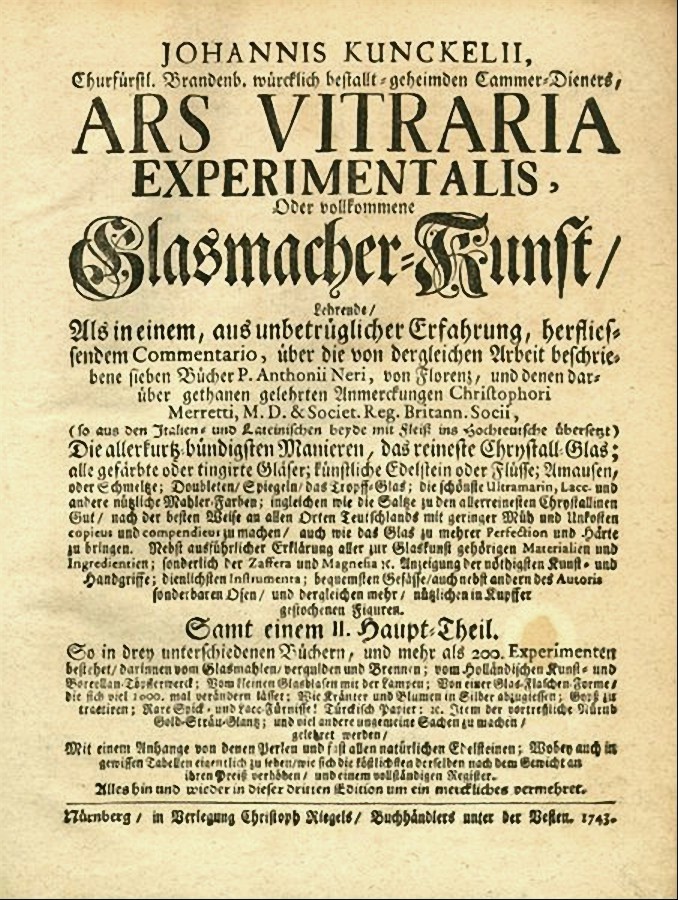
A gathering and mingling of early Kunkel families talks about our first notable figure, Baron Johann Kunckel von Löwenstern, a German chemist. Around 1678, he replicated Hennig Brand’s discovery of phosphorus isolation. Kunckel later managed the laboratory and glassworks in Brandenburg as a court chemist and apothecary.
Ars Vitraria ExperimentalisJohannes Kunckel, Ars Vitraria Experimentalis, 1679
The illustration by George Smith from his 1738 chapter “The art of blowing glass in miniature” (fig. 3) is not labeled alphabetically, but Johannes Kunckel’s 1679 engraving (fig. 4) is:
A — table around which four people may work at once
B — the lamp, filled with oil and a strong cotton wick
C—the hole where the tapered blowpipe is attached . . . so that the air is directed onto the acute and concentrated flame, producing a flame that will melt glass. Goldsmiths have a similar system for soldering metal.
D — bellows attached to pipes of tin that are hidden under the table
E — lever, attached to the foot pedal
F — ventilation hood
G — foot treadle for the bellows, pressed by the worker
Left: Probably engraved by Gottfried Spiller (1658–1728). Covered goblet with “Fruit Children,” before 1700. Gold ruby glass, H. 9 1/8 in. (23.1 cm). Focke-Museum, Bremer Landesmuseum für Kunst und Kulturgeschichte, Bremen (68.253). Center: Ruby glass flute with “AR” monogram, around 1715. German, Dresden. Gold ruby and transparent glass (blown, cut), H. 23 cm. Green Vault, Staatliche Kunstkammlungen Dresden (IV 228). Right:Covered goblet, 1725–35. German, Potsdam. Transparent dark gold ruby glass (blown, cut) 10 9/16 x 3 5/8 in. (26.9 x 9.2 cm). Corning Museum of Glass, Corning, New York, Bequest of Jerome Strauss (79.3.318) Gold ruby glass was perfected through alchemist and glassmaker Johann Kunckel’s experimentation under the patronage of Frederick William, Elector of Brandenburg, at the elector’s glassworks in Potsdam. Its name comes from the addition of colloidal gold to the glass before melting, a complex operation that required the skills of both alchemist and glassmaker. Displayed in a Kunstkammer, glass pieces served as signs of the alchemical knowledge required to produce them.
~ ~ ~ ~ ~ ~ ~ ~ ~ ~ ~ Continue Reading If You’re Interested in the Kunkle Line.
Our Kunkles trace back to my grandmother, Hilda Leonore Kunkle. However, I don’t have any personal stories to share as I didn’t know my dad’s family. I gained most of my knowledge later in life through my siblings, letters from my Aunt Elva (Hilda’s daughter), and documented facts and history shared by others.
Hilda married Glen Henry Logan in 1921 in Indiana County, Pennsylvania. Her father was Charles J. Kunkel. You’ll notice how the name is interchangeable with the -el and -le. He married Carrie Morrison in 1892. Charles lived most of his life in Westmoreland, Pennsylvania, until his wife died in 1937. He then moved to Michigan to live with his daughter, Hilda, and her family until his death in 1948 at the age of 82.
Charles’ father was Michael Kunkle. He also grew up in Westmoreland, Pennsylvania. In 1860, Michael married his neighbor, Esther “Hettie” Hawk. They were Lutherans, and Michael worked as a carpenter before becoming a farmer for the rest of his life. Michael passed away at the age of 80 in 1918 in Westmoreland.
Michael’s father was Daniel. They lived on Michaelsburg Plantation, a 336-acre estate owned by a family member. His family was among the First Families in Hempfield Township.
Some family stories were recorded in the History of Westmoreland County, Pennsylvania by Boucher, John Newton; Jordan, John W. (John Woolf), 1840-1921, joint editor. Publication date 1906. Publisher New York, Chicago, The Lewis publishing company. Contributor Allen County Public Library Genealogy Center
Daniel married Mary Elizabeth Kepple, and they had a son named Michael. They moved from Westmoreland to Indiana, Pennsylvania, where he worked as a railroad lock tender. Unfortunately, Elizabeth passed away about 10 years later. After her death, he married Catherine Iseman in 1844, but she died of cancer in 1850. In 1852, Daniel married Sarah, whose last name is unknown. It is still unknown when Daniel passed away, but it is confirmed that he was alive at least until 1870, as he is listed in the census at age 66 and still working for the railroad.
I’ve been putting off delving into the Kunkel family, but now things are more interesting. The first names in the family often begin with Johann for boys and Anna or Maria for girls. I’ve had to redo my Kunkle family tree twice because I initially followed the wrong line. However, thanks to the help of other researchers, Vernon Cook and James Kunkle, I am now back on track.
Daniel’s father is Johann Jacob Kunkel (Gunckel), Jr. It is in this generation that the Kunkel and Gunckel names are interchangeable. He married Elizabeth Schaeffer in 1789 and had 10 children. My records indicate that he was a farmer, and his cause of death was “gravel.” After researching old terms for the cause of death, “gravel” seemed to refer to the modern equivalent of kidney stones. He is buried in Brush Creek Evangelical Lutheran Church Cemetery.
Johann Jacob’s father is Johann Jacob Gunkel, Sr. His father is our immigrant ancestor of this family. He was born in Breitenburg, Germany in 1746, and they immigrated in 1749 when Jacob was only 3 years old.
Tom writes, One of the first known settlers in Pine Grove area after the French and Indian War, 1689-1763, Great Britain Battles France over unsettled territories in N. America, was Jacob Gunkel. He was located on the site of the Eagle Hotel in 1771. Here, he laid claim to a tract of two hundred acres of land, which he subsequently purchased from John and Richard Penn, proprietors of the Colony of Pennsylvania, which included the site of the present borough of Pine Grove. The convergence of several roads on Gunkel’s plantation made it an excellent location for a tavern, and soon after he purchased the land, he erected a log building, Gunkel’s Tavern, which he kept till 1810 and then he removed to a farm about a mile south from the borough were he died in 1813. His property was located next to the property of his daughter Eva and husband Johannes Loffler.
Another source states he “kept a house of entertainment, and in 1795 opened a store which he kept until 1810. (Source: History of Schuylkill Co, PA, by W. W. Munsell & Co, – 1881). On May 21, 1810, Jacob Gunckel of Pinegrove Township, Berks Co, PA, yeoman, and Susannah, his wife, sell to John Gunckel, yeoman, for 255 pounds, land containing 235 acres, part of the larger tract of land called “Gunckel’s Farm.” (Deed book 24, page 488).
Cemetery records for St. Peter’s (Gunkle’s) Union Church of Pinegrove Township, Schuylkill County include the following references: Jacob Gunkel; born September 28, 1746; died September 2, 1813 Eva Lefler; born Mar 25, 1809; died Jun 21, 1841 Johannes Leffler; born Jul 5, 1764; died Aug 16, 1849; son of Gottfried, Mahanoy Twp., Northumberland Co. Eva Lofler (nee Kunkle); w/John; died Jan 26, 1857; 83y 11m 15d
Gunkel’s Cemetery, located across the street from St. Peter’s Lutheran Church, contains a memorial plaque that reads: Site of the 1st Reformed-Lutheran Church 1782-1817 Donated by Jacob & Susanna Gunkel
Joh. Jacob’s father was Johann John Gunkel, born in 1722 in Breitenborn, Germany. John Gunckel married Anna Margarethe Lorentz and arrived in America in 1749 with his young son. In the book “Naturalizations of Foreign Protestants in the American Colonies,” there is the following: “John Gunckel of Bethel Twp., Berks County, Pennsylvania, became a citizen 20 September 1761.” These naturalizations were performed at the Philadelphia County, PA Courthouse. https://archive.org/stream/naturalizationso24grea#page/75/mode/2up/search/gunckel
Johann has often been confused with Johann Michael Gunkel, who was the same age. They were first cousins from Breitenborn and used similar names for their children. They also attended the same church. By the way, Johann (John) also had a brother named Johann Jacob. Talk about confusing!
John is also our Revolutionary War ancestor. His SAR Patriot number is P-171729. The John Gunckel of Bethel Township, who performed Revolutionary War service and from whom we are descended, was enrolled in 1777-1779 in the First Class, Captain Valentine Shoufler’s Seventh Company, First Battalion, Lancaster County Militia. He was assessed 26 pounds in fines, according to the evidence of an undated list of Class Fines. (Pennsylvania State Archivist, Military Accounts (Militia), Records of the Comptroller General, at the Division of Archives and Manuscripts) Larry Patrick Cornwell, 138085, has a SAR-approved supplemental under this John Gunckel. Larry served as the Genealogist General of the National Society, Sons of the American Revolution from 2011-2014 (www.sar.org)
John died in 1795 at the age of 73.
John’s father was Lorentz Gunkel, born in Breitenborn, Germany. He immigrated to the US in 1751 on the ship the “Duke of Bedford” with wife and one child, from Rotterdam, and last from Portsmouth, England. Port of entry was Philadelphia, PA, on a Saturday. Records show that Lorentz settled first in Northampton Co, PA, and later pioneered in Allegheny & Westmoreland Counties, PA. He was a Revolutionary War soldier and a pensioned veteran. *(Record Sources: 1804, pg 335 (Supp. 1983) aud 9041, pg 459 (From Flörsbach, Germany).
Lorentz wed Anna Catharina Gundlach in 1709. It’s uncertain who the “young child” who immigrated with them is. However, it could be our ancestor, Johann Jacob, as he was born in 1746.
Lorentz’s father was Hans Gunkel, who was born in Neuhütten, Spessart, Germany, in 1636. He was known as a Catholic man. He married Margareth N. and worked in a “glass house.” They later moved to Breitenborn, where Hans was invited by Heinrich Gundlach, the headmaster of the Breitenborn Works, to recruit glass makers from all over the country in the 1670s and 1680s.
When I originally published this post, a cousin replied, introducing himself. He also stated, “I do not believe that anyone actually lived in a “Glass House” I believe that this is simply a misinterpretation of the translation of Neuhutten. The Huts of glass were simply the buildings that were constructed… or the kilns… that were used to make the glass. These kilns were made of bricks so they could be brought to new areas where the resources (forests) were over-exploited to the point that they had to move to continue to be able to make glass. When they relocated to the area of NeuHutten they simply called it that “New Huts”.”
Hans Kunkel was a skilled glassblower, and many Kunkels were known for their glassblowing skills all over Europe at that time. Gundlach, an entrepreneur, made efforts to recruit the most talented glassblowers to come to Breitenborn. It is impressive that Hans Kunkel was still very productive in the 1680s. For instance, between January 4, 1684, and November 26, 1685, at around 50 years old, he produced 42,300 drinking glasses of various types and earned 91 fl. 16 alb (the equivalent of the dollar in those days). In addition to blowing glass, he occasionally attended the furnace, an important task for maintaining proper temperatures during the melting process.
During the winter months, the furnace stayed cold. The production period was 9 months per years – max. During the winter months, most of the works the people were also engaged in was cutting the firewood (beech and oak) for the furnace which did eat up a lot during the production period. So additionally they had another income. There were over 20 men permanently assigned to the fire wood cutting and handling, plus the seasonal ones. Hans Kunkel, for example, made 83-1/2 Clafter (7’x7’x3′) and earned 25 fl. additionally in 1689.
Despite all the hard work, Hans Kunkel lived to be nearly 100 years of age. There is a lot more similar data available, basically showing production figures, earnings, how they were paid (normally 50% cash, and the other in natural things, like grain, flour, etc. and the beverages, like beer and brandy were also brewing there.)
(Above Source: – “Heinrich P. Göbel” – Germany Researcher. (1994)
Hans’ father was Johann Michael, born in Glasshouse, Germany about 1600. He married Anna Katharine Naumann. He died in 1676. There is not much else known about him.
The Kunkels were already living in Neuhutten before the Thirty Years War. It seems that Neuhutten and that part of Germany were already in the Lutheran camp. The Kunkels all seemed to have been born, married, and died in “The Glasshouse” in Neuhutten.
Joh. Michael’s father was Johannes Jurg, born about 1565. He married Elisabeth Christina Houser.
The Kunkel family still live primarily in the Spessart Mountain range area, which is a mostly wooded region in the heart of Germany. There is a historical mention of an early Glasshouse in the Spessart area dating back to 22 August 1349. During that time, the area was under the jurisdiction of the Archbishop of Mainz.
The Union Letter (Bundesbrief) of 1537 (or the Federal Charter or Letter of Alliance) lists two KUNKELs, namely Jurge (George) and Hentze Kunkel, and in a later revision dated 24 February 1559, again two KUNKELs – George and Friedrich Kunkel. There are links, as glass-making was only carried down by the same families.–Janet and Robert Wolfe Genealogy, “Notes for Johann Jurg Kunkel and Elisabeth Christina Houser” Webpage: www.umich.edu/~bobwolfe/gen/mn/m6413x6414.htm Email address: JanetRobertWolfeGenealogy@gmail.com Go to the Genealogy Page for Johann Jurg Kunkel Go to the Genealogy Page for Elisabeth Christina Houser Go to the Kunkel surname index. Go to the Houser surname index. Go to the Home Page for Janet and Robert Wolfe Genealogy
Much research is still needed to fill out all the missing information; however, I have been told that genealogy records beyond this point are next to impossible to find due to all the wars that took place in this country. The Thirty Years War (1618-1648) destroyed many church records throughout Germany. So many records have been destroyed, and finding a cemetery with headstones that can be read after 500 years would be impossible.
All Kunkels do not accept the “dweller by deep water” definition of the name. Other research has yielded another possibility for its origin: It seems to derive from the Old High German name “KUHN,” meaning “wise.” (In this case, such a compliment would make it acceptable.) GUNKEL probably refers to living in deep water. In German, KUNKEL means the part of a spinning wheel called the distaff. A staff on which fibers such as flax or wool are wound before being spun into thread.
As you study the descendants of these families, you will find that intermarriages were rather common. Men had limited ways to meet eligible mates and could usually not go farther than they could walk or ride horseback to court. When there were family get-togethers, they met women who just happened to be related in one way or another. (James E. Kunkle- 2000)
Joh. Jurg’s father was Hans. Hans was born about 1530 in Glasshouse, Germany. He married Anna Catharina Wolfgang in 1554. Hans Kunkel of Neuhutten was called “Schwarzkoph” in the Parish records. Meaning “Black Forest.”
Some show Claus Kunkle, born 1490, as Hans’ father, and Conrad, born 1460, as Claus’ father, but I do not have sources to back these up.
The Coat-of-Arms of the Kunkel, Kunkle, etc., family is recorded in Rietstap’s Armorial General (Pg. 1144)
This link is one of James’ first works on the Kunkles and contains a lot of interesting information, from their Coat of Arms to their superstitions to their culture, customs, and rituals. Conkle/Kunkle File #1
While I couldn’t find exact Kunkel glass other than the original Johann’s, I did find some drawings of the glassblowers’ working areas in that century.
Glass blowing, from a Book of Trades, 1542 (engraving), German School, (16th century) / Private Collection / The Stapleton Collection / The Bridgeman Art Library
There is still much to learn about certain individuals in this family, and I hope to contribute to James and Wallace’s wonderful work. RIP, guys! You left a wonderful legacy for all of us.
Glass furnace, with workers. Georg Agricola (German, 1494–1555). In De re metallica [Berckwerck Buch, Frankfurt-am-Main, 1580, p. cccxc]. Rakow Research Library, The Corning Museum of Glass (66820). Photo: The Corning Museum of Glass. Read more at https://www.cmog.org/article/lamp.
If you need research assistance, do not hesitate to contact me.
Your Family
Tree Research Specialist
As an Amazon Associate, I earn from qualifying purchases.
So, witches run in my family. Why doesn’t that surprise me?
Susanna (née Clark) was the wife of Josiah Rootes (1613-1683). Josiah Rootes, originally from Great Chart, Kent, England, was a passenger on the Hercules of Sandwich, under the command of Captain John Witherley. The ship was bound for “the plantation called New England in America” in the spring of 1634/5. Josiah, along with his mother and brother, migrated to America and was instrumental in founding the Beverly Church.
Josiah had taken the oath of allegiance and supremacy at Great Chart and received his certificate from Robert Gorsham, curator of Great Chart, on 20 March 1634/35. The Hercules of Sandwich is probably the same as the Hercules of Dover mentioned by Winthrop as being here in the summer. ~~Samuel G. Drake, Result of Some Researches Among the British Archives for Information Relative to the Founders of New England: Made in the Years 1858, 1859 and 1860 (n.p.: H.W. Dutton and Son, Printers, Transcript Office, 1860; reprint Baltimore: Genealogical Publishing Co., 1963), 84.
On June 25, 1678, Josiah made a sworn accusation of thievery against William and Elizabeth Hoar. He claimed the family had stolen (clothing, apples, wood, and hay) from him for nearly twenty years, and he had only just discovered proof – in the form of Goody Hoar’s apron.
When several neighbors came under suspicion of receiving stolen goods from Mr. Hale’s maid, Margaret Lord, Josiah Rootes complained to the court in a written statement that “for neare twenty years together we haue ben Aflicted by hauing owr goods stollen At sundri time And we not Abell To make due profe haue ben forsed To sufer owr seuellfes To be wrownged in estat And name: And god by his prouidens hauing latlie discouered sum of Theas wokes of darknes wee Judg yt. To be owre duty To speake in vindicasion of Truth and Conuictccion of sine…. He deposed in Salem Court that same month, aged about 65, and again, aged about 60, as did his wife “Susanah Roots, aged about forty-eight years…”
Their son, Jonathan Rootes, aged about thirteen years, affirmed…” Among those who testified were Abigell Stone, Jr., Abigall Ston, Jr., John Lovet, Jr., and Bethiah Lovet (Sussanah’s daughter).”
That same day, Susanna first appears on record: Susanah Roots, aged about fifty-three years, Mary, wife of Heugh Woodbery, aged about forty-eight years, and Sarah Roots, aged about twenty-four years, deposed that about two months ago they saw Mary, wife of Samuell Harres and Tabitha Slew carry a parcel of small linen into Samuell Harris’ house.
Five years later, in the spring of 1683, Josiah Rootes passed away. He named Susanna as the executrix of his will and stipulated, “…my loveing wife Susanna [have] the use & improvement of all my small estate, what ever untill such time, as my son Jonathan cometh to the age…” and if she did not remarry, “[Jonathan] shall pay unto her, his said mother eight pounds, [yearly] duerring the terme of her widdowhood, or her natural life, and let her have the use of the west end of my now dwellinghouse, of a bed, beding, her firewood brought to the doare [door].”
For the period, this is an appropriate provision for a wife who worked land, maintained a household, bore and nurtured six children. Josiah’s specification that Susanna have the sunny west-facing room with cozy bed and fire burning is lovely and fitting after 40 years of toil at his side. –Poor Irish & Pilgrims. New World Shoots from Old World Roots.
Inventory of the estate of Josiah Roots of Beverly, who deceased June 3, 1683, taken by Samuel Corning, sr., and Andrew Elliott: one coverlaide, lOs.; 1 bed ticking, iSs.; coverlaide, ili.; 4 yards of red Cloth at 6s. per yard, 21i. 4s.; 7 yards of Lining Cloth, ili. 8s.; 4 yards of Dowless, 8s.; 4 yards and 1-2 of kerzey, ili. 6d.; New England money, 71i. 8s.; old England money, 16s., 81i. 4s.; 2 yards of broad Cloth, ili. 2s.; 1 yard & 1-2 of broad Cloth, 18s.; 2 yards and 1 quarter of Red Cloth, 155.; 1 Carpet, lOs.; 11 yards of sarge, 21i. 4s.; 7 yards of white Cotten, 14s.; 1 Chest, 2s. and his woolling wearing Cloths, 51i. 5s.; and his wearing Linning, ili. lOs.; 61i. 17s.; 6 yards of kerzey, ili. 16s.; 4 yards and a quarter of kerzie, 31i. is. 6d.; 3 yards of Lining Cloth, 55. & 1 hatt, 45. 9s.; 8 pair of sheets for beding, 41i.; bed and its belongings, 41i. lOs.; 1 bed and 2 bed steads with other furniture, 5 li.; 1 bed with its furniture, 21i. lOs., and other Lumber, 31i.; 3 chests, ili. 2s.; 1 Table and 3 Joint stooles, 1 Table, 18s.; Cushions, 6s.; 1 Little Table, 4s. 21i. lOs.; 2 Chairs, 3s.; pewter, 21i.; brass & Iron, ili. 13s., 31i. 13s.; I Cart & wheels, plowghs & plowgh tackell, 41i.; 1 sled & 4 axes, 6s.; 3 hoes, 3s. 9s.; barrell, Tubs and other Lumber, 12s.; 3 other Tubs, 2s. & 2 spades, 55. 7s.; 1 horse, 2li. lOs.; parcel of shingles, ili. 55., 31i. 155.; 10 thousand of shingle nailes, ili. 105.; 2 oxen, 71i. & 4 Cows at 121i., 19 Ii., 2 Steeres, 41i. los.; 19 Sheep & Lambs at 3 Ii. 19s., 81i. 9s.; houses, land and orchard, 2601i.; 6 Acres of meadow, 301i.; 5 swine, lOs. per, 21i. lOs.; total, 3841i. 19s. Several debts, 191i. 8s. 3d.
In his will dated 15 May 1683, Josiah Rootes, “of the town of Beverly,” leaves his entire estate to his son Jonathan, after settling legacies for his other children, Bethiah, John, and Thomas. He entrusts the management of his estate to his wife Susanna, whom he appoints as executrix until Jonathan reaches adulthood. After Jonathan comes of age, he is responsible for his mother’s support as long as she remains unmarried.~~ George Francis Dow, Records and Files of the Quarterly Courts of Essex County, IX: 66. 67.
On June 26, 1683, Susanna Roots, now a widow, renounced her role as the executor of her husband’s will in a Salem court. She stated that she had “many weaknesses and infirmities of old age” and, therefore, could not serve as executor.
The court appointed John Hill and Nehemiah Grover to bring in an inventory as soon as possible, and the inventory was sworn to on 6 July 1683. (Andrew Elliot, who would, in 1692, accuse Susanna Rootes of witchcraft, was one of the appraisers).~~ George Francis Dow, Records and Files of the Quarterly Courts of Essex County, VIII: 66, 6
Nine years later, as she approached her 70th year, she found herself being taken to Boston and thrown into jail with irons on a charge of witchcraft, which carried a sentence of death.
Accusing neighbors of theft in a close-knit community is a serious matter. It’s possible that friends of William and Mary Hoars, Mary Harres, and Tabitha Slew held a grudge against the Rootes family, or they might have been jealous of the Rootes’ wealth, leading to the accusations.
(Warrant for Arrest of Susannah Roots )
Salem May 21-1692
To the Constables of Beverly.
Whereas Complaint hath been this day made before us, by Sergent Thomas Puttnam and John Puttnam: both of Salem village yeomen against Susannah Roots of Beverly widdow for sundry acts of witchcrafft by her Commited on the bodys of Mary wallcott Abigal williams Marcy Lewis Ann Puttnam and others.
You are therfore in their Majesties names hereby Required to apprehend and forthwith bring before us Susannah Roots of Beverly widdow, who stands charged with Committing Sundry acts of witchcraft as aboves’d to the wrong and Injury of the bodys of the above-named Persons, in order to her Examination Relateing to the aboves’d Premises faile not Dated Salem May the 21’st 1692
John Hathorne
Jonathan. Corwin
[Pbar ]r order of the Govener & Councell
To the Marshall of Essex or his Deputy vera Copia attest
May 21 — 1692
*Geor: Herrick Marshall of Essex
I doe apoint mr Jonathan Biles to bee my Lawffull Deputy to serve this warrant
*Geo: Herrick Marshall of Essex
(Reverse) I have prosecutted the within written warant and have apprehended the person of the within mentioned Suzannah Roots and Brought her befour awthority. 23: may 1692
An information if it might be any help in the examination of the person before you goode Roots I being in the house of Mr Laurence Denni’s some time since she was suspected for what shee is now before you & there was Likewise Leonard Austen of our Town of Beverly s’d Austen then s’d that he thought she was a bad woman, his reason was that he Living in the house with s’d Roots not Long since and when he went to prayer at any time with his wife & thought s’d Roots would acompany them in s’d Duty but Did not at any time but would withdraw & absent herselfe: & further when my self were gone to bed & she unto her bed. she would rise in the night & we Could hear her talk in the roome below I lying in the Chamber over s’d roome as if there #[there] were: 5: or six persons with her more s’d Austen might speak if caled thereunto as far as know more concer[n]ing Roots
Susannah was eventually released, but while she was in prison, her grandson John Lovett III visited her and gave the following deposition about his conversation with Dorcas Hoar, another prisoner:
The depersision of John Lovet aged about 25 years this deponant tetifieth & say that he the s’d deponant sume time in June last past went into the prisan to see my gran mother then goodee hore asked me the s’d. deponant whether I knew of any witnesses that would Come in or be brought in against hear.&.I the s’d deponant told her I did not know of any and then the s’d. hore asked me whether goodman witreg would not Come in against her about his Cow I the s’d debonant tould the s’d whore I did believe he Would the s’d whore replyed she did not know that he had ara Cow, furder saith not
Supposedly Susannah was released due to insufficient evidence but died less than a month later. Susannah ended up in the care of Ambrose Gale after Josiah died since she had no known family members who survived her. However, the arrangement was not without a business-like aspect. In June of 1684, the court ordered that Susannah’s inheritance should be given to Gale to reimburse him for expenses. It was agreed that with the transfer of her assets, Gale would care for her for the rest of her life. (Note: Susannah was the mother of Ambrose Gale’s deceased son-in-law, Thomas Rootes, husband of Elizabeth Gale. Not much is known about how she died. Maybe her decline in health and the conditions in jail made her too weak.
A student essay submitted in the UK states an interesting theory:
“Some of the witches like Susannah Roots were also accused for entertaining people late at night or adultery, but just because they did those kinds of things did not mean they were looking for power or attention from the whole town, but from the people they did it with. What we know now that did not know then is that the accused must have had been sick in some way or form. We can conclude this with the fact that the symptoms of witchery are the same symptoms as the Encephalitis Epidemic that accrued in the early 1900s to the mid-1900s.” https://www.ukessays.com/essays/history/salem-witch-craft-hysteria-history-essay.php
Browsing the homepage of my Ancestry database reveals upcoming birthdays and anniversaries, including both marriages and deaths. August 3rd was the anniversary of my 3rd great-grandfather, Mathias J. Chapman, passing away on my mother’s side. As I reviewed his details, I realized I had very little information and couldn’t recall the last time I had researched about him.
As I reviewed my information to verify its accuracy, something caught my attention. First, he had served in the Civil War, and second, he had been incarcerated as a “rebel deserter.” His imprisonment took place at Fort Mifflin in Pennsylvania. 1 I knew I had to dig into this further!
Peggy Seymour possesses a family bible that indicates Mathias was born approximately in 1841 in Spotsylvania, Virginia, to Herman and Ann Chapman. (Peggy and Barbara are the daughters of Ellen Seymour, who is my great-grandmother’s first cousin on her father’s side.) Mathias married Sarah J. Crutchfield in Goochland, Virginia, on January 4, 1861, at the age of 19. The bible also notes that Mathias and Sarah had a child in 1862, but unfortunately, the baby passed away the same year.2
Mathias joined the Confederate Army during the Civil War on August 29, 1861. Historical records indicate that he had a fair complexion, blue eyes, and sandy hair. He stood 5 feet 9 inches tall. According to NARA records, he completed his service in October 1862 and transferred to the Virginia King William Light Artillery Battery. He mustered out again on December 15, 1862, and once more on January 15, 1863. On June 20, 1863, he was categorized as a “rebel deserter” and was imprisoned at Fort Mifflin until his release on November 17, 1863.
The NARA has “Descriptive Book of Arrested Deserters” ledgers, but the one he would be in is not online. I am waiting for the NARA to get back to me with their information on him. These books usually have descriptive information, so I hope they tell me more.
Update 6 Sep 2024: From the NARA via email:
The National Archives does not have Confederate pension files in our custody. Pensions based on military service in the Confederate States of America were authorized by some Southern states, but not by the federal government. To see if a former Confederate or his widow received a pension, contact the state archives of the former Confederate state where the veteran or his widow lived after the Civil War.
Confederate records that are in the custody of the National Archives are located in Record Group 109 War Department Collection of Confederate Records. These records are incomplete, due to the hazards of war and the destruction of records at the end of the Civil War. RG 109 consists of records that were captured by, or surrendered to, Union forces during and at the end of the Civil War, as well as records that were later donated to, or purchased by, the U.S. War Department.
Fort Mifflin held three kinds of prisoners: Confederate prisoners of war, Union soldiers, and civilians. The prisoners were held in the Fort’s three largest casemates or bombproof shelters.
The same gentleman who emailed me also sent me his Oath of Allegiance.
The oath of allegiance probably refers to a list of prisoners in Fort Mifflin, Pennsylvania, who signed a document indicating that they had taken the oath of allegiance. This document is located in RG 109 Entry 199 Records of Confederates in Union Prisons, under Pennsylvania. Although the National Archives is not appropriated to provide free copies of records in our holdings, because the number of pages involved is small and because the series is not available on microfilm or in digital form, we have made a one-time exception. A complimentary scan of the endorsement page and of the page where Chapman signed his name is attached.
In July 1863, Fort Mifflin started to accommodate Confederate prisoners of war taken during the Battle of Gettysburg, which occurred from July 1 to July 3. At its highest occupancy, the fort held up to 216 Confederate POWs in its largest casemate. Their time at Fort Mifflin was short-lived, as many were eventually moved to larger facilities like Fort Delaware, or they were released after pledging allegiance to the United States. 3
According to the records, Mathias’s desertion coincided with the birth of their child. The family Bible also notes that his wife, Sarah passed away in 1863.
While Mathias was stationed at Fort Mifflin, a significant skirmish took place in Hagerstown, Maryland. Already an important center for trade and transportation, Hagerstown would later be instrumental during the Civil War. In July 1863, while Mathias was still imprisoned, Hagerstown played a key role in the Confederate army’s retreat from Gettysburg. Following the Union victory at the Battle of Gettysburg, General Robert E. Lee and his troops aimed to cross the Potomac River into Virginia. Union cavalry, led by General H. Judson Kilpatrick, attempted to intercept the Confederate forces and engaged them in Hagerstown. Lee had established a garrison in the area to protect their rear. The subsequent Battle of Hagerstown lasted seven hours, involved around 2,000 soldiers, and resulted in close to 200 casualties.4 Interestingly, being labeled a ‘rebel deserter’ and becoming a POW may have ultimately saved Mathias’s life.
My great-grandmother’s notes indicate that he served as a drummer boy during the Civil War, but there are no documents to support this claim. They only show that he was part of Light Artillery units, although it’s possible he served in both roles.
One year after his release from Fort Mifflin, he married my third great-grandmother, Mary Isadore Burns, in Hagerstown, Maryland, just over the border from Pennsylvania. Their wedding took place at Saint Paul’s Methodist Episcopal Church (now John Wesley United Methodist Church) and was officiated by Rev. George W. Heyde. 5 Mathias worked as a brick mason, and they welcomed three sons while living in Pennsylvania. In 1872, the family moved to Virginia, where they had three more sons and one daughter.
By 1896, Mathias was serving as the superintendent of Cedar Grove, Elmwood, and West Point cemeteries, and he was later elected as the “Keeper of the Cemeteries.”
In 1894, he was elected to his present office, and he has fulfilled his duties in an able manner that leaves no room for criticism. Under his supervision, great changes have taken place. Under his care, great attention has been given to the cemetery grounds, and they have been kept neat and beautiful, a fact that is appreciated by all those who have loved ones there entombed.Mr. Chapman is well in touch with his fellowmen and is a member of K of P Lodge No. 56. Vandalia Lodge No. 57. I. O. O. F. No. 79, Orinoco Tribe, I. O. Red Men; Palestine Tent No. 40, Rechabites, and Friendship Council No. 4. Chosen Friends. He has intelligent plans for the further improvement of the cemeteries, and his past efforts for the public good should entitle him to a continuance in the office. All of the property in his care is well kept, and a special improvement is noted in the West Point Cemetery. When he went into office, he found that place overgrown with weeds and the branches choked with underbrush. The weeds have been removed, the underbrush cut away, and the cemetery is now a neat, well-kept, and slightly place, that is a credit to Norfolk.6—
Mathias passed away from a stroke at 11:00 a.m. on August 3, 1898, at the age of 56, in Norfolk, Virginia.7
Google is a valuable tool for genealogy research, providing access to various resources and information. Here are some tips for using Google for genealogy:
Specify Your Search
Identify what you want to find. Formulate your question to Google just as you would to a research librarian or archivist.
Use Search Operators
Use quotation marks to find exact matches. (You don’t need to put around the whole sentence. For instance, Where is the “National Dairy” in “Butte”)
The word “AND” includes multiple words or phrases. How do you tell the search engine that you want to find Web sites that contain references to Keyword A and Keyword B? (Coal and Mines)
The word “OR” combines searches. It is beneficial for finding synonyms or related concepts. Using “OR” allows you to conduct multiple similar searches simultaneously, saving time.
Placing a tilde character (~) immediately in front of the keyword. asks Google to find pages with the word or words similar to it. The resulting pages for ~genealogy may include genealogy, family tree, roots, ancestry, heritage, vital records, or other words.
Use the minus sign (-) to eliminate keywords. The minus sign is just a hyphen in front of a term you want to have excluded from the search results. For example, if you were looking for a salsa recipe, you might search for salsa and discover multiple definitions. There’s the dance. There’s the music. Don’t forget the food. By using -dancing or -music, we can focus solely on salsa recipes: salsa -dance -music. Or, if you do not want onions, add -onions.
Don’t use “stop words.” Google often ignores small, commonly occurring words, such as ‘the,’ ‘at,’ and ‘of,’ and refers to them as stop words. When we search The Great Wall of China, we get about 471,000,000 results. By searching Great Wall China, we get about 815,000,000 results. And if we use the parenthesis around “The Great Wall of China,” we only get about 5,570,000 results.
Use 3-5 keywords for the most relevant results in a search query. Using too many keywords will limit your results.
Google Alerts
Google Alerts enables you to set up multiple keyword searches to track specific information for free. It allows you to monitor any keyword or phrase you like without manually entering it.
Use Google Maps
Select a location and then use the “find businesses” tab to identify points of interest like churches, cemeteries, and historical societies. You can also see the surrounding areas.
Use Google Earth
Discover your ancestors’ hometowns, see how they look today, and locate nearby buildings, schools, and churches. You can also utilize Google Earth Pro to generate personalized maps of your ancestors’ surroundings. Click and drag the image to take a virtual walk down the street where your ancestors once lived.
Use Google Images
Google Image Search will display photos with a brief title and website address when searching for ancestors’ names, surnames, or places they lived, including nicknames or abbreviations. It provides exact matches and visually similar images based on your uploads and critical phrases. Clicking on a result will bring up a pop-up with more details about the image, potential copyright status, and a gallery of related photos.
You may also want to try Google’s Reverse Image search. This technique uses a photo rather than text to search Google.
To perform a reverse image search on Google, follow these steps:
1. Go to Google.com and click the “Images” link in the upper right corner.
2. Click on the camera icon in the search box.
3. You can drag and drop a photo from your computer onto the Google Search page or click “Upload” to select an image from your computer or mobile device.
4. Review the search results page for the related images and information.
Use Google Photos
You can create, edit, and add maps and text to your photo albums, containing up to 20,000 photos or videos. You can organize your albums by family, surname, individual, or event and label them with relevant information.
Google Books (One of my favorites!)
You may already know that Google Books will keyword search within billions of pages of text in published books worldwide. Some of these books are even available to read on the site. Searching Google Books can lead you to facts, stories, new sources for your research, and even images. I’ve found many ancestors this way.
Google News Archive
Google News Archive is no longer actively digitizing and indexing newspapers. However, it can still help you find online content for specific newspapers. You can access an alphabetical listing of newspapers and enter keyword searches in the search box on the webpage for all the newspapers listed there.
Google Scholar
Google Scholar is the go-to resource for accessing scholarly articles, theses, dissertations, and other academic sources. It specializes in searching for high-level academic content. You can find specialized content on Google Scholar, such as biographies of little-known ministers or histories of small towns.
As an Amazon Associate, I earn from qualifying purchases.
Have you heard of rabbit holes in genealogy? They are more common than anything else in genealogy. Imagine you’re researching Aunt Betty and discover that her famous strawberry pie recipe is now made in several bakeries nationwide. To understand how Betty achieved this success, you delve deeper into her family history.
.
Made with Microsoft Designer AI
You find that her uncle was a chef at a popular restaurant in New York, so you start exploring his family background. It turns out that their family owned a farm and grew all their food. Betty’s uncle’s mother taught all the boys how to cook using the produce from their garden.
.
That’s a rabbit hole. We neglected poor Aunt Betty while we went on our adventure, similar to Alice in Wonderland.
.
Stop getting distracted by unexpected genealogical discoveries. Have a plan.
.
Before beginning your research, write out your research question or statement. Writing it out will help guide you and keep you on task.
Break your primary research question down into more minor, individual research questions. Be specific in the question.
.
Analyze what you already have. Start with what you know: Work from the known to the unknown.
.
Remember to take notes: Write down key findings and questions as you go or after you have finished. You might forget what you’ve learned if you haven’t anything down.
.
Use a separate notebook: Keep a notebook for your research facts, and always record the source. Recording the source will make it easier to add more details later. If you are going astray, write down what you found and then return to your main question.
.
Set a timer: Keep track of how much time you’re spending on your research.
.
I don’t avoid rabbit holes, but it is much easier for me to get back on track when I do if I have a plan in writing to fall back on.
In April, a client contacted me seeking assistance with his family history, particularly regarding his father. This gentleman, in his 80s, had limited information about his father, who passed away when the client was just a teenager.
The client was aware of his father’s life from the time of his marriage to his mother onwards but had no details about his father’s earlier life. He only knew that his father hailed from Michigan and had briefly stayed in Canada to visit his brother, with little additional information.
I had been stuck for a while but then stumbled upon newspaper articles detailing minor run-ins with the police. Initially, I thought it was a case of mistaken identity with someone else sharing the same name.
Then, I found his birth record.
It turned out that he was actually born in Canada, not Michigan, which enabled me to locate him in the Canadian census records for 1891, 1902, and 1911. Although he visited his brother in Michigan in 1919, he returned to Canada in 1921.
Port Huron, Michigan, and the border town where he lived in Canada
Further research helped me discover a previous marriage. This was in 1924. Another surprise for my client. The Canadian marriage records from that period were remarkably detailed, even including their street address. This small town immediately caught my attention, as it matched the address in the census records and was the same neighborhood mentioned in the newspaper article I previously referenced.
In 1921, he was charged in a pedestrian accident, followed by a car theft less than a year later. Subsequently, I lost track of him. My next step was to investigate the first wife, but I hit a dead end, as they both mysteriously disappeared.
Around four weeks later, I stumbled upon a 1926 newspaper article from a Canadian newspaper that revealed this client’s father’s full name. The article mentioned his arrest in Tampa, Florida, on suspicion of fraud, and mentioned that he had a wife and child residing in Chicago, Illinois.
Not his actual records.
While processing this information, I wanted to ensure I was completely certain before approaching my client. I also needed more details. Upon revisiting research on the wife, I discovered her mother was from Chicago and her father from England.
Interestingly, the 1931 Canadian census indicated her father was widowed. Turning back to the US Census records, I found the wife living in Chicago with her mother and stepfather, which raised some questions.
Further investigation revealed that both Canadian and US census records indicated the wife’s mother was from New Jersey, hinting at a connection. Digging deeper into the wife’s mother’s background, I stumbled upon her parents’ 1921 Canadian census, where they were listed with two boarders.
Funnily enough, one of the boarders’ names caught my attention – the man her mother was married to in Chicago!
Are you following along so far? But wait, there’s more.
The census records indicated that the wife had two children living with her. It appeared that when he married in 1924, he had a daughter nine months later.
His son was born in Tampa in 1927, fifteen months after their daughter. I surmised from the dates that his wife was about three months pregnant when her husband was arrested in Tampa for the fraud.
In April 1930, his first wife resided in Chicago with her mother and stepfather. Although her marital status is listed as married, her husband is not recorded in the census.
Five years later, in 1935, his first wife and their children had remained in Chicago, residing with her “partner” and his mother. Her marital status is still listed as married. At the same time, her husband was serving a new prison term in Florida, this time on the opposite coast, for a period of ten months due to breaking and entering.
He married my client’s mother in 1937, and they had two sons together, staying in the area of his last arrest. Interestingly, in the 1940 US census, his first wife is still listed as married. Sometime following that, but before 1950, she tied the knot with her new partner.
Sadly, by the time I made my discoveries, all three of my client’s siblings had died. His mother died seventeen years before him hiring me.
This wasn’t the result we anticipated while uncovering the lost years of his father. Family isn’t just about the intriguing tales; it encompasses their complete narrative with all its highs, lows, and imperfections.
I hope reading this encourages you to explore beyond the obvious. Look into all those related families, friends, in-laws, etc.–cluster and collateral research.
Cluster research examines the “clusters” of individuals who lived in your ancestor’s community. This strategy places special emphasis on the friends, peers, neighbors, coworkers, and other community members who were part of your ancestor’s everyday life.
Collateral research investigates your non-direct-line ancestors. Though you may not share much DNA with your great-great-grand-uncle, records of him can lead you to records of your ancestor.
I am a participant in the Amazon Services LLC Associates Program, an affiliate advertising program designed to provide a means for us to earn fees by linking to Amazon.com and affiliated sites.
A couple of weeks ago, I received my jury notice. Yes, like you, I immediately rolled my eyes and groaned. But, as the date got closer, my curiosity got the better of me.
The first day was the narrowing of the jury, but it was very tiresome. The waiting around and the same questions were fraying my nerves, but I was one of the seven picked. The guards called us the “Lucky Seven.” We were to report to trial the next day.
The trial was going to be an interesting one. An assault case but not a cut-and-dry matter. I was excited to fulfill my obligation as an American citizen. Our court system has been tried this way for over 200-400 years, and I would be a part of that history. And, to think, it was only one year before I was born that women could even serve on a jury!
The trial lasted only one day. The whole process was fascinating. Not the interesting you see on television, but many of the same aspects, weighing evidence, hearing testimonies of witnesses, etc. The hardest part is not speculating or giving an opinion.
Yes, it is an obligation to serve, but it is also a privilege and an honor. I will not roll my eyes the next time I get a summons.
As an Amazon Associate, I earn from qualifying purchases.




![FIG. 39. Glass furnace, with workers. Georg Agricola (German, 1494–1555). In De re metallica [Berckwerck Buch, Frankfurt-am-Main, 1580, p. cccxc]. Rakow Research Library, The Corning Museum of Glass (66820). Photo: The Corning Museum of Glass.](https://i0.wp.com/i.pinimg.com/564x/4e/49/5e/4e495ec5a072d9bb33f6f130891e9660.jpg?w=840&ssl=1)


You must be logged in to post a comment.