Have you ever wondered where your Irish ancestors might have received their education? In a time when formal schooling was forbidden for many, a unique and resilient form of education emerged—one that defied the harsh penal laws of the British Crown. Welcome to the world of Irish Hedge Schools, where knowledge was passed down in secret, hidden away in the countryside, beneath the very hedgerows that gave these schools their name. Join me as we uncover the history of these remarkable institutions and the brave souls who kept the flame of learning alive in the face of adversity.
For about two hundred years, this was an illegal, informal, and unofficial local education system.
In the mid-1600s, Oliver Cromwell’s arrival in Ireland led to the outlawing of bardic schools (secular institutions.) Cromwell’s notorious reputation for the massacre of Irish people and the confiscation of their lands has made him an unpopular figure in Irish and English history. Cromwell referred to the bardic schools as popish schools due to his belief that they taught superstition, idolatry, and evil Celtic customs.
A few decades later, when William of Orange was the British king, the British enacted the penal laws. These banned Catholicism and banned priests, which, of course, prohibited the teaching of Catholicism, whether in church or school or anywhere else, for that matter.
In response to discrimination, communities began taking control of their education. This led to the developing of a network of informal schools, referred to as hedge schools, throughout the country. These schools were strategically located to avoid detection by local authorities ‘beneath the sunny side of a hedge’ and were run by schoolmasters who charged a fee for their services. Hedge schools provided instruction in various subjects, including Latin and Greek.
It’s believed that by the 1820s, Hedge Schools educated up to 400,000 students in 9000 schools. This remained in force until it was repealed in 1782. It wasn’t until 1967, with the Free Secondary Education Act in the Republic of Ireland, that secondary school education became open for all.
Because of the secrecy and illegalities, there are few records concerning these schools. Although you can scour the internet and find some teacher’s names in some places.
The story of the Irish Hedge Schools is a testament to the indomitable spirit of a people determined to preserve their heritage and educate their children, no matter the obstacles. While the records of these schools are scarce, their legacy lives on in the countless descendants who carry the torch of knowledge passed down through generations. As we reflect on this hidden chapter of Irish history, let us remember the resilience and ingenuity of our ancestors, who found a way to nurture minds even in the darkest of times.
With countless programs like FamilySearch and Ancestry offering quick hints and automated family trees, one is left to wonder: Why hire a genealogist or family history researcher when it seems so easy to trace your roots online? The answer lies not in the data itself, but in the stories, accuracy, and deeper connections that only an expert can uncover.
For one, they can help you find errors. These databases cannot always narrow in on your specific ancestor. Think about it: how many John Smith’s are there in the world? Reddit says there are 46,000 people named John Smith just in the U.S., while Whitepages.com says there are 33,031. Without some research, Ancestry or other databases cannot narrow it down to your one guy. A family history researcher or genealogist can also help you disprove details that you think are accurate but are actually incorrect.
Family history researchers can assist you in making sure your sources are reliable and reputable. Along with verifying the details in your tree, they can also assist you in finding the original source documents that support the facts for each member of your family, including parents, children, and dates and locations of birth and death.
In addition, because they have worked on numerous projects, genealogists are able to quickly determine the most effective strategy for your research. Through their access to specialized databases, professional colleagues, and personal libraries, they can also help you avoid wasting time and money on pointless research. This proficiency with available resources means we can quickly determine which repositories, collections, or databases are most likely to hold the answers you seek.
Genealogists and family history researchers can help you trace your ancestors, such as by discovering where your immigrant ancestors came from or researching a family line dating back to a specific time period. This can be helpful if you want to join a lineage society and need to prove that an ancestor participated in a historical event.
The majority of people who have dedicated time to researching their ancestry have at least one line that appears to be at an absolute dead end, or a “brick wall,” that they require assistance deciphering. Experienced researchers possess the knowledge and abilities needed to overcome challenging genealogical issues because they have experience solving them.
In order to confirm that the independent research you’ve done is accurate, you will want to engage the services of an expert. Perhaps the work of other family members has been passed down to you, or you’ve come across a lot of credible information online. but you’re simply unsure. An expert genealogist or family historian can examine your data, assess the reliability of your sources, and assist you in filling in any gaps in your records. If we identify a mistake in your tree, we can assist you in fixing it, so you don’t have to waste the next five years studying the incorrect line.
Once your family history narrative is complete, preserve your legacy. You can choose to have it presented in a binder or a custom hardbound book.
While online tools like FamilySearch and Ancestry offer a glimpse into your heritage, the depth, accuracy, and authenticity of your family history require the expertise of a seasoned genealogist. By hiring an experienced researcher, you’re not just piecing together names and dates; you’re uncovering the true stories, verifying the details, and connecting with your ancestors on a deeper level. A genealogist’s or family history researcher’s experience ensures that every branch of your family tree is accurately traced, every brick wall is meticulously examined, and your family’s legacy is preserved with the care and precision it deserves. When it comes to something as personal and meaningful as your heritage, entrusting it to a professional isn’t just an option—it’s the best decision you can make.
AI-generated image using Microsoft Designer with DALL-E 3.
For most of us, Pennsylvania played an important role in our ancestors’ history. Pennsylvania has been a destination for a wide range of immigrants, including Europeans, African Americans, and others. These individuals were drawn to the state because of its significant role in the nation’s development and its diverse industries. During the colonial period, Pennsylvania’s religious freedom attracted various ethnic and religious groups, such as Quakers, Mennonites, and Amish. Welsh Quakers settled in what are now Montgomery, Chester, and Delaware counties, while German immigrants developed their own dialect and eventually became known as the Pennsylvania Dutch.
Pennsylvania experienced substantial industrial growth, particularly in steel production, coal mining, and oil fields. This led to a large influx of European immigrants seeking employment, including individuals from Ireland, Germany, Italy, Poland, Scandinavia, Russia, and Slovakia. Moreover, the state played a pivotal role in the Civil War and served as a primary entry point for many immigrants.
The Pennsylvania Historical & Museum Commission was created in 1945 and is responsible for the collection, conservation, and interpretation of Pennsylvania’s historic heritage. Not only do they oversee the state archives, which you can visit in person or online, but they also have a wonderful museum section. These museums encompass Daniel Boone (he was born in Pennsylvania), the lumber industry, the mining industry, the railroads, and many others. They even have a “village & farming” museum. You can visit these in person or online as well.
In addition, check out PA History 2 G0, a series of videos produced by the PHMC, with funding from the Institute of Museum and Library Services. These short videos introduce you to Pennsylvania’s state-owned historic sites and museums as they explore the varied stories that make up the commonwealth’s rich history. Still, they have an online collection of historical objects, archaeological artifacts, and natural history specimens.
Pennsylvania’s rich history is deeply intertwined with the stories of our ancestors, who found in this state a place of opportunity, freedom, and growth. From the religious sanctuaries of the colonial era to the booming industries that shaped the nation, Pennsylvania has been a beacon for diverse communities and a witness to pivotal moments in American history. As we explore the state’s historic sites, museums, and archives, whether in person or online, we not only honor our heritage but also gain a deeper understanding of the challenges and triumphs that have shaped the lives of those who came before us. The Pennsylvania Historical & Museum Commission continues to preserve and share these stories, ensuring that the legacy of our ancestors remains alive for generations to come.
Image Depicting Pennsylvania’s Rich History and Industrial Heritage. OpenAI, 2024.
Here’s a remarkable story about how the past is linked to the present.
A couple of years ago, my cousin’s wife reached out to me for assistance. Her mother and aunt were facing difficulties in obtaining their naturalization papers, renewing their driver’s licenses, and getting passports due to the lack of documentation of their immigration from Latvia to the USA in 1949. Despite their efforts, they were unable to find their names on the ship’s manifest or in courthouse records and were told they were not listed at Ellis Island. It was as if they didn’t exist.
Their journey began in 1940 when the first Soviet occupation began after the immigrant’s marriage, and she was only 19 years old. The occupation ended a month after the birth of her first child. Along with her mother-in-law and young family, they were forced from Jelvaga, Latvia to Schneidemühl, Germany in 1944. From there, the Schneidemühl Labour Office sent them to Landsberg, Germany. In December of 1944, they had their second daughter. The harsh living conditions caused the 6-week-old baby to lose all her fingernails and toenails due to the extreme cold.
In January of 1945, they fled Landsberg, heading towards Bamberg, Germany, and were sent by the labor office to work on a farm in Stucht, Germany, where they received food and an apartment. She and her husband worked there until June 18, 1945. During the same month, they went to Erlangen, Germany, where she began working for an American family. Their fortunes changed in 1946 when she started working in a US Army Officer’s Mess as a waitress. Through the sponsorship of a Lutheran Church Council, they were able to make the journey to America, where the Lutheran minister arranged for the grandfather’s employment in Illinois. In total, they moved 27 times before reaching the United States and finally arrived in New York in 1949.
My cousin contacted me for help, initially asking me to verify the ship the family was on and the port they arrived in. However, I was able to do much more than that. I located 25 clear documents, including scanned copies of the original immigration cards for her entire family, the amended ship manifest with their names on it, her grandparent’s work application, written notes about the camp in Germany they were in, and details about their escape from Latvia, even the list of items in their suitcases when they arrived. One such picture is
My cousin-in-law’s mother has now obtained her naturalization record, and we now have the necessary information to assist her aunt in obtaining a passport. For more information on how I can help you connect your present to the past, please see my bio, profile, or website.
The story of this family’s journey serves as a powerful reminder of the resilience and determination of individuals in the face of adversity. By uncovering and documenting their history, we can help them navigate the present and future with confidence. I hope this story inspires others to seek out their family histories, and I am committed to assisting anyone looking to make similar connections.
Image generated by DALL-E, depicting a young couple with two daughters and the father’s mother fleeing Soviet occupation in 1944, part of their journey from Jelvaga, Latvia to Schneidemühl and Landsberg, Germany, and eventually to New York in 1949.
In the late fall of 1670, Hampton planter John Fuller discovered that someone had pilfered about 20 bushels of his unharvested turnip crop. John Hancock, Fuller’s partner in the patch, swore that if he could prove who did it, the “taker of them” would be prosecuted.
The taker, as it turned out, was a prominent citizen named Nathaniel Weare. To his friends John and Martha Cass he had admitted that he “did take about a bushel and a half” after “accidentally” stumbling upon Fuller’s turnip patch. And if the ground hadn’t been so darned hard, he “might have took a few more.” As he said, he took them because they were so “remote in the woods,” and with the frost and all, he thought they would be “lost.”
John Cass asked if he had been given permission to take the turnips, to which Nathaniel replied “No.” But, he said, he had talked to John Fuller and had paid for the turnips with some pork.
The turnip thief is accused.
Given Weare’s status in the community and his payment of pork, the rather minor matter of the stolen turnips should never have seen the inside of a courtroom. But it did because a man named Edward Gove had publicly accused him of being a thief.
“You fool, you loggerheadedly, boby-headed ass. Get you about your business,” Weare said when Gove confronted him.
“How came I to be your tomfool loggerhead?” Gove wondered.
His response did not sit well with Weare, who then did what any adult male Puritan in his position would do: he hit Gove with a stick. Aghast at his own act of violence, he reportedly fell upon his knees before Gove, not once, but twice, which, Gove claimed, “hath been Weare’s custom so to act to others” besides himself. Apparently Gove knew Weare as a man who had a lot to apologize for.
“Get up again like a lubber,” Gove said as he helped Weare to his feet.
The accuser becomes the accused.
Weare wished that Gove, who was known to suffer now and again from an “unsound mind,” would withdraw his accusation and leave him alone. But he did not, perhaps in part because of a grudge Gove may have been harboring, from a time when Weare had driven his hogs onto Gove’s land without permission. Whatever the reason, their present feud had caused enough of a stir that Weare had sent his friend, Nathaniel Clark of Newbury, and Henry Palmer of Hampton to talk some sense into Gove. When they met at Henry Roby’s tavern, located near the present-day Baptist Church on Winnacunnet Road, Gove agreed that Weare had not intentionally taken the turnips. Still, he had broken the 8th commandment (thou shalt not steal), which was contrary to Law.
“It will be an encouragement to others to go on in such wicked courses, contrary to Christianity and civility,” he said to explain why he could not let the matter go.
He added, “It is easy making an excuse for the theft if after the thing be like to be proved against the person.” Translation: Weare confessed only because his misdeed had been found out.
It seems that the only way to make Gove shut up was to sue him. In Norfolk County court, then, Weare brought charges of his “reproachful speeches and assaulting carriage,” and of his killing a hawk on the Lord ’s Day. The jury deliberated the evidence and brought in a verdict of guilty.
The accused appeals the verdict.
Gove appealed the verdict to the Court of Assistants in Boston, saying that “Your appellant apprehends himself much disadvantaged” because the trial jury foreman, who had also been the grand jury foreman, had vowed that if Gove came to trial he “would warrant [Gove] should suffer.” It was Gove’s contention that he would have been acquitted had this biased man not sat on the jury. The record, however, does not agree with his “facts”; it shows that two different men, Lt. Benjamin Swett and Henry Palmer, had served as jury foremen.
Rather than rest on a claim of an unfair trial, he further asserted that he was only defending himself when Weare hit him with the stick, and that he helped Weare to his feet, not pushed him down, as he had been accused of doing. And he had broken no law in calling Nathaniel Weare a thief. It had been John Fuller’s kinsman, William Fuller, who said that Weare had taken the turnips from the field. Why, then, was it Gove and not Fuller who was charged? In answering his own question he said, “Indeed [it was] better for Fuller to lose his turnips than for he that took them disorderly to lose his friend.”
Gove rather unwisely condemned the entire Massachusetts judicial system, saying that if Weare were to be tried in England, with the weight of Gove’s evidence against him, “he would appear in all his colors as he is to all the beholders.” Weare was to Gove like Haman the Evil, an Old Testament figure who had tried to destroy the Jewish people but had had the tables turned horribly upon himself.
If righteous indignation counted, Gove should have won his appeal on that aspect alone. Unfortunately, we’ll never know how things turned out – the record was lost, destroyed, or, just as likely, Gove dropped his appeal after he cooled off. As for Nathaniel Weare, there is no record that he was ever brought to court for taking the turnips.
Epilogue
From the Case of the Stolen Turnips, it would hardly be possible to peg these two highly imperfect men as stalwart heroes of Hampton’s history, our early defenders of Liberty and Freedom. But both men are venerated for their fervent opposition to New Hampshire’s royal governor Edward Cranfield, a man forever despised as a tyrant.
While it’s true that Cranfield fit the stereotype of the arrogant English nobleman, let’s not blame him entirely for the failures of his regime. He had been given the impossible task of imposing Royal rule on a people who for fifty years had managed their own affairs, under Massachusetts and English law, and had no intention of parting with the privilege.
In 1683, while under the influence of “ardent spirits,” an inherited predisposition to “lunacy,” and a lack of sleep, Edward Gove attempted to muster a rebellion against Cranfield’s government. Doing little more than riding through the towns causing a ruckus, he was soon enough arrested by the Hampton militia – on a warrant that his old nemesis Nathaniel Weare, as Justice of the Peace, had been obliged to serve.
Not even Weare would have wanted what happened next. To all those New Hampshire men whom Cranfield loathed as “unmanageable creatures,” Gove was to be made an example, even though the Governor had been presented with depositions to show that the man was subject to fits of madness. No matter, Gove was put on trial and convicted of high treason. Weare had been among the men summoned to give testimony in the trial.
The Court sentenced Gove to the standard traitor’s punishment: to be hanged by the neck and cut down alive, his entrails taken out and burnt before his face, his head cut off, his body divided into four quarters, all to be disposed of at the King’s pleasure. He was shipped off to England and imprisoned in the Tower of London to await this gruesome fate.
But Cranfield soon realized that he had made a terrible miscalculation. Instead of bringing the rebel dogs to heel, sentencing their fellow countryman to death only stiffened their resistance against him.
In 1684 Weare undertook a mission to England, bearing a petition signed by 219 citizens of Portsmouth, Dover, Exeter, and Hampton, to lay the problem of Cranfield’s misrule at the feet of the King. The petition and Weare’s testimony helped bring about the Governor’s eventual recall.
As for Edward Gove, cooler heads prevailed in the mother country and his sentence was never carried out – in large part, it’s been said, because Nathaniel Weare had a hand in securing his pardon from the King. Both men returned home to New Hampshire.
In the end, perhaps Nathaniel Weare learned a valuable lesson: if you’re going to “borrow” a bushel of turnips from a neighbor’s patch, it’s best not to do so with a witness—and certainly not with the ground so hard you can’t make a clean getaway. As for poor Edward Gove, one can only imagine that next time, he’ll steer clear of any tavern debates involving turnips, sticks, or overly apologetic neighbors. After all, in 1670s Hampton, the only thing stickier than a turnip theft was the awkward aftermath of a public apology on bended knee!
Lassiter, Cheryl. “The Case of the Stolen Turnips.” Portsmouth Herald, 27 Apr. 2015, www.seacoastonline.com/search/?q=Stolen%2BTurnips.
It was exciting for me to stumble across a great article in the New England Ancestors Fall 2008 issue about my 11th great-grandmother, Dionis Stevens Coffin.
As I read the article and dug deeper, I discovered that Mary Coffyn (later Coffin) Starbuck, her daughter and my 10th great-grandaunt, born in 1645 in Massachusetts, had an impressive education. Despite living in the 1600s, she had a strong Puritan work ethic and was literate and proficient in Latin and Greek, which was unusual for a woman at that time. Mary was also well-versed in the scriptures. Her ability to read and write the classical languages was mostly only a skill obtained by young men studying the ministry at Harvard College.
At sixteen, she was engaged to Nathaniel Starbuck, her father’s business partner, in a marriage probably arranged by her parents. Their wedding in 1661 was the first in New England on the island of Nantucket, and their daughter was the first white child born there. Mary’s brother had already married Nathaniel’s sister, so she knew Nathaniel as a family friend.
Women of Petticoat Row ca.1895. Courtesy of Nantucket Historical Association.
With her education, Mary confidently expressed her knowledge of the world around her and actively participated in town meetings. She and her husband hosted many town meetings in their home, which became known locally as the “Parliament House.” Mary started a trading post or “country store” attached to their house shortly after their marriage. One of their primary customers was the Algonquian Indians. Mary’s account books, owned by the Nantucket Historical Association, date from 1683 to 1757 and reveal that they traded goods and labor in the store. The account books indicate that as many as 200 Indians, mainly involved in cod-fishing, fowling, routine manual work, and later whaling, received necessary tools, cloth, and supplies for their efforts.
Mary found her religious freedom and was allowed to sell items as she pleased. She was truly a free woman. Mary became a leader in introducing Quaker practices in Nantucket. She became a minister in the Society, as were several of her children. She was consulted on all matters of public importance because her judgment was superior, and she was well-acknowledged as a great woman.
The first Meeting House on Nantucket was built in 1711; however, Mary did not live to see the official Nantucket Monthly Meeting established. Mary Coffin Starbuck passed away on Nantucket Island on November 13, 1717, at the age of seventy-two. Her body was buried in the Friends’ burial ground next to the new meetinghouse, which was constructed on land donated by her son and the Nantucket proprietors.
Mary Coffyn Starbuck’s remarkable life serves as a testament to the strength, intellect, and determination of women in early American history. Her contributions to her community, her role in introducing Quaker practices to Nantucket, and her ability to navigate both the public and private spheres with grace and authority make her a figure worth remembering. As we reflect on her legacy, we are reminded of the power of education, faith, and resilience in shaping the course of history. Mary’s story is not just one of personal achievement but also one of enduring influence, leaving a lasting impact on the island of Nantucket and beyond.
Gavin, A. M. (2008, January 9). A Tale of Two Women: Seventeenth Century Coffin and Starbuck Matriarchs. Fall 2008 New England Ancestors, 9(4), 21-24.
Katherine Schober is the CEO and Founder of Germanology Unlocked, translating client’s German documents to English. She also teaches her clients how to translate their own documents. In fact, in 2019, she launched “Reading the Old German Handwriting.” According to one of her posts, since then she has had:
*Over 1,200 excited and hardworking students
*Over 650 students in a course community Facebook group
*One new “German for Genealogists” course
*Multiple German handwriting workshops
*Countless brick walls are broken and ancestors discovered
I have been following Katherine for a while. I mean, I do have German ancestors everywhere! Recently, I’ve seen her posts about her work behind the scenes for one of my favorite shows, the PBS show Finding Your Roots with Dr. Henry Louis Gates. She has permitted me to post her blog about the process. It is quite interesting.
In fact, recently, she was able to meet one of the show’s guests, comedian Iliza Shlesinger, for whom she had translated German records of her ancestors’ records—you can read about that at I Met Iliza Shlesinger: Finding Your Roots Meets Beverly Hills. Katherine has also translated documents for guests Cyndi Lauper, Lena Dunham, Paul Ryan, Pamela Adlon, Nina Totenberg, and Isabella Rossellini.
Below is a snippet of her translating process for the PBS Show Finding Your Roots.
So, how does translating for the show work? As I have now translated documents for Seasons 5-10, I can speak from my own experience – Finding Your Roots is wonderful to work with. I usually receive a request from one of the McGee Media series producers an entire year or so before the planned episode will air – but they have a lot of future research to do on their end, so the translation turnaround times are usually tight!
In the e-mail, the producer sends me the document(s) they will need translated, but there is one thing I do not know – whose ancestors that document is for! I don’t find out that information until much later, about a week before the show airs…keeping me in as much suspense as all of you!
Nevertheless, I still need to ask my normal translator question: “Can you tell me any names of people, dates, and towns related to this document?” Since the documents are often hundreds of years old, the last names are often different enough that it doesn’t immediately give away whose ancestors I am dealing with. And knowing the context of the document, for any client, helps significantly in deciphering the mystery words in the handwriting. Although I always verify any information given, knowing where to start looking for any more difficult handwritten words provides a significant head start in my research.
And then I get to work! While these translations are exciting to do, they work the same as I would do for any client. I first transcribe the handwritten text into typed German, verifying the mention of any towns with Meyers Gazetteer and verifying any last names with Geogen or other last name tools.
In wrapping up, Katherine Schober’s contributions to both genealogical research and popular media underscore the importance of meticulous translation work. Her expertise not only helps individuals uncover their ancestral stories but also brings these histories to life on a larger stage through shows like Finding Your Roots. It’s inspiring to see how her passion for history and language continues to bridge the past and present, making it accessible and engaging for everyone. For those of us with German ancestry, Katherine’s work is a vital resource, and I look forward to seeing more of her translations and insights in the future.
Schober, Katherine. “Unlock the Stories of Your Family’s Past with German Genealogy Translations, Courses, Books, and More!” Germanology Unlocked, 4 Apr. 2024, germanologyunlocked.com/.
Happy Relaxation Day! There is a day for everything these days. But today, it made me wonder if, with everything our ancestors had to go through, they were in a constant state of anxiety. Our ancestors, facing huge threats, coped by focusing on their next step to manage stress.
I often think about the anxiety and stress our ancestors faced hundreds of years ago. When I read about a 14-year-old crossing the ocean with only one bag and $5 in his pocket, I not only think about the anxiety he was experiencing but also about the worries of his loved ones back home, especially his mother. My son is in his mid-20s, and I cannot imagine him making that kind of journey.
Throughout much of human history, people have encountered immense threats. Children often engaged in dangerous manual labor, while villages faced frequent invasions and pillaging. Whether witnessing these events firsthand or hearing about them from others, the dangers were ever-present.
Imagine living in a time when calling 911 or seeking emergency medical care wasn’t an option. Our ancestors faced health challenges without the benefits of modern technology like X-rays or CAT scans to diagnose their conditions. Every pain could escalate into a life-threatening situation. Even something as simple as a toothache meant enduring the discomfort until the tooth decayed enough to fall out on its own. How did they cope with the inevitable anxiety that came with such uncertainty?
Be conscious of the fact that they had more realistic expectations. They understood that being happy every minute was not a realistic goal. They realized that others weren’t happy all the time and that they were not missing out. They also recognized that feeling fearful sometimes didn’t necessarily mean something was wrong with them.
Our ancestors actively worked on building self-soothing skills. They recognized that finding serenity wasn’t about good genes or relying on medicine. They saw it as a skill that could be learned and developed, so they dedicated time to cultivating it.
They focused on their next step. Focusing on the next step is a fundamental self-soothing strategy for our brain. Let’s take a closer look at this. Imagine you’re hungry prey. Every step involves the risk of being eaten by predators, but you must venture out to find food and avoid starvation. Therefore, focusing on the next step becomes crucial. Our ancestors weighed the sensory evidence with each step and made choices – moving toward a reward or away from a threat. Approaching a reward triggered the brain’s dopamine release while escaping a threat relieved cortisol. Then, they analyzed their next step, just like the prey who doesn’t wait for complete safety but moves forward confidently.
Before refrigerators and supermarkets, people had to work hard to prepare simple meals like bread and butter. They had to grow wheat, grind flour, heat an oven with firewood, milk a cow, and churn butter. In those times, our ancestors constantly sought food for survival.
Without birth control, there was pressure to meet the needs of many children as well as your own. Failure to find water or firewood could mean death, so people focused on their immediate needs, with dopamine as their reward.
Today, we have a lot of energy left after we eat bread and butter. Our brain has sufficient energy to continuously produce a flow of imagined threats and imagined rewards. Suppose we fill our minds with imagined threats. In that case, we flood ourselves with cortisol and deprive ourselves of dopamine. We can end up feeling bad despite the unprecedented level of safety and comfort we enjoy.
We are here because our ancestors were survivors.
As we reflect on the resilience of our ancestors, it’s clear that their ability to focus on the next step, build self-soothing skills, and embrace the reality of their circumstances were key to their survival. In a world that often feels overwhelming, we can learn from their strength and determination. By taking things one step at a time and appreciating the progress we make, we too can manage our stress and anxiety, honoring the legacy of those who came before us.
A few weeks ago I wrote A Look at Time Management and Social Media Strategy. For the past couple of days, I’ve been giving my website a refresher. I searched for “how to rejuvenate a website” and “how to refresh the content of a website” and learned a lot about improving user experience and getting more traffic to my blog.
I have also been more engaged with my fellow family historians and genealogists on their websites, social media accounts, and other websites where others ask questions about their own ancestry and where or how to find something. It still amazes me how many people do not know about their families, even one generation back, or how tracking ancestry works. The number of people jumping to buy DNA tests, thinking they will give all the answers, is mind-boggling. One woman gave a review that her DNA test was terrible because it didn’t tell her who her father was. What?
However, another suggestion to improve my website traffic will have to be put on the back burner for now. It was suggesting a YouTube channel for my business. Not only am I not comfortable doing videos right now, but I just worked on my time management and do not want to add anything else to my plate. Did you know that according to SimilarWeb, YouTube is the 2nd most popular website on the planet? I actually have a YouTube channel. It has two videos on it from when I was teaching children about ancestry.
When visiting my website, you’ll notice a couple of new features. One is a sharing feature to the left of each page.
So, if you are reading something you think a friend or family member would be interested in, click on the icon on the left of your favorite share feature (email, Facebook, messenger, text, and others.) and share the content. Easy peasy!
Second, I have added a “Question or Comment” button. Here, you can quickly email me with questions about a particular blog post (this feature will only be on new blog posts) or a page on the website. You may even have a question about your ancestry. Every blog post currently has a comment feature already, but this box is highlighted on each page, so you can click on it whenever you think of something or see something not quite right about something I posted. Feel free to leave me some kudos, too!
Finally, I added an easy “Subscribe” button to each page. You will already be a subscriber if you receive this post in your email. However, if you are reading this post because you found me through a Google search, please Subscribe so you receive new posts as I publish them. Subscribers also get free access to my Free Resources page.
Sample
As I continue to refine my website and explore new strategies for enhancing user experience, I’m excited to share these updates with you. From repurposing older content to engaging more deeply with the genealogical community, these changes are all part of my ongoing journey to provide valuable and accessible content for fellow family historians. While some suggestions, like creating a YouTube channel, will have to wait, I’m thrilled about the new features that make it easier for you to connect, share, and stay informed. Whether you’re a long-time follower or new to my blog, I hope these updates make your experience even more enjoyable. Don’t forget to subscribe to stay in the loop, and feel free to reach out with any questions or feedback. Here’s to discovering the past together!
I want to emphasize that all the research mentioned below was conducted by other individuals, and I simply discovered their work. Fortunately, our relatives were very supportive and willing to share their findings with me.
James E. Kunkle, a retired US Navy officer who resided in Colorado, passed away in 2017 at the age of 90. I had been corresponding with him since 2012. He and Wallace M. Kunkel (also deceased) have compiled the following history of the Kunkel families, which is available at the Family History Library, among other works authored by James, and at the Library of Congress. I have put a link to it here. A gathering and mingling of early Kunkel families
Wallace’s grandmother began the genealogy work in the late 1940s, spending long hours at her typewriter. She created genealogy books for her seven grandchildren as Christmas presents in the 1960s. Wallace, his daughter Mary, and his grandchildren have continued this work. When Wallace was alive, he collaborated with James on this historical project. It’s poignant that yesterday (I originally wrote this blog on April 8, 2018.) marked the anniversary of his passing. Wallace was also known as “Mr. Sawdust,” a skilled furniture maker and the founder of the “Mr. Sawdust School of Professional Woodworking.”
“At least forty families of Protestant Kunkels immigrated to America from Germany between 1728 and 1770. Some of the Catholic families of Kunkels immigrated to the United States after the War of 1812. Many of the early Kunkel families settled in Pennsylvania. Today, Kunkels live in Pennsylvania, Maryland, Ohio, Wisconsin, Illinois, Indiana, Minnesota, and throughout the United States. The surname is spelled Kunkel, Kunkle, Gunkel, Gunkle, Konkel, Konkle, and other variant spellings.” -J.E. Kunkle & W.M. Kunkel, 1995 (415 pages of history).
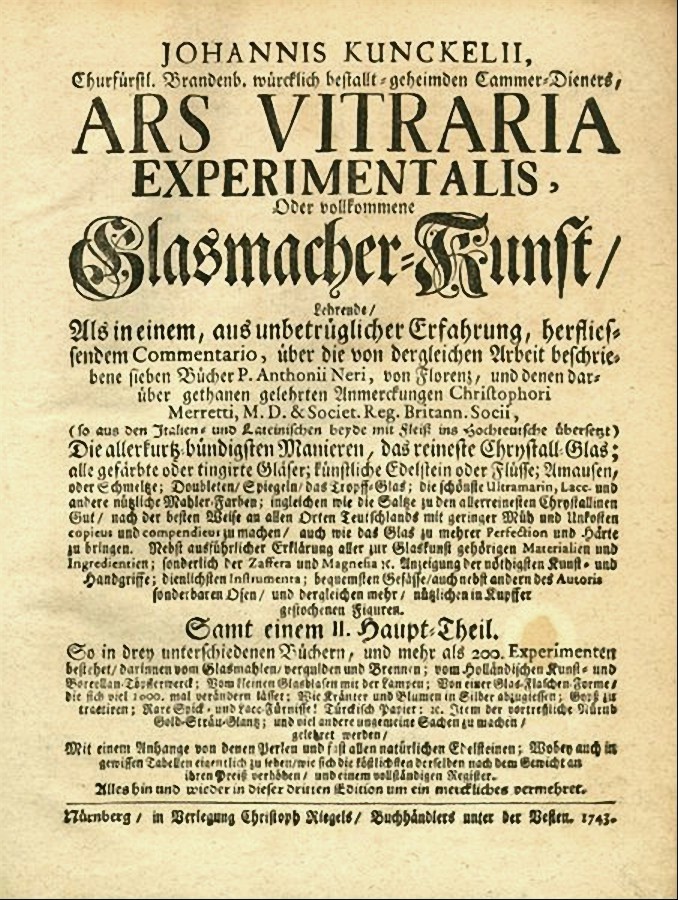
A gathering and mingling of early Kunkel families talks about our first notable figure, Baron Johann Kunckel von Löwenstern, a German chemist. Around 1678, he replicated Hennig Brand’s discovery of phosphorus isolation. Kunckel later managed the laboratory and glassworks in Brandenburg as a court chemist and apothecary.
Ars Vitraria ExperimentalisJohannes Kunckel, Ars Vitraria Experimentalis, 1679
The illustration by George Smith from his 1738 chapter “The art of blowing glass in miniature” (fig. 3) is not labeled alphabetically, but Johannes Kunckel’s 1679 engraving (fig. 4) is:
A — table around which four people may work at once
B — the lamp, filled with oil and a strong cotton wick
C—the hole where the tapered blowpipe is attached . . . so that the air is directed onto the acute and concentrated flame, producing a flame that will melt glass. Goldsmiths have a similar system for soldering metal.
D — bellows attached to pipes of tin that are hidden under the table
E — lever, attached to the foot pedal
F — ventilation hood
G — foot treadle for the bellows, pressed by the worker
Left: Probably engraved by Gottfried Spiller (1658–1728). Covered goblet with “Fruit Children,” before 1700. Gold ruby glass, H. 9 1/8 in. (23.1 cm). Focke-Museum, Bremer Landesmuseum für Kunst und Kulturgeschichte, Bremen (68.253). Center: Ruby glass flute with “AR” monogram, around 1715. German, Dresden. Gold ruby and transparent glass (blown, cut), H. 23 cm. Green Vault, Staatliche Kunstkammlungen Dresden (IV 228). Right:Covered goblet, 1725–35. German, Potsdam. Transparent dark gold ruby glass (blown, cut) 10 9/16 x 3 5/8 in. (26.9 x 9.2 cm). Corning Museum of Glass, Corning, New York, Bequest of Jerome Strauss (79.3.318) Gold ruby glass was perfected through alchemist and glassmaker Johann Kunckel’s experimentation under the patronage of Frederick William, Elector of Brandenburg, at the elector’s glassworks in Potsdam. Its name comes from the addition of colloidal gold to the glass before melting, a complex operation that required the skills of both alchemist and glassmaker. Displayed in a Kunstkammer, glass pieces served as signs of the alchemical knowledge required to produce them.
~ ~ ~ ~ ~ ~ ~ ~ ~ ~ ~ Continue Reading If You’re Interested in the Kunkle Line.
Our Kunkles trace back to my grandmother, Hilda Leonore Kunkle. However, I don’t have any personal stories to share as I didn’t know my dad’s family. I gained most of my knowledge later in life through my siblings, letters from my Aunt Elva (Hilda’s daughter), and documented facts and history shared by others.
Hilda married Glen Henry Logan in 1921 in Indiana County, Pennsylvania. Her father was Charles J. Kunkel. You’ll notice how the name is interchangeable with the -el and -le. He married Carrie Morrison in 1892. Charles lived most of his life in Westmoreland, Pennsylvania, until his wife died in 1937. He then moved to Michigan to live with his daughter, Hilda, and her family until his death in 1948 at the age of 82.
Charles’ father was Michael Kunkle. He also grew up in Westmoreland, Pennsylvania. In 1860, Michael married his neighbor, Esther “Hettie” Hawk. They were Lutherans, and Michael worked as a carpenter before becoming a farmer for the rest of his life. Michael passed away at the age of 80 in 1918 in Westmoreland.
Michael’s father was Daniel. They lived on Michaelsburg Plantation, a 336-acre estate owned by a family member. His family was among the First Families in Hempfield Township.
Some family stories were recorded in the History of Westmoreland County, Pennsylvania by Boucher, John Newton; Jordan, John W. (John Woolf), 1840-1921, joint editor. Publication date 1906. Publisher New York, Chicago, The Lewis publishing company. Contributor Allen County Public Library Genealogy Center
Daniel married Mary Elizabeth Kepple, and they had a son named Michael. They moved from Westmoreland to Indiana, Pennsylvania, where he worked as a railroad lock tender. Unfortunately, Elizabeth passed away about 10 years later. After her death, he married Catherine Iseman in 1844, but she died of cancer in 1850. In 1852, Daniel married Sarah, whose last name is unknown. It is still unknown when Daniel passed away, but it is confirmed that he was alive at least until 1870, as he is listed in the census at age 66 and still working for the railroad.
I’ve been putting off delving into the Kunkel family, but now things are more interesting. The first names in the family often begin with Johann for boys and Anna or Maria for girls. I’ve had to redo my Kunkle family tree twice because I initially followed the wrong line. However, thanks to the help of other researchers, Vernon Cook and James Kunkle, I am now back on track.
Daniel’s father is Johann Jacob Kunkel (Gunckel), Jr. It is in this generation that the Kunkel and Gunckel names are interchangeable. He married Elizabeth Schaeffer in 1789 and had 10 children. My records indicate that he was a farmer, and his cause of death was “gravel.” After researching old terms for the cause of death, “gravel” seemed to refer to the modern equivalent of kidney stones. He is buried in Brush Creek Evangelical Lutheran Church Cemetery.
Johann Jacob’s father is Johann Jacob Gunkel, Sr. His father is our immigrant ancestor of this family. He was born in Breitenburg, Germany in 1746, and they immigrated in 1749 when Jacob was only 3 years old.
Tom writes, One of the first known settlers in Pine Grove area after the French and Indian War, 1689-1763, Great Britain Battles France over unsettled territories in N. America, was Jacob Gunkel. He was located on the site of the Eagle Hotel in 1771. Here, he laid claim to a tract of two hundred acres of land, which he subsequently purchased from John and Richard Penn, proprietors of the Colony of Pennsylvania, which included the site of the present borough of Pine Grove. The convergence of several roads on Gunkel’s plantation made it an excellent location for a tavern, and soon after he purchased the land, he erected a log building, Gunkel’s Tavern, which he kept till 1810 and then he removed to a farm about a mile south from the borough were he died in 1813. His property was located next to the property of his daughter Eva and husband Johannes Loffler.
Another source states he “kept a house of entertainment, and in 1795 opened a store which he kept until 1810. (Source: History of Schuylkill Co, PA, by W. W. Munsell & Co, – 1881). On May 21, 1810, Jacob Gunckel of Pinegrove Township, Berks Co, PA, yeoman, and Susannah, his wife, sell to John Gunckel, yeoman, for 255 pounds, land containing 235 acres, part of the larger tract of land called “Gunckel’s Farm.” (Deed book 24, page 488).
Cemetery records for St. Peter’s (Gunkle’s) Union Church of Pinegrove Township, Schuylkill County include the following references: Jacob Gunkel; born September 28, 1746; died September 2, 1813 Eva Lefler; born Mar 25, 1809; died Jun 21, 1841 Johannes Leffler; born Jul 5, 1764; died Aug 16, 1849; son of Gottfried, Mahanoy Twp., Northumberland Co. Eva Lofler (nee Kunkle); w/John; died Jan 26, 1857; 83y 11m 15d
Gunkel’s Cemetery, located across the street from St. Peter’s Lutheran Church, contains a memorial plaque that reads: Site of the 1st Reformed-Lutheran Church 1782-1817 Donated by Jacob & Susanna Gunkel
Joh. Jacob’s father was Johann John Gunkel, born in 1722 in Breitenborn, Germany. John Gunckel married Anna Margarethe Lorentz and arrived in America in 1749 with his young son. In the book “Naturalizations of Foreign Protestants in the American Colonies,” there is the following: “John Gunckel of Bethel Twp., Berks County, Pennsylvania, became a citizen 20 September 1761.” These naturalizations were performed at the Philadelphia County, PA Courthouse. https://archive.org/stream/naturalizationso24grea#page/75/mode/2up/search/gunckel
Johann has often been confused with Johann Michael Gunkel, who was the same age. They were first cousins from Breitenborn and used similar names for their children. They also attended the same church. By the way, Johann (John) also had a brother named Johann Jacob. Talk about confusing!
John is also our Revolutionary War ancestor. His SAR Patriot number is P-171729. The John Gunckel of Bethel Township, who performed Revolutionary War service and from whom we are descended, was enrolled in 1777-1779 in the First Class, Captain Valentine Shoufler’s Seventh Company, First Battalion, Lancaster County Militia. He was assessed 26 pounds in fines, according to the evidence of an undated list of Class Fines. (Pennsylvania State Archivist, Military Accounts (Militia), Records of the Comptroller General, at the Division of Archives and Manuscripts) Larry Patrick Cornwell, 138085, has a SAR-approved supplemental under this John Gunckel. Larry served as the Genealogist General of the National Society, Sons of the American Revolution from 2011-2014 (www.sar.org)
John died in 1795 at the age of 73.
John’s father was Lorentz Gunkel, born in Breitenborn, Germany. He immigrated to the US in 1751 on the ship the “Duke of Bedford” with wife and one child, from Rotterdam, and last from Portsmouth, England. Port of entry was Philadelphia, PA, on a Saturday. Records show that Lorentz settled first in Northampton Co, PA, and later pioneered in Allegheny & Westmoreland Counties, PA. He was a Revolutionary War soldier and a pensioned veteran. *(Record Sources: 1804, pg 335 (Supp. 1983) aud 9041, pg 459 (From Flörsbach, Germany).
Lorentz wed Anna Catharina Gundlach in 1709. It’s uncertain who the “young child” who immigrated with them is. However, it could be our ancestor, Johann Jacob, as he was born in 1746.
Lorentz’s father was Hans Gunkel, who was born in Neuhütten, Spessart, Germany, in 1636. He was known as a Catholic man. He married Margareth N. and worked in a “glass house.” They later moved to Breitenborn, where Hans was invited by Heinrich Gundlach, the headmaster of the Breitenborn Works, to recruit glass makers from all over the country in the 1670s and 1680s.
When I originally published this post, a cousin replied, introducing himself. He also stated, “I do not believe that anyone actually lived in a “Glass House” I believe that this is simply a misinterpretation of the translation of Neuhutten. The Huts of glass were simply the buildings that were constructed… or the kilns… that were used to make the glass. These kilns were made of bricks so they could be brought to new areas where the resources (forests) were over-exploited to the point that they had to move to continue to be able to make glass. When they relocated to the area of NeuHutten they simply called it that “New Huts”.”
Hans Kunkel was a skilled glassblower, and many Kunkels were known for their glassblowing skills all over Europe at that time. Gundlach, an entrepreneur, made efforts to recruit the most talented glassblowers to come to Breitenborn. It is impressive that Hans Kunkel was still very productive in the 1680s. For instance, between January 4, 1684, and November 26, 1685, at around 50 years old, he produced 42,300 drinking glasses of various types and earned 91 fl. 16 alb (the equivalent of the dollar in those days). In addition to blowing glass, he occasionally attended the furnace, an important task for maintaining proper temperatures during the melting process.
During the winter months, the furnace stayed cold. The production period was 9 months per years – max. During the winter months, most of the works the people were also engaged in was cutting the firewood (beech and oak) for the furnace which did eat up a lot during the production period. So additionally they had another income. There were over 20 men permanently assigned to the fire wood cutting and handling, plus the seasonal ones. Hans Kunkel, for example, made 83-1/2 Clafter (7’x7’x3′) and earned 25 fl. additionally in 1689.
Despite all the hard work, Hans Kunkel lived to be nearly 100 years of age. There is a lot more similar data available, basically showing production figures, earnings, how they were paid (normally 50% cash, and the other in natural things, like grain, flour, etc. and the beverages, like beer and brandy were also brewing there.)
(Above Source: – “Heinrich P. Göbel” – Germany Researcher. (1994)
Hans’ father was Johann Michael, born in Glasshouse, Germany about 1600. He married Anna Katharine Naumann. He died in 1676. There is not much else known about him.
The Kunkels were already living in Neuhutten before the Thirty Years War. It seems that Neuhutten and that part of Germany were already in the Lutheran camp. The Kunkels all seemed to have been born, married, and died in “The Glasshouse” in Neuhutten.
Joh. Michael’s father was Johannes Jurg, born about 1565. He married Elisabeth Christina Houser.
The Kunkel family still live primarily in the Spessart Mountain range area, which is a mostly wooded region in the heart of Germany. There is a historical mention of an early Glasshouse in the Spessart area dating back to 22 August 1349. During that time, the area was under the jurisdiction of the Archbishop of Mainz.
The Union Letter (Bundesbrief) of 1537 (or the Federal Charter or Letter of Alliance) lists two KUNKELs, namely Jurge (George) and Hentze Kunkel, and in a later revision dated 24 February 1559, again two KUNKELs – George and Friedrich Kunkel. There are links, as glass-making was only carried down by the same families.–Janet and Robert Wolfe Genealogy, “Notes for Johann Jurg Kunkel and Elisabeth Christina Houser” Webpage: www.umich.edu/~bobwolfe/gen/mn/m6413x6414.htm Email address: JanetRobertWolfeGenealogy@gmail.com Go to the Genealogy Page for Johann Jurg Kunkel Go to the Genealogy Page for Elisabeth Christina Houser Go to the Kunkel surname index. Go to the Houser surname index. Go to the Home Page for Janet and Robert Wolfe Genealogy
Much research is still needed to fill out all the missing information; however, I have been told that genealogy records beyond this point are next to impossible to find due to all the wars that took place in this country. The Thirty Years War (1618-1648) destroyed many church records throughout Germany. So many records have been destroyed, and finding a cemetery with headstones that can be read after 500 years would be impossible.
All Kunkels do not accept the “dweller by deep water” definition of the name. Other research has yielded another possibility for its origin: It seems to derive from the Old High German name “KUHN,” meaning “wise.” (In this case, such a compliment would make it acceptable.) GUNKEL probably refers to living in deep water. In German, KUNKEL means the part of a spinning wheel called the distaff. A staff on which fibers such as flax or wool are wound before being spun into thread.
As you study the descendants of these families, you will find that intermarriages were rather common. Men had limited ways to meet eligible mates and could usually not go farther than they could walk or ride horseback to court. When there were family get-togethers, they met women who just happened to be related in one way or another. (James E. Kunkle- 2000)
Joh. Jurg’s father was Hans. Hans was born about 1530 in Glasshouse, Germany. He married Anna Catharina Wolfgang in 1554. Hans Kunkel of Neuhutten was called “Schwarzkoph” in the Parish records. Meaning “Black Forest.”
Some show Claus Kunkle, born 1490, as Hans’ father, and Conrad, born 1460, as Claus’ father, but I do not have sources to back these up.
The Coat-of-Arms of the Kunkel, Kunkle, etc., family is recorded in Rietstap’s Armorial General (Pg. 1144)
This link is one of James’ first works on the Kunkles and contains a lot of interesting information, from their Coat of Arms to their superstitions to their culture, customs, and rituals. Conkle/Kunkle File #1
While I couldn’t find exact Kunkel glass other than the original Johann’s, I did find some drawings of the glassblowers’ working areas in that century.
Glass blowing, from a Book of Trades, 1542 (engraving), German School, (16th century) / Private Collection / The Stapleton Collection / The Bridgeman Art Library
There is still much to learn about certain individuals in this family, and I hope to contribute to James and Wallace’s wonderful work. RIP, guys! You left a wonderful legacy for all of us.
Glass furnace, with workers. Georg Agricola (German, 1494–1555). In De re metallica [Berckwerck Buch, Frankfurt-am-Main, 1580, p. cccxc]. Rakow Research Library, The Corning Museum of Glass (66820). Photo: The Corning Museum of Glass. Read more at https://www.cmog.org/article/lamp.
If you need research assistance, do not hesitate to contact me.
Your Family
Tree Research Specialist
As an Amazon Associate, I earn from qualifying purchases.




![FIG. 39. Glass furnace, with workers. Georg Agricola (German, 1494–1555). In De re metallica [Berckwerck Buch, Frankfurt-am-Main, 1580, p. cccxc]. Rakow Research Library, The Corning Museum of Glass (66820). Photo: The Corning Museum of Glass.](https://i0.wp.com/i.pinimg.com/564x/4e/49/5e/4e495ec5a072d9bb33f6f130891e9660.jpg?w=840&ssl=1)
You must be logged in to post a comment.