From Court Chemist to Master Glassblower: The Remarkable Journey of Baron Johann Kunckel von Löwenstern

And the Alchemical Secrets of Gold Ruby Glass

I want to emphasize that all the research mentioned below was conducted by other individuals, and I simply discovered their work. Fortunately, our relatives were very supportive and willing to share their findings with me.

James E. Kunkle, a retired US Navy officer who resided in Colorado, passed away in 2017 at the age of 90. I had been corresponding with him since 2012. He and Wallace M. Kunkel (also deceased) have compiled the following history of the Kunkel families, which is available at the Family History Library, among other works authored by James, and at the Library of Congress. I have put a link to it here. A gathering and mingling of early Kunkel families

Wallace’s grandmother began the genealogy work in the late 1940s, spending long hours at her typewriter. She created genealogy books for her seven grandchildren as Christmas presents in the 1960s. Wallace, his daughter Mary, and his grandchildren have continued this work. When Wallace was alive, he collaborated with James on this historical project. It’s poignant that yesterday (I originally wrote this blog on April 8, 2018.) marked the anniversary of his passing. Wallace was also known as “Mr. Sawdust,” a skilled furniture maker and the founder of the “Mr. Sawdust School of Professional Woodworking.”

At least forty families of Protestant Kunkels immigrated to America from Germany between 1728 and 1770. Some of the Catholic families of Kunkels immigrated to the United States after the War of 1812. Many of the early Kunkel families settled in Pennsylvania. Today, Kunkels live in Pennsylvania, Maryland, Ohio, Wisconsin, Illinois, Indiana, Minnesota, and throughout the United States. The surname is spelled Kunkel, Kunkle, Gunkel, Gunkle, Konkel, Konkle, and other variant spellings.” -J.E. Kunkle & W.M. Kunkel, 1995 (415 pages of history).

You can see some of Wallace’s work at https://mrsawdust.com/genealogy.

A gathering and mingling of early Kunkel families talks about our first notable figure, Baron Johann Kunckel von Löwenstern, a German chemist. Around 1678, he replicated Hennig Brand’s discovery of phosphorus isolation. Kunckel later managed the laboratory and glassworks in Brandenburg as a court chemist and apothecary.

Johannes Kunckel.jpg
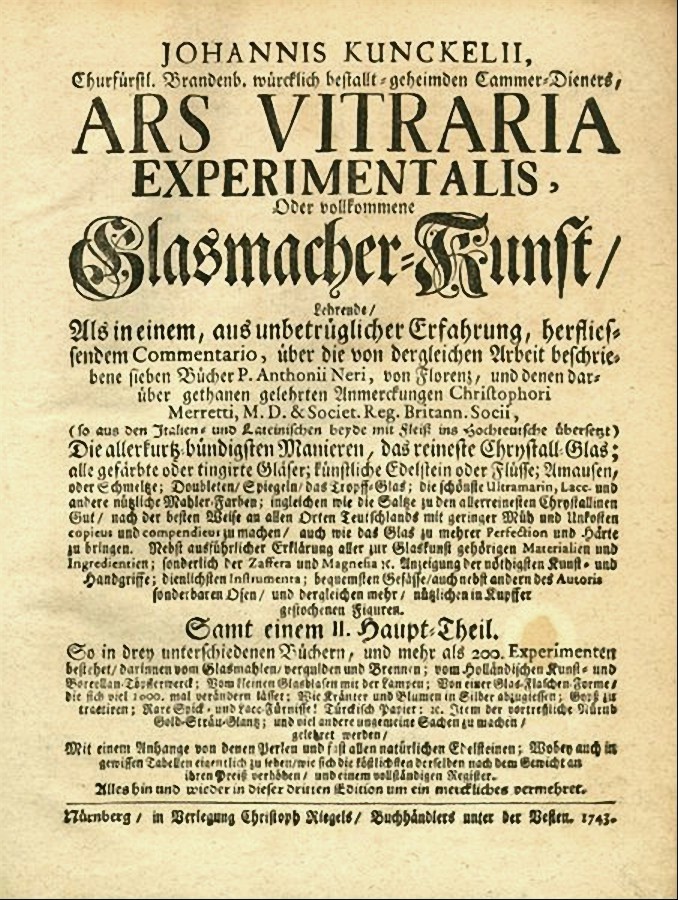
Ars Vitraria Experimentalis
Image result for Kunkel's Art vitraria experimentalis
Johannes Kunckel, Ars Vitraria Experimentalis, 1679

The illustration by George Smith from his 1738 chapter “The art of blowing glass in miniature” (fig. 3) is not labeled alphabetically, but Johannes Kunckel’s 1679 engraving (fig. 4) is:

  • A — table around which four people may work at once
  • B — the lamp, filled with oil and a strong cotton wick
  • C—the hole where the tapered blowpipe is attached . . . so that the air is directed onto the acute and concentrated flame, producing a flame that will melt glass. Goldsmiths have a similar system for soldering metal.
  • D — bellows attached to pipes of tin that are hidden under the table
  • E — lever, attached to the foot pedal
  • F — ventilation hood
  • G — foot treadle for the bellows, pressed by the worker
Ruby Glass
Left: Probably engraved by Gottfried Spiller (1658–1728). Covered goblet with “Fruit Children,” before 1700. Gold ruby glass, H. 9 1/8 in. (23.1 cm). Focke-Museum, Bremer Landesmuseum für Kunst und Kulturgeschichte, Bremen (68.253). Center: Ruby glass flute with “AR” monogram, around 1715. German, Dresden. Gold ruby and transparent glass (blown, cut), H. 23 cm. Green Vault, Staatliche Kunstkammlungen Dresden (IV 228). Right: Covered goblet, 1725–35. German, Potsdam. Transparent dark gold ruby glass (blown, cut) 10 9/16 x 3 5/8 in. (26.9 x 9.2 cm). Corning Museum of Glass, Corning, New York, Bequest of Jerome Strauss (79.3.318) Gold ruby glass was perfected through alchemist and glassmaker Johann Kunckel’s experimentation under 
the patronage of Frederick William, Elector of Brandenburg, at the elector’s glassworks in Potsdam. Its name comes from the addition of colloidal gold to the glass before melting, a complex operation that required the skills of both alchemist and glassmaker. Displayed in a Kunstkammer, glass pieces served as signs of the alchemical knowledge required to produce them.

This link is a link to Johann Kunkel’s book. Vollständige Glassmacherkunst

~ ~ ~ ~ ~ ~ ~ ~ ~ ~ ~ Continue Reading If You’re Interested in the Kunkle Line.

Our Kunkles trace back to my grandmother, Hilda Leonore Kunkle. However, I don’t have any personal stories to share as I didn’t know my dad’s family. I gained most of my knowledge later in life through my siblings, letters from my Aunt Elva (Hilda’s daughter), and documented facts and history shared by others.

Hilda married Glen Henry Logan in 1921 in Indiana County, Pennsylvania. Her father was Charles J. Kunkel. You’ll notice how the name is interchangeable with the -el and -le. He married Carrie Morrison in 1892. Charles lived most of his life in Westmoreland, Pennsylvania, until his wife died in 1937. He then moved to Michigan to live with his daughter, Hilda, and her family until his death in 1948 at the age of 82.

Charles’ father was Michael Kunkle. He also grew up in Westmoreland, Pennsylvania. In 1860, Michael married his neighbor, Esther “Hettie” Hawk. They were Lutherans, and Michael worked as a carpenter before becoming a farmer for the rest of his life. Michael passed away at the age of 80 in 1918 in Westmoreland.

Michael’s father was Daniel. They lived on Michaelsburg Plantation, a 336-acre estate owned by a family member. His family was among the First Families in Hempfield Township.

Some family stories were recorded in the History of Westmoreland County, Pennsylvania by Boucher, John Newton; Jordan, John W. (John Woolf), 1840-1921, joint editor. Publication date 1906. Publisher New York, Chicago, The Lewis publishing company. Contributor Allen County Public Library Genealogy Center

[https://archive.org/details/historyofwestmor01bouc/page/n9/mode/2up]

Daniel married Mary Elizabeth Kepple, and they had a son named Michael. They moved from Westmoreland to Indiana, Pennsylvania, where he worked as a railroad lock tender. Unfortunately, Elizabeth passed away about 10 years later. After her death, he married Catherine Iseman in 1844, but she died of cancer in 1850. In 1852, Daniel married Sarah, whose last name is unknown. It is still unknown when Daniel passed away, but it is confirmed that he was alive at least until 1870, as he is listed in the census at age 66 and still working for the railroad.

I’ve been putting off delving into the Kunkel family, but now things are more interesting. The first names in the family often begin with Johann for boys and Anna or Maria for girls. I’ve had to redo my Kunkle family tree twice because I initially followed the wrong line. However, thanks to the help of other researchers, Vernon Cook and James Kunkle, I am now back on track.

Daniel’s father is Johann Jacob Kunkel (Gunckel), Jr. It is in this generation that the Kunkel and Gunckel names are interchangeable. He married Elizabeth Schaeffer in 1789 and had 10 children. My records indicate that he was a farmer, and his cause of death was “gravel.” After researching old terms for the cause of death, “gravel” seemed to refer to the modern equivalent of kidney stones. He is buried in Brush Creek Evangelical Lutheran Church Cemetery.

Tom Gunckel has conducted extensive research on the Gunckel family. You can view his research at http://www.gunckel.com/gunckela.pdf.

Johann Jacob’s father is Johann Jacob Gunkel, Sr. His father is our immigrant ancestor of this family. He was born in Breitenburg, Germany in 1746, and they immigrated in 1749 when Jacob was only 3 years old.

Tom writes, One of the first known settlers in Pine Grove area after the French and Indian War, 1689-1763, Great Britain Battles France over unsettled territories in N. America, was Jacob Gunkel. He was located on the site of the Eagle Hotel in 1771. Here, he laid claim to a tract of two hundred acres of land, which he subsequently purchased from John and Richard Penn, proprietors of the Colony of Pennsylvania, which included the site of the present borough of Pine Grove. The convergence of several roads on Gunkel’s plantation made it an excellent location for a tavern, and soon after he purchased the land, he erected a log building, Gunkel’s Tavern, which he kept till 1810 and then he removed to a farm about a mile south from the borough were he died in 1813. His property was located next to the property of his daughter Eva and husband Johannes Loffler.

Another source states he “kept a house of entertainment, and in 1795 opened a store which he kept until 1810. (Source: History of Schuylkill Co, PA, by W. W. Munsell & Co, – 1881). On May 21, 1810, Jacob Gunckel of Pinegrove Township, Berks Co, PA, yeoman, and Susannah, his wife, sell to John Gunckel, yeoman, for 255 pounds, land containing 235 acres, part of the larger tract of land called “Gunckel’s Farm.” (Deed book 24, page 488).

Cemetery records for St. Peter’s (Gunkle’s) Union Church of Pinegrove Township, Schuylkill County include the following references:
Jacob Gunkel; born September 28, 1746; died September 2, 1813
Eva Lefler; born Mar 25, 1809; died Jun 21, 1841
Johannes Leffler; born Jul 5, 1764; died Aug 16, 1849; son of Gottfried, Mahanoy Twp., Northumberland Co. Eva Lofler (nee Kunkle); w/John; died Jan 26, 1857; 83y 11m 15d

Gunkel’s Cemetery, located across the street from St. Peter’s Lutheran Church, contains a memorial plaque that reads:
Site of the 1st Reformed-Lutheran Church
1782-1817
Donated by Jacob & Susanna Gunkel

Joh. Jacob’s father was Johann John Gunkel, born in 1722 in Breitenborn, Germany. John Gunckel married Anna Margarethe Lorentz and arrived in America in 1749 with his young son. In the book “Naturalizations of Foreign Protestants in the American Colonies,” there is the following: “John Gunckel of Bethel Twp., Berks County, Pennsylvania, became a citizen 20 September 1761.” These naturalizations were performed at the Philadelphia County, PA Courthouse. https://archive.org/stream/naturalizationso24grea#page/75/mode/2up/search/gunckel

Johann has often been confused with Johann Michael Gunkel, who was the same age. They were first cousins from Breitenborn and used similar names for their children. They also attended the same church. By the way, Johann (John) also had a brother named Johann Jacob. Talk about confusing!

John is also our Revolutionary War ancestor. His SAR Patriot number is P-171729. The John Gunckel of Bethel Township, who performed Revolutionary War service and from whom we are descended, was enrolled in 1777-1779 in the First Class, Captain Valentine Shoufler’s Seventh Company, First Battalion, Lancaster County Militia. He was assessed 26 pounds in fines, according to the evidence of an undated list of Class Fines. (Pennsylvania State Archivist, Military Accounts (Militia), Records of the Comptroller General, at the Division of Archives and Manuscripts) Larry Patrick Cornwell, 138085, has a SAR-approved supplemental under this John Gunckel. Larry served as the Genealogist General of the National Society, Sons of the American Revolution from 2011-2014 (www.sar.org)

John died in 1795 at the age of 73.

John’s father was Lorentz Gunkel, born in Breitenborn, Germany. He immigrated to the US in 1751 on the ship the “Duke of Bedford” with wife and one child, from Rotterdam, and last from Portsmouth, England. Port of entry was Philadelphia, PA, on a Saturday. Records show that Lorentz settled first in Northampton Co, PA, and later pioneered in Allegheny & Westmoreland Counties, PA. He was a Revolutionary War soldier and a pensioned veteran. *(Record Sources: 1804, pg 335 (Supp. 1983) aud 9041, pg 459 (From Flörsbach, Germany).

Lorentz wed Anna Catharina Gundlach in 1709. It’s uncertain who the “young child” who immigrated with them is. However, it could be our ancestor, Johann Jacob, as he was born in 1746.

Lorentz’s father was Hans Gunkel, who was born in Neuhütten, Spessart, Germany, in 1636. He was known as a Catholic man. He married Margareth N. and worked in a “glass house.” They later moved to Breitenborn, where Hans was invited by Heinrich Gundlach, the headmaster of the Breitenborn Works, to recruit glass makers from all over the country in the 1670s and 1680s.

When I originally published this post, a cousin replied, introducing himself. He also stated, “I do not believe that anyone actually lived in a “Glass House” I believe that this is simply a misinterpretation of the translation of Neuhutten. The Huts of glass were simply the buildings that were constructed… or the kilns… that were used to make the glass. These kilns were made of bricks so they could be brought to new areas where the resources (forests) were over-exploited to the point that they had to move to continue to be able to make glass. When they relocated to the area of NeuHutten they simply called it that “New Huts”.”

Hans Kunkel was a skilled glassblower, and many Kunkels were known for their glassblowing skills all over Europe at that time. Gundlach, an entrepreneur, made efforts to recruit the most talented glassblowers to come to Breitenborn. It is impressive that Hans Kunkel was still very productive in the 1680s. For instance, between January 4, 1684, and November 26, 1685, at around 50 years old, he produced 42,300 drinking glasses of various types and earned 91 fl. 16 alb (the equivalent of the dollar in those days). In addition to blowing glass, he occasionally attended the furnace, an important task for maintaining proper temperatures during the melting process.

During the winter months, the furnace stayed cold. The production period was 9 months per years – max. During the winter months, most of the works the people were also engaged in was cutting the firewood (beech and oak) for the furnace which did eat up a lot during the production period. So additionally they had another income. There were over 20 men permanently assigned to the fire wood cutting and handling, plus the seasonal ones. Hans Kunkel, for example, made 83-1/2 Clafter (7’x7’x3′) and earned 25 fl. additionally in 1689.
Despite all the hard work, Hans Kunkel lived to be nearly 100 years of age. There is a lot more similar data available, basically showing production figures, earnings, how they were paid (normally 50% cash, and the other in natural things, like grain, flour, etc. and the beverages, like beer and brandy were also brewing there.)
(Above Source: – “Heinrich P. Göbel” – Germany Researcher. (1994)
Hans’ father was Johann Michael, born in Glasshouse, Germany about 1600. He married Anna Katharine Naumann. He died in 1676. There is not much else known about him.

The Kunkels were already living in Neuhutten before the Thirty Years War. It seems that Neuhutten and that part of Germany were already in the Lutheran camp. The Kunkels all seemed to have been born, married, and died in “The Glasshouse” in Neuhutten.

Joh. Michael’s father was Johannes Jurg, born about 1565. He married Elisabeth Christina Houser.

The Kunkel family still live primarily in the Spessart Mountain range area, which is a mostly wooded region in the heart of Germany. There is a historical mention of an early Glasshouse in the Spessart area dating back to 22 August 1349. During that time, the area was under the jurisdiction of the Archbishop of Mainz.

The Union Letter (Bundesbrief) of 1537 (or the Federal Charter or Letter of Alliance) lists two KUNKELs, namely Jurge (George) and Hentze Kunkel, and in a later revision dated 24 February 1559, again two KUNKELs – George and Friedrich Kunkel. There are links, as glass-making was only carried down by the same families.–Janet and Robert Wolfe Genealogy, “Notes for Johann Jurg Kunkel and Elisabeth Christina Houser”
Webpage: www.umich.edu/~bobwolfe/gen/mn/m6413x6414.htm
Email address: JanetRobertWolfeGenealogy@gmail.com
Go to the Genealogy Page for Johann Jurg Kunkel
Go to the Genealogy Page for Elisabeth Christina Houser
Go to the Kunkel surname index.
Go to the Houser surname index.
Go to the Home Page for Janet and Robert Wolfe Genealogy

Much research is still needed to fill out all the missing information; however, I have been told that genealogy records beyond this point are next to impossible to find due to all the wars that took place in this country. The Thirty Years War (1618-1648) destroyed many church records throughout Germany. So many records have been destroyed, and finding a cemetery with headstones that can be read after 500 years would be impossible.

All Kunkels do not accept the “dweller by deep water” definition of the name. Other research has yielded another possibility for its origin: It seems to derive from the Old High German name “KUHN,” meaning “wise.” (In this case, such a compliment would make it acceptable.) GUNKEL probably refers to living in deep water. In German, KUNKEL means the part of a spinning wheel called the distaff. A staff on which fibers such as flax or wool are wound before being spun into thread.

As you study the descendants of these families, you will find that intermarriages were rather common. Men had limited ways to meet eligible mates and could usually not go farther than they could walk or ride horseback to court. When there were family get-togethers, they met women who just happened to be related in one way or another. (James E. Kunkle- 2000)

Joh. Jurg’s father was Hans. Hans was born about 1530 in Glasshouse, Germany. He married Anna Catharina Wolfgang in 1554. Hans Kunkel of Neuhutten was called “Schwarzkoph” in the Parish records. Meaning “Black Forest.”

Some show Claus Kunkle, born 1490, as Hans’ father, and Conrad, born 1460, as Claus’ father, but I do not have sources to back these up.

The Coat-of-Arms of the Kunkel, Kunkle, etc., family is recorded in Rietstap’s Armorial General (Pg. 1144)

Kunkle Coat of Arms

This link is one of James’ first works on the Kunkles and contains a lot of interesting information, from their Coat of Arms to their superstitions to their culture, customs, and rituals. Conkle/Kunkle File #1

While I couldn’t find exact Kunkel glass other than the original Johann’s, I did find some drawings of the glassblowers’ working areas in that century.

Glass blowing, from a Book of Trades, 1542 (engraving), German School, (16th century) / Private Collection / The Stapleton Collection / The Bridgeman Art Library

There is still much to learn about certain individuals in this family, and I hope to contribute to James and Wallace’s wonderful work. RIP, guys! You left a wonderful legacy for all of us.

FIG. 39. Glass furnace, with workers. Georg Agricola (German, 1494–1555). In De re metallica [Berckwerck Buch, Frankfurt-am-Main, 1580, p. cccxc]. Rakow Research Library, The Corning Museum of Glass (66820). Photo: The Corning Museum of Glass.
Glass furnace, with workers. Georg Agricola (German, 1494–1555). In De re metallica [Berckwerck Buch, Frankfurt-am-Main, 1580, p. cccxc]. Rakow Research Library, The Corning Museum of Glass (66820). Photo: The Corning Museum of Glass. Read more at https://www.cmog.org/article/lamp.

If you need research assistance, do not hesitate to contact me.

Your Family Tree Research Specialist

As an Amazon Associate, I earn from qualifying purchases.

Uncovering the Story of Susanna Clark Rootes, My 9th Great Grandmother: A Tale of Witches and New England Founders

📸Microsoft Designer AI

So, witches run in my family.  Why doesn’t that surprise me?

Susanna (née Clark) was the wife of Josiah Rootes (1613-1683). Josiah Rootes, originally from Great Chart, Kent, England, was a passenger on the Hercules of Sandwich, under the command of Captain John Witherley. The ship was bound for “the plantation called New England in America” in the spring of 1634/5. Josiah, along with his mother and brother, migrated to America and was instrumental in founding the Beverly Church.

Josiah had taken the oath of allegiance and supremacy at Great Chart and received his certificate from Robert Gorsham, curator of Great Chart, on 20 March 1634/35. The Hercules of Sandwich is probably the same as the Hercules of Dover mentioned by Winthrop as being here in the summer. ~~Samuel G. Drake, Result of Some Researches Among the British Archives for Information Relative to the Founders of New England: Made in the Years 1858, 1859 and 1860 (n.p.: H.W. Dutton and Son, Printers, Transcript Office, 1860; reprint Baltimore: Genealogical Publishing Co., 1963), 84.

On June 25, 1678, Josiah made a sworn accusation of thievery against William and Elizabeth Hoar. He claimed the family had stolen (clothing, apples, wood, and hay) from him for nearly twenty years, and he had only just discovered proof – in the form of Goody Hoar’s apron.  

When several neighbors came under suspicion of receiving stolen goods from Mr. Hale’s maid, Margaret Lord, Josiah Rootes complained to the court in a written statement that “for neare twenty years together we haue ben Aflicted by hauing owr goods stollen At sundri time And we not Abell To make due profe haue ben forsed To sufer owr seuellfes To be wrownged in estat And name: And god by his prouidens hauing latlie discouered sum of Theas wokes of darknes wee Judg yt. To be owre duty To speake in vindicasion of Truth and Conuictccion of sine…. He deposed in Salem Court that same month, aged about 65, and again, aged about 60, as did his wife “Susanah Roots, aged about forty-eight years…

Their son, Jonathan Rootes, aged about thirteen years, affirmed…” Among those who testified were Abigell Stone, Jr., Abigall Ston, Jr., John Lovet, Jr., and Bethiah Lovet (Sussanah’s daughter).”

That same day, Susanna first appears on record: Susanah Roots, aged about fifty-three years, Mary, wife of Heugh Woodbery, aged about forty-eight years, and Sarah Roots, aged about twenty-four years, deposed that about two months ago they saw Mary, wife of Samuell Harres and Tabitha Slew carry a parcel of small linen into Samuell Harris’ house.

Five years later, in the spring of 1683, Josiah Rootes passed away. He named Susanna as the executrix of his will and stipulated, “…my loveing wife Susanna [have] the use & improvement of all my small estate, what ever untill such time, as my son Jonathan cometh to the age…” and if she did not remarry, “[Jonathan] shall pay unto her, his said mother eight pounds, [yearly] duerring the terme of her widdowhood, or her natural life, and let her have the use of the west end of my now dwellinghouse, of a bed, beding, her firewood brought to the doare [door].”

For the period, this is an appropriate provision for a wife who worked land, maintained a household, bore and nurtured six children. Josiah’s specification that Susanna have the sunny west-facing room with cozy bed and fire burning is lovely and fitting after 40 years of toil at his side.Poor Irish & Pilgrims. New World Shoots from Old World Roots. 

Inventory of the estate of Josiah Roots of Beverly, who deceased June 3, 1683, taken by Samuel Corning, sr., and Andrew Elliott: one coverlaide, lOs.; 1 bed ticking, iSs.; coverlaide, ili.; 4 yards of red Cloth at 6s. per yard, 21i. 4s.; 7 yards of Lining Cloth, ili. 8s.; 4 yards of Dowless, 8s.; 4 yards and 1-2 of kerzey, ili. 6d.; New England money, 71i. 8s.; old England money, 16s., 81i. 4s.; 2 yards of broad Cloth, ili. 2s.; 1 yard & 1-2 of broad Cloth, 18s.; 2 yards and 1 quarter of Red Cloth, 155.; 1 Carpet, lOs.; 11 yards of sarge, 21i. 4s.; 7 yards of white Cotten, 14s.; 1 Chest, 2s. and his woolling wearing Cloths, 51i. 5s.; and his wearing Linning, ili. lOs.; 61i. 17s.; 6 yards of kerzey, ili. 16s.; 4 yards and a quarter of kerzie, 31i. is. 6d.; 3 yards of Lining Cloth, 55. & 1 hatt, 45. 9s.; 8 pair of sheets for beding, 41i.; bed and its belongings, 41i. lOs.; 1 bed and 2 bed steads with other furniture, 5 li.; 1 bed with its furniture, 21i. lOs., and other Lumber, 31i.; 3 chests, ili. 2s.; 1 Table and 3 Joint stooles, 1 Table, 18s.; Cushions, 6s.; 1 Little Table, 4s. 21i. lOs.; 2 Chairs, 3s.; pewter, 21i.; brass & Iron, ili. 13s., 31i. 13s.; I Cart & wheels, plowghs & plowgh tackell, 41i.; 1 sled & 4 axes, 6s.; 3 hoes, 3s. 9s.; barrell, Tubs and other Lumber, 12s.; 3 other Tubs, 2s. & 2 spades, 55. 7s.; 1 horse, 2li. lOs.; parcel of shingles, ili. 55., 31i. 155.; 10 thousand of shingle nailes, ili. 105.; 2 oxen, 71i. & 4 Cows at 121i., 19 Ii., 2 Steeres, 41i. los.; 19 Sheep & Lambs at 3 Ii. 19s., 81i. 9s.; houses, land and orchard, 2601i.; 6 Acres of meadow, 301i.; 5 swine, lOs. per, 21i. lOs.; total, 3841i. 19s. Several debts, 191i. 8s. 3d.

In his will dated 15 May 1683, Josiah Rootes, “of the town of Beverly,” leaves his entire estate to his son Jonathan, after settling legacies for his other children, Bethiah, John, and Thomas. He entrusts the management of his estate to his wife Susanna, whom he appoints as executrix until Jonathan reaches adulthood. After Jonathan comes of age, he is responsible for his mother’s support as long as she remains unmarried.~~ George Francis Dow, Records and Files of the Quarterly Courts of Essex County, IX: 66. 67.

On June 26, 1683, Susanna Roots, now a widow, renounced her role as the executor of her husband’s will in a Salem court. She stated that she had “many weaknesses and infirmities of old age” and, therefore, could not serve as executor.

The court appointed John Hill and Nehemiah Grover to bring in an inventory as soon as possible, and the inventory was sworn to on 6 July 1683. (Andrew Elliot, who would, in 1692, accuse Susanna Rootes of witchcraft, was one of the appraisers).~~ George Francis Dow, Records and Files of the Quarterly Courts of Essex County, VIII: 66, 6

Nine years later, as she approached her 70th year, she found herself being taken to Boston and thrown into jail with irons on a charge of witchcraft, which carried a sentence of death.

Accusing neighbors of theft in a close-knit community is a serious matter. It’s possible that friends of William and Mary Hoars, Mary Harres, and Tabitha Slew held a grudge against the Rootes family, or they might have been jealous of the Rootes’ wealth, leading to the accusations.

                         (Warrant for Arrest of Susannah Roots )

Salem May 21-1692

To the Constables of Beverly.

Whereas Complaint hath been this day made before us, by Sergent Thomas Puttnam and John Puttnam: both of Salem village yeomen against Susannah Roots of Beverly widdow for sundry acts of witchcrafft by her Commited on the bodys of Mary wallcott Abigal williams Marcy Lewis Ann Puttnam and others.

You are therfore in their Majesties names hereby Required to apprehend and forthwith bring before us Susannah Roots of Beverly widdow, who stands charged with Committing Sundry acts of witchcraft as aboves’d to the wrong and Injury of the bodys of the above-named Persons, in order to her Examination Relateing to the aboves’d Premises faile not Dated Salem May the 21’st 1692

John Hathorne

Jonathan. Corwin

[Pbar ]r order of the Govener & Councell

To the Marshall of Essex or his Deputy vera Copia attest

May 21 — 1692

*Geor: Herrick Marshall of Essex

I doe apoint mr Jonathan Biles to bee my Lawffull Deputy to serve this warrant

*Geo: Herrick Marshall of Essex

(Reverse) I have prosecutted the within written warant and have apprehended the person of the within mentioned Suzannah Roots and Brought her befour awthority. 23: may 1692

By me *Jonathan Biles Constible of Beverly

( Essex County Archives, Salem — Witchcraft Vol. 1 Page 133 )


( Andrew Elliott v. Susannah Roots )

An information if it might be any help in the examination of the person before you goode Roots I being in the house of Mr Laurence Denni’s some time since she was suspected for what shee is now before you & there was Likewise Leonard Austen of our Town of Beverly s’d Austen then s’d that he thought she was a bad woman, his reason was that he Living in the house with s’d Roots not Long since and when he went to prayer at any time with his wife & thought s’d Roots would acompany them in s’d Duty but Did not at any time but would withdraw & absent herselfe: & further when my self were gone to bed & she unto her bed. she would rise in the night & we Could hear her talk in the roome below I lying in the Chamber over s’d roome as if there #[there] were: 5: or six persons with her more s’d Austen might speak if caled thereunto as far as know more concer[n]ing Roots

*Andrew Eliott
(Reverse)
Andrew Elliot ag’t G. Roots
( Essex County Archives, Salem — Witchcraft Vol. 1 Page 133 )
Complaint Letter

Susannah was eventually released, but while she was in prison, her grandson John Lovett III visited her and gave the following deposition about his conversation with Dorcas Hoar, another prisoner:

The depersision of John Lovet aged about 25 years this deponant tetifieth & say that he the s’d deponant sume time in June last past went into the prisan to see my gran mother then goodee hore asked me the s’d. deponant whether I knew of any witnesses that would Come in or be brought in against hear.&.I the s’d deponant told her I did not know of any and then the s’d. hore asked me whether goodman witreg would not Come in against her about his Cow I the s’d debonant tould the s’d whore I did believe he Would the s’d whore replyed she did not know that he had ara Cow, furder saith not 

Supposedly Susannah was released due to insufficient evidence but died less than a month later.   Susannah ended up in the care of Ambrose Gale after Josiah died since she had no known family members who survived her. However, the arrangement was not without a business-like aspect. In June of 1684, the court ordered that Susannah’s inheritance should be given to Gale to reimburse him for expenses. It was agreed that with the transfer of her assets, Gale would care for her for the rest of her life. (Note: Susannah was the mother of Ambrose Gale’s deceased son-in-law, Thomas Rootes, husband of Elizabeth Gale.   Not much is known about how she died.  Maybe her decline in health and the conditions in jail made her too weak. 

A student essay submitted in the UK states an interesting theory:

“Some of the witches like Susannah Roots were also accused for entertaining people late at night or adultery, but just because they did those kinds of things did not mean they were looking for power or attention from the whole town, but from the people they did it with. What we know now that did not know then is that the accused must have had been sick in some way or form. We can conclude this with the fact that the symptoms of witchery are the same symptoms as the Encephalitis Epidemic that accrued in the early 1900s to the mid-1900s.” https://www.ukessays.com/essays/history/salem-witch-craft-hysteria-history-essay.php

The entire case of the Witch Trials can be found here for anyone interested.

By the way, dear family members.  This is on the Logan side of the family.

As an Amazon Associate, I earn from qualifying purchases.

Tracing the Roots of John MacBean: A Scottish POW’s Journey to America

I recently covered information about the Bean family while researching William Bean on the Logan side a few weeks ago. For example, our Bean immigrant was a Scottish Prisoner of War and was sold as an indentured servant.

John MacBean (my 9th great-grandfather) came from Scotland as a POW.  He was one of 272 prisoners from the Battle of Worcester on the ship John and Sarah in 1651 that traveled to Boston (the Mac was dropped in Boston).

There is *no* documentary evidence giving John Bean of Exeter's parents/grandparent's names, or origins. We can confirm that he was most likely born in Scotland, was taken prisoner in England at the Battle of Worcester, and was one of the 'Scottish Prisoners' transported to New Hampshire on the ship "Sarah and John"; but that's it for anything prior to his arrival in America. Both the US and UK branches of the Clan MacBean Inc. Genealogy Department have been trying to locate _any_ additional information *without* success. The _suggested_ names for John's father/grandfather first appear during the mid-20th century and have no basis in fact. If anyone has *documented* evidence - with solid provenance - of his ancestry and origins, we would be overjoyed to receive it; but if your information comes from family trees without sources or provenance, or family 'legend' handed down without anything to back it up, then please do *not* treat it as gospel, or base any further research on it. --Allan MacBain MBCS Associate Genealogist (UK and Europe), Clan MacBean Inc.

John Bean and six others were indentured to Nicholas Lissen, owner of sawmills on the Exeter and Oyster Rivers. Usually, these servants had to serve six to eight years for their master, but John married his master’s daughter within THREE years! Nicolas’ other two daughters married John’s friends and fellow POWs.   Interestingly, the Lissens were also from Scotland.

John MacBean was born about 1634 in Strathdearn, Inverness, Scotland.  As with the Clan Logan Visits Scotland, the MacBeans also belong to a Clan.  From clanmacbean.org:

Our Gaelic name is MacBheathain, meaning “Son of the Lively One.” It is pronounced MacBain in Scotland. The “bh” in the Gaelic has a “bv” sound. The “ea” has the harsh “a.” The “th” has an h sound. The “ai” has the harsh “e” sound. This becomes “Macbvaheen.” This is why there are so many spellings of the sound. For a long time, everything was spelled phonetically. There was no set way. You can find one family member that spelled his name one way, and his brothers spelled it another way. Many records show the names spelled the way the recorder spelled it, not the way the family spelled it.

The Prefix of “Mac” means “Son of.” As time passed, many people dropped the a and put a line underneath the “Mc” with two dots to show that the a was suppose to be there. Later the lines and dots were dropped altogether. Some times you will find M’ which means the same as Mac. Mack is also accepted. 

Kinchyle is the Cry that the clan warriors would yell as they began to engage in battle. It was meant to unite them as one force. Kinchyle (kin-hile) was the land owned by the Clan which stretched around 2 miles along Lock Ness. This was located approximately where the town of Dores (due-ers) is today.

Clan Motto: Touch not a catt bot a targe!
This motto, which is written on our badge, means, don’t mess with this cat unless you have a shield for protection against it!

This monument to Clan MacBean is inside the McBain Memorial Park, created by Hughston McBain of McBain, the 21st chief. It lies above Kinchyle near Dores on the south shore of Loch Ness. The site was opened in 1961.

In the spring of 1650, when Oliver Cromwell threatened to invade Scotland, many Scottish highlanders enlisted to defend their homeland. The Scots lost the Battle of Dunbar on 3 September 1650, but a year later, a reorganized Scottish army prepared to fight Cromwell at the Battle of Worcester. When no ammunition was provided, the Scots resorted to clubs, stones, and the butts of their muskets until they were finally overpowered, and Scotland lost her independence. The surviving Scottish soldiers were taken as prisoners of war.  From Volume I, Descendants of John Bean of Exeter (2019 edition) 

On April 18, 1654, John married Hannah, the daughter of Lissen. Shortly after, he became a partner in the sawmills, a business that continued until Hannah’s death and John’s subsequent remarriage. In addition to his work in the sawmills, John Bean was also a land developer. Between 1660 and 1708, he acquired nearly 20 acres of land, cleared it of timber, and transformed it into working farms, preparing them for sale to new settlers. Furthermore, he was involved in farming and crafted boots for settlers as well as shoes for trade with Native Americans.

John Bean was Presbyterian, and Margaret, his second wife, was a member of the Hampton church in 1671 but was dismissed from that church in 1698 to join the church in Exeter. They chose to worship at the Congregational Church because there was no Presbyterian Church in Exeter, though John remained a Presbyterian until his death.

His first wife, Hannah, was born around 1635 in Scotland. She passed away at the age of 24 in 1659 during the birth of their third child in Exeter, New Hampshire. She was buried at Old Gathering House Churchyard in Belknap, New Hampshire. Hannah Lissen had two sisters: Elizabeth Lissen, who married Henry Magoon, and Mary Lissen, who married Alexander Gordon. Both men were with John Bean on the ship John and Sara.

John Bean and Margarett Rees married before 16 November 1660 in Exeter, Massachusetts Bay. Margarett Rees was born around 1635 in Wales. She passed away in 1714 at 79 in Exeter, New Hampshire, and was laid to rest at the Old Meeting House Churchyard in Belknap, New Hampshire.

John Bean artist's rendition
Artists Conception John Bean

John’s eleventh son, James, is my ancestor. He was born on December 17, 1672, in Exeter, Massachusetts Bay. James became a significant landowner in his own right. In February 1698, he purchased 30 acres from the town of Exeter, which he added to the land he inherited from his father. James was a trapper and a hunter, and he actively participated in the Indian Wars, fighting against Indigenous peoples until they withdrew from New Hampshire around 1710. In July of that same year, James successfully thwarted an attempted kidnapping of his three nieces by Indians who intended to take them to Canada.

James Bean married his first wife, Sarah Coleman, in 1692 in Exeter. Sarah was baptized in 1673, indicating she was born around that same year. She passed away in 1696.

James’ first son, John, is my ancestor. He was born in 1693 in Brentwood, New Hampshire, and married Sarah Sinkler in 1718 in Exeter, New Hampshire, which was part of British America at the time. John passed away in 1747 in Brentwood, New Hampshire. It is said that he was his grandfather’s favorite and was rather spoiled by him, ultimately acquiring land through his will.

Their sons were very influential in Exeter, New Hampshire. In fact, Nathaniel was one of the delegates who ratified the Constitution of the United States. However, my ancestor is their first son, Joshua.

Joshua was born in 1719 in Brentwood, New Hampshire. He was a Quaker and had a remarkable family, with a total of 22 children—eleven from his first wife and eleven from his second wife. It’s no wonder there are so many Beans across North America! Around 1781, their daughter Hannah and her husband relocated to Gilmanton, Strafford, New Hampshire. Hannah was the first white woman to settle in Gilmanton, and their child was the first white child born there.

In 1781, Joshua and his first wife, Lydia Brown, moved to Gilmanton. They traveled on horseback, carrying their three small children in the saddles. Four of Joshua’s sons attended Dartmouth College, and five of his grandsons also graduated from Dartmouth. Additionally, two of his grandsons graduated from Harvard.

Because Joshua was a Quaker, he was unable to serve in the Revolutionary War or sign the Association Test Act of 1776. He and his sons were part of a group of thirty-five individuals who sent a letter expressing their support for the Declaration of Independence, which was adopted on July 4th.

My ancestor, John, was the sixteenth child of Joshua and Hannah Robinson. He was born on September 4, 1746, in Brentwood, New Hampshire. John married Abigail Fowler in 1767, also in Brentwood. Abigail was born on June 14, 1747, in Brentwood. Unfortunately, not much more information is available about John.

I have conducted most of my research for this blog using Volume I: Descendants of John Bean of Exeter from the clanmacbean.org website. However, this source did not provide information about the rest of my family line, so I reached out to them to inquire about adding my family line to their research.

John and Abigail’s seventh son, also named John, was born on April 20, 1781, in Gilmanton, Strafford, New Hampshire. He married Abiah Chase on January 11, 1803. In 1814, they moved to Warsaw, New Hampshire, and in 1834, they relocated to Sparta, Pennsylvania. John served in the military in 1813.

Company Number:  33rd U.S. Infantry

Enlistment Date:  10 May 1813

Comments:  Mustered Out June 30, 1813

Eye Color:  Blue

Height:  5′ 7″

Hair Color:  Light

Complexion:  Light

John and Abiah had eight children. Their third child, Louise, is my Bean ancestor. She was born on February 9, 1809, in Gilmanton, Belknap, New Hampshire. She married Lemuel H. Logan in May 1828 in Warsaw, Genesee, New York. Lemuel’s will stated he left money to each of his children, while all his real estate went to his “youngest son, Ryland.” It is believed that Louise died giving birth to Ryland.

According to the 1865 IRS Tax Assessment Lists, Lemuel was a “Retail Dealer” for a Farmer’s Market, and he paid taxes on the profit. Lemuel purchased 100 acres of land near the Catholic Cemetery in Corry, Pennsylvania. My 2nd great-grandfather, Silas H. Logan, was born on March 10, 1833, in Batavia, Genesee, New York, to Louise and Lemuel.

Silas was a farmer and then worked on the railroad; you can read more about him at

James Lemuel Logan and Silas H. Logan, and read about the Logans at https://amzn.to/3xNAVCj.

Want to learn about your own mysteries in your family tree? Read a Beginner’s Guide to Genealogy: How to Start Your Family History Journey

Until next time, Your Family Tree Research Specialist

Thank you for reading!

As an Amazon Associate, I earn from qualifying purchases.

Essential Tips for Correctly Recording Names in Genealogy:

A Beginner’s Guide

Have you ever looked at other family trees online? I have, and they are pretty interesting. You can certainly tell the beginners from someone who has been doing it a long time. I am not judging, not harshly, anyway, because I was a beginner, too.

If people use the trees only for aesthetic value, they can insert their ancestors’ names in the way they like. However, if you are using an online service and expecting hints or assistance from DNA matches, it’s essential to input names and dates correctly.

Here are the rules for correctly recording names in genealogy.

USE WOMEN’S MAIDEN NAMES. Always enter a woman’s maiden name if you have it (her surname at birth) in parentheses on a written/typed chart or a database’s last name field. When you do not know a female’s maiden name, insert her first and middle name on the chart, followed by empty parentheses (). For example, to record Sara Elizabeth, whose maiden name is unknown and who is married to John ROWAN, write “Sara Elizabeth ()” or “Sara Elizabeth () ROWAN.” When using a database such as Ancestry, MyHeritage, or Family Search, use the maiden name in the last name field. If you do not know the maiden name, leave it blank.

UNKNOWN NAMES. Do not put “LNU,” (Last Name Unknown), “UNK,” (Unknown), “MNU,” (Middle or Maiden Name Unknown) as these databases do not pick those up as you mean them. UNK is an absolute last name in Dutch. LNU is Vietnamese (Lưu) from the Chinese surname 劉 in central and southern Vietnam. It is the Chinese variant of Lu or Liu. When it comes to names you do not know, you accept that you do not know it and leave the field blank or use () on a typed or written chart.

NAMES IN SEARCH ENGINES.

🌱Ancestry: For better search results, provide more information for the search engine to match against. For example, specifying a middle name like “Lemuel” can help narrow down results when searching for someone with a common name like “John Smith.” There are fewer John Lemuel Smiths globally than John Smiths. Ancestry automatically considers common nicknames, abbreviations, and alternate spellings. An example of their tips is that a search for “Bill Smith” could also return results for “William Smith,” “Wm Smith,” “Bill Smyth,” or “B. Smith.” An exact name match is the most relevant, followed by common misspellings, nicknames, and other variations. Remember that names can be misspelled or mistranscribed in original records or indexes, so looking for alternate spellings may lead to the right match despite the name appearing incorrect.

👨‍👩‍👧‍👧🔎Family Search: They state, “The more of a surname you type as a search term, the smaller the results list will be. Since many surnames have spelling variations, you may want to broaden your search. To do this, you can type only part of the surname. (Or truncating your search.) For example, if you type “Newcombe” as your search term, the computer will find only that spelling of the name. However, if you type “Newcom” as your search term, the computer will find any surname that begins with those letters, including Newcom, Newcomb, Newcome, Newcombe, and so forth.”

👤👥My Heritage: When typing in the name in their fields, advanced options appear and allows you to specify whether you want an exact match, whether to include spelling variations, matching initials, and so on.

🚨The critical takeaway is to take a few minutes at the beginning of your search and learn how the particular database search functions. Most sites have a tips section.

RECORD NAMES IN THEIR NATURAL ORDER.—first, middle, last (surname/maiden name). Using full names whenever possible makes lineage easier to trace. If a middle name is unknown, you may use an initial if you have one. Write names just as they appear on a birth certificate or spoken aloud upon introduction; no commas are necessary.

LAST NAMES. In the computer world, typing in all capital letters is considered yelling. Most genealogists choose to print surnames in all capital letters. Capitalizing the last name is a matter of preference rather than correctness. However, capitalized last names make it easier to read and distinguish surnames from first and middle names on family trees and in publications.

NICKNAMES AND ALTERNATE NAMES. Most databases have a separate field for nicknames or “also known as” names. You should not put them in the main name fields. If using written or typed charts, include them in quotes after the first given name. If the nickname is customary (i.e., Dan for Daniel), it is unnecessary to record it because only more unique nicknames need to be written (i.e., Esther “Hettie” HAWK.) If a person is known by multiple names, perhaps due to adoption or a non-marital name change, include all alternate names in parentheses after the surname on charts or a written tree. Clarify this with an “a.k.a.”, also known as, before the full alternate name, so that anyone reading your chart understands that the following is an alternate name. An example is Johann Leopold SCHWITTKOWSKI (a.k.a. John Paul HENNIG). Record it even when parts of the name are the same.

ALTERNATE SPELLINGS. When researching your ancestor’s surname, consider alternate spellings, particularly if the spelling has changed throughout time. There are several reasons why a last name might have been altered, such as illiteracy. It was common for ancestors who could not read or write to spell their last name phonetically, based on how it sounds, and this often led to slight variations between generations. When documenting surname usage, start with the earliest known usage, followed by all later known variations. For example, as in my family tree, you would write John LOGEN/LOGGAN/LOGAN or Johann SCHWITTKOWSKI/ HENNIG.

MAKE NOTES. Most databases have a place where you can insert notes. When recording names in your family tree, write notes or use the notes field. Specify unusual or confusing details for clarity. For instance, if a female ancestor’s maiden name is the same as her husband’s surname, briefly note why you have entered the same last name twice for her. Explaining prevents others from assuming it’s a mistake and helps them understand its reasoning.

Adhering to these straightforward guidelines ensures that your genealogical data is sufficiently clear for others to comprehend.

💁‍♀️EXTRA TIP: Are you finding the best search results for locating your ancestors? Did you know that misspellings and transcription errors limit your search? Unsure about the spelling of your ancestor’s names in records?

It’s time to try a wildcard search!

One of the best search secrets is using wildcard characters like “*” or “?” to substitute for letters you don’t know or are unsure of. When you use these characters in a search, it instructs the search engine (such as Google or Ancestry) to consider any letter in that position as a match.

Before using the genealogy wildcard search, remember that “*” replaces zero to multiple characters, while “?” replaces just one character. Read the search tips section for the database you use for their wildcard characters.

Read my tips and tricks on Maximizing Your Genealogy Research with Google: Proven Strategies for Effective Online Searches for your family history research.

📸Microsoft Designer AI

Maximizing Your Genealogy Research with Google: Proven Strategies for Effective Online Searches

Google is a valuable tool for genealogy research, providing access to various resources and information. Here are some tips for using Google for genealogy:

Specify Your Search

Identify what you want to find. Formulate your question to Google just as you would to a research librarian or archivist.

Use Search Operators

  • Use quotation marks to find exact matches. (You don’t need to put around the whole sentence. For instance, Where is the “National Dairy” in “Butte”)
  • The word “AND” includes multiple words or phrases.  How do you tell the search engine that you want to find Web sites that contain references to Keyword A and Keyword B? (Coal and Mines)
  • The word “OR” combines searches. It is beneficial for finding synonyms or related concepts. Using “OR” allows you to conduct multiple similar searches simultaneously, saving time.
  • Placing a tilde character (~) immediately in front of the keyword. asks Google to find pages with the word or words similar to it. The resulting pages for ~genealogy may include genealogy, family tree, roots, ancestry, heritage, vital records, or other words.
  • Use the minus sign (-) to eliminate keywords. The minus sign is just a hyphen in front of a term you want to have excluded from the search results. For example, if you were looking for a salsa recipe, you might search for salsa and discover multiple definitions. There’s the dance. There’s the music. Don’t forget the food. By using -dancing or -music, we can focus solely on salsa recipes: salsa -dance -music. Or, if you do not want onions, add -onions.
  • Don’t use “stop words.” Google often ignores small, commonly occurring words, such as ‘the,’ ‘at,’ and ‘of,’ and refers to them as stop words. When we search The Great Wall of China, we get about 471,000,000 results. By searching Great Wall China, we get about 815,000,000 results. And if we use the parenthesis around “The Great Wall of China,” we only get about 5,570,000 results.  
  • Use 3-5 keywords for the most relevant results in a search query. Using too many keywords will limit your results.

Google Alerts

Google Alerts enables you to set up multiple keyword searches to track specific information for free. It allows you to monitor any keyword or phrase you like without manually entering it.

Use Google Maps

Select a location and then use the “find businesses” tab to identify points of interest like churches, cemeteries, and historical societies. You can also see the surrounding areas.

Use Google Earth

Discover your ancestors’ hometowns, see how they look today, and locate nearby buildings, schools, and churches. You can also utilize Google Earth Pro to generate personalized maps of your ancestors’ surroundings. Click and drag the image to take a virtual walk down the street where your ancestors once lived.

Use Google Images

Google Image Search will display photos with a brief title and website address when searching for ancestors’ names, surnames, or places they lived, including nicknames or abbreviations. It provides exact matches and visually similar images based on your uploads and critical phrases. Clicking on a result will bring up a pop-up with more details about the image, potential copyright status, and a gallery of related photos.

You may also want to try Google’s Reverse Image search. This technique uses a photo rather than text to search Google.  

To perform a reverse image search on Google, follow these steps:

1. Go to Google.com and click the “Images” link in the upper right corner.

2. Click on the camera icon in the search box.

3. You can drag and drop a photo from your computer onto the Google Search page or click “Upload” to select an image from your computer or mobile device.

4. Review the search results page for the related images and information.

Use Google Photos

You can create, edit, and add maps and text to your photo albums, containing up to 20,000 photos or videos. You can organize your albums by family, surname, individual, or event and label them with relevant information.

Google Books (One of my favorites!)

You may already know that Google Books will keyword search within billions of pages of text in published books worldwide. Some of these books are even available to read on the site. Searching Google Books can lead you to facts, stories, new sources for your research, and even images. I’ve found many ancestors this way.

Google News Archive

Google News Archive is no longer actively digitizing and indexing newspapers. However, it can still help you find online content for specific newspapers. You can access an alphabetical listing of newspapers and enter keyword searches in the search box on the webpage for all the newspapers listed there.

Google Scholar

Google Scholar is the go-to resource for accessing scholarly articles, theses, dissertations, and other academic sources. It specializes in searching for high-level academic content. You can find specialized content on Google Scholar, such as biographies of little-known ministers or histories of small towns.

As an Amazon Associate, I earn from qualifying purchases.

Image created with Microsoft Designer AI

The Violent Nor’easter of 1889

Poyner’s Hill Keeper, Captain John Thomas Wescott, and his crew of surfmen.

From Lago Mar on the Back Bay‘s original post on Oct. 24, 2020

On October 24, 1889, more from the violent nor’easter that began on the 23rd…

A fifth vessel that met with disaster on our coast in the heavy nor’easter gale that began about sunset on the 23rd was the British three-masted schooner Busiris of St. John, New Brunswick. This vessel, manned by a crew of seven men, including the captain, had sailed from St. Mary’s, Georgia, several days previously with a full cargo of lumber for her home port.

All went well until the evening of the above-mentioned day, when the weather became boisterous, with a terribly heavy head sea, causing the schooner to labor badly. At 11 o’clock at night, some twenty-five miles east-northeast of the Currituck Beach Lighthouse, the mainmast, and mizzenmast went by the board, rendering her entirely unmanageable. She fell off into the trough of the sea and drifted before the storm, completely at the mercy of the wind and waves.

The Busiris soon became waterlogged, but the buoyancy of her cargo prevented her from sinking. At 1 o’clock in the afternoon of the following day (24th), the wreck was sighted by the lookout at the Poyner’s Hill Station (Sixth District) toward which it was being driven. Station Keeper, Capt. John Thomas Wescott, Jr. led his crew into immediate action, for it was seen that the dismasted craft must come ashore nearby and that it would require sharp work to save her crew.

Time to raise the flags at Poyner’s Hill Life Saving Station. Ships in distress, such as the Busiris, were often first spotted from the lookout tower, seen here to the left.

The apparatus cart was run out of the boat room, hauled to the beach, and, as far as possible, the gear made ready for action. An hour after being discovered, the wreck grounded some two hundred yards above the station and about the same distance offshore. The Lyle gun was soon fired, placing the shot line across the jib stay, but so far aloft that the crew could not secure it from deck, and the frightful rolling of the vessel prevented them from climbing for it.

Seeing the difficulty and not wishing to lose any time, the life savers hauled the projectile ashore and fired again. This shot landed the line within the reach of the anxious sailors, who eagerly seized it and hauled aboard the whip that the station men had bent to it. The hawser soon followed, and in a very few minutes, the gear was set up.

The crew of Poyner’s Hill Life Saving Station working with breeches buoy equipment.

A tremendous surf broke on the beach, and the vessel was lying so uneasily that it was impossible to keep the hawser taut. At the suggestion of the district superintendent, who had hurried to the scene at the first alarm, cork jackets were sent off to the vessel with the breeches buoy. This proved to be a wise precaution, every man having to be drawn ashore through the surf.

Many residents in the vicinity gathered on the beach and rendered much-needed assistance to the life savers. Men were stationed constantly at the crotch to keep it upright and at the tackle, but so heavy and sudden were the vessel’s motions that the strain could not be kept on the hawser, and its bight was often in the water.

The work of landing, though expeditiously performed considering the circumstances, was attended with much labor and trouble owing to the slack line, and it would have been difficult for the station men to have accomplished it unaided. But for the cork jacket, which enabled the sailors to keep their heads above water when the buoy dipped into the surf, the rescued men would have fared badly.

One hour was consumed in effecting the transfer. The schooner’s captain was entertained by the district superintendent until after the sale of the wreck. Others of the shipwrecked crew went to the station, where they were furnished with a complete outfit of clothing (part of which was from the supply donated by the Women’s National Relief Association) until their own wet garments could be dried.

Twenty-four hours later, they departed for their homes. The Busiris and her cargo were sold at auction November 5th for a nominal sum. The following letter received by the assistant inspector of life saving stations (Sixth District) some days after the wreck plainly indicates the value placed upon the services of the life-saving men on that occasion by the captain of the schooner:

POYNER’S HILL STATION, November 1, 1889

“SIR: I beg leave to acknowledge the gallant service rendered myself and crew of the wrecked schooner Busiris, which drifted ashore dismasted and waterlogged during the terrible gale October 24th last, by the crew of the Poyner Hill Station. Their assistance was prompt and effective, and I desire to compliment them and the United States Life Saving Service in general for the efficiency displayed on that occasion. Without their assistance, all of us would have perished. I wish to extend my kindest thanks to all. Yours, ever truly, E.L. Morris, Master of the schooner Busiris.”

Poyner’s Hill Life Saving Station. Photograph is the property of Norman & Sandi Roberts and kindly submitted by Ben Bateman. No part of this document may be used for any commercial purposes. However, please feel free to copy any of this material for your own personal use and family research.

☸️ Annual Report of the Operations of the United States Life-Saving Service for the Fiscal Year Ending June 30, 1890

☸️ Photograph of Poyner’s Hill Life Saving Station is the property of Norman & Sandi Roberts and kindly submitted by Ben Bateman. No part of this document may be used for any commercial purposes.

https://loganalogy.com/…/captain-john-thomas-wescott-jr/

As an Amazon Associate, I earn from qualifying purchases.

A Video Through Time: Ruby Louise Chapman Wescott

My MeMa, my great-grandmother, Ruby Louise Chapman Wescott through the years.

As an Amazon Associate, I earn from qualifying purchases.

Martha “Mattie” Lee Chapman

Martha “Mattie” Lee Chapman was born on this day in 1888. She was my great-grandmother’s sister, so my great-grandaunt.

She married Charles Hobdy Forbes at the age of 21 in Norfolk, VA. Her last year of schooling was when she was a freshman in high school. She was a housewife, a mother of two, and a member of First Baptist Church in Norfolk. Her husband was a barber and owned his own shop by 1930.

She had a fractured hip, which the coroner put as the main reason for her death, but generalized arteriosclerosis “contributed” to her death three weeks later. Her daughter died a year before her death.

There were many references to Mattie from my great-grandmother, so I presumed them to be very close.

Stay tuned for more blogs regarding the Chapman family coming soon.

As an Amazon Associate, I earn from qualifying purchases.

Memoirs of Glenn Henry Logan

At the end of the year 2020, my sister and brother were sent the personal history that our grandpa wrote shortly after our grandma’s death in 1972. My sister told my brother it was almost unreadable, but with my brother scanning and enlarging and playing with the contrast, my sister managed to transcribe it.

My sister left his language, missing or misspelled words, and doubled words as close as she could to provide the full flavor of his writing.

I included the pictures from my research on our family.

PERSONAL HISTORY YOU MIGHT LIKE TO KNOW

When I was born my brothers and sister were going to throw me down the outside toilet because I was not a girl.

At the age of 5 years I got up to the table (as the water was carried in a bucket) to get a drink of water from the bucket and thought I was drowned as I pulled the whole thing over on myself. 

At 9 or 10 I was playing a drum for the children of the grade school to march out by.

My family moved to Detroit in 1912. I sold newspapers on the corner of Myrtle Troumble and Grand River Avenues. 

His father, James Lemuel Logan abt. 1886

At 17 we lived in Highland Park, Mich. My mother died during that year. She had fallen during the winter and bumped her head. She was in a coma when I left for the school. When I got a call to come home I knew there was something terrible wrong. I rushed home by running the mile and a half. The ambulance was on its way to take her to the hospital but she died before they arrived. That was in March.

His mother, Caroline Stitt Logan abt. 1885

In the summer of 1917 I went to work making reamers at the National Twist Drill and Tool Co. in Detroit working with my brother Orville who was the foreman of the department.

At the age of 18 I quit school to enlist in the army. Feb 1918 I passed the test and was sent Columbus O. I was rejected because of my teeth being bad. I went back to Detroit, got my teeth fixed up then returned to the recruiting office and passed again. I was put in charge of the gang of boys going to Columbus O. again. In June 25 I was accepted then went to Fort Monroe Va. While at Columbus getting the shots I went over and leaned on the window. The next thing I knew someone had me by the heels holding me up trying to get me out of my faint.

U.S., Army Transport Service, Passenger Lists, 1910-1939

In Fort Monroe we were trained on the disappearing guns and working on the railroad cars as we were to be operating guns mounted on railroad cars. In Sept. the 25th we were sent Hoboken N.Y. for boarding transport for overseas. We were on sealed orders I understand so we sailed south picking up the rest of the other ships in the convoy which was 9 more plus two cruisers. On the way over we had an average of 30 men die with the flu per day. In the whole trip 600 had died being buried at sea. I was put on a detail to attend the sick. We were wearing masks and was sprayed every little while with something to prevent us from getting the flu. Over 1000 men had died in the whole convoy. On arriving at St. Nazaire France I was on the detail to carry the remainder of dead off ship. On the way over the convoy zig zagged to avoid the subs. Traveling near the Azore Islands then up to St. Nazaire France. 

It took 2 weeks to weeks to make the voyage. We had several scares but turned out to be floating wreckage. There were nothing but high clifts in the harbor which made the transporting cargo a much harder job. 

While at camp the boys played football. We tore so many clothes the Colonel stopped our playing. On our last day at camp I was put on guard at 4:00 p.m. but at midnight we were taken off to board the train to be taken to the regular Arty (Army?) railroad camp. At Camp Hausemont which was a near Mailly we were put in quarantine as one boy in my got the measles and one in the car of Battery E car. It was on a hill with two building side by side. We had games and boxing in our quarters. One night two of non-coms. went out on the town and brought back two bottles. In their admiring the booze they had brought back one of them was rolling them too and fro on the bed when one bottle exploded cutting him across the nose. The other man keep running around repeaping he bleeding like a stuck pig’. In this camp I was put on the machine gun which we used for anti-aircraft. My other job was carring shells to the guns. I was trained to take the gun apart blind folded so in the dark we could take do the same. Our trips to the front were moving up and back half mile at each shot so the enemy couldn’t find the range.

Imperial War Museum image Q78964, with thanks.
“Damaged houses in Mailly-Maillet, 23 August 1918”.

Page 2

I played a drum in the drum and bugle by ear. After the armistice was signed I was carrying wood for the kitchen as I was on K.P. Some of the boys went to Mailly to celebrate but I didn’t have any money and drinking didn’t interest me anyway. In December 1st or 2nd we left for Brest where we had to sleep in barracks without windowsglass and only corrugated iron sheets. To get a ship unloaded so we could go home they asked for volunteers to help unload the ships. Norm. Mable and I were among the group. While unloading the boxes they were accidently kicked open on purpose so there were Hershey bars, dried fruit and etc. Norm. put some of the dried fruit in his pant legs as we had putties on our so that kept them from dropping out. I got the Hershey bars. Norm. ate the dried fruit it absorbed the water, swelling his stomach.

On Dec 13th we boarded the ship from Brest to come home which was a wonderful sound to us. Woodrow Wilson landed that day to begin negotiations for the League of Nations. We landed in N.Y. Dec 23rd and was sent to Fort Totton where our clothes were put through the cootie treatment in steam boilers. When the clothes came out they were all wrinkled. Some of the boys used knives to cut holes in their suits so they could get other. I was afraid to take a chance for home was just ahead and I wasn’t taking any chances of being court marshalled. But the boys got by without any trouble. We had a big Christmas dinner (near a million dollar) but I had a cold and couldn’t eat much and besides our stomach had shrunk from the small meals we had overseas.

On Jan. 3rd 1919 I was discharged from Camp Custer. I went back to Detroit an got my job back at the National Twist Drill but I wasn’t satisfied so I put my application in the Ford Motor. I was put on a lathe turning starter covers but again I was not pleased so I went so often to see a man who had charge of the Tool And Die depts. I think he got so tired of seeing me he put me in the tool and die room. I was there 6 to 8 months when the depression came along so like so many others was on the loafing list. I paid my room and board for a month in advance to be sure of eating. At the end of the month I left for Penn. My Uncle Sam Wilson was [engineer?] of the Protestant Home for the Friendless where I stayed. Another cousin (by marriage) (a patternmaker) and I went around trying to sell magazines but no sale. We then bought gas mantles 2 for 25 cts. and sold them for 25 cts. We averaged 2 to 3 dollars a day. In Pgh. they nearly all used gas at that time.

Wilson’s 1916- standing with arm on post to left, Sam; girl from Home for the Friendless to his right; below left, Alice; rt. Belle; below, Ida; below, May and LaVerne, Lauretta, Sarah Stiit Wilson, Samuel Hunter Wilson; standing left, Ray, Eliza, Bud; front Richard Wilson with Belle’s children.

At the end of 1919 I went to visit my cousin Bess Stitt in Indiana Pa. and I met the girl of my dreams. WE done a lot of corresponding and I saw her every other week. One week end we arranged to visit my brother Bill in Appollo and her Aunt in Leechburg We were walking home in the rain under an umbrella when I proposed to her. To my surprise she accepted me.

I was working at the home of the Protestant Home for Incurable such as Arthritis, stookes and etc. I was making 30:00 dollars per month Hilda was teaching school making $100 per month. You can see love is much stronger than money. We got married and managed getting along well as her parents had a two family house and let us go to house-keeping next door to them. I filed an application with the A and P stores and was given a store in Indiana Pa. It was rough trying to make those stores pay off so I went to work as ass’t shipping clerk at McCreary Tire and Rubber Co. I got transferred to building tires. It took me 30 days to make $5.20 a day. The first day I made @1.29. The changed the way of making and asked for suggestion of names. I turned in several names. Success was the name they chose and I was given $5.00 as my prize.

Elva was born in 1922. Hilda had a good laugh when we took Elva out in the baby carriage as I would look in at nearly every little while. Arthur was born in Nov. 1924. We were so happy to have a girl and a boy. Shortly after we moved to Leechburg where I worked vulcanizing tires while the owner took a vacation. I then went to work at Leechburg Steel on shearing fender steel for auto makers in Detroit. In that work I made from $1:50 to $14:00 per day.

My brother Orville in Detroit fell from a scaffle injuring his leg bone. I went three times to visit him but on the third trip I wasnt going to take as our money was low but Hilda the wise of the two of us insisted I go to the funeral. She said I would always regret it if I didn’t. (according to his death certificate, Orville’s doctor first saw him for this in April of 1926 and last saw him alive on 14 June 1926.)

In 1926 when I took this trip to the funeral not having money to go back I took a lathe operator job at Wilson Foundry in Pontiac. The hour wage was 80 cents an hour. The work was interesting and lasted until the depression in 1929.

Page 3

In 1926 I got a chance to buy a house in July and My father paid for the moving of our furniture out from Penna. in Aug. Hilda came in Oct. during a cold spell and snow piled so high along the side walks you could hardly see over. She was very well pleased I had the furnature all arranged so well.

In 1929 the depression came just when I had put an addition on the house where we were making around $165 a month but all the roomers left for their various homes. The first six months we managed to struggle along. But in the following June I got a job in Detroit on experimental, on a six sleve valve motor. This lasted one year. During the next six months we, Hilda and I went to the woods with a crosscut saw getting all the wood we could to keep warm. The help from the Welfare and the garden we had provided us with our living to a certain extent but there were times when with the great planning of the wonderful cook, Hilda, make it possible to survive.

In 1930 baby Earl was born. At the same time Elva had Scarlet Fever so I had three of them in the hospital at the same time. I drove the 25 miles to Detroit which made 50 miles then would go to visit them. After Hilda was able to travel I took a stool in the car and Hilda wanted to know what it was for. I told wait and see. After visiving baby Earl I drove to the Contagious Hospital, carried the stool up the outside stairs, then carr- Hilda up to the window where Elva’s room was. In Sept. Earl died. When the job finished in Detroit, and after the six months off I got into the General Motors Truck plant at 44 cts. per hour.

In Aug 1935 Glenn Jr. was born. Hilda and looked around to find a baby to fill the empty spot she had in her heart but didn’t find one to some up her expectations. The doctor had said ‘ with carring such a large baby of 10 lbs. it had left her in disorder with Earl, and suggested another child would probably correct it, which resulted as he said.

In Sept. of that year Hilda, Glenn Jr. (just a month or so old) and I went to Ypsilanta to drum corp (on a bus)competition. The ladies and men were so afraid their day was going to be spoilt but Glenn was so quiet and pleasant they all wanted to hold him and take care of him. In the same month we were going to another competition in our car and had an accident just out of Pontiac, we had Elva with a few cracked ribs, Art. with a gash on his head, Hilda was banged up tat I had to help her out of bed so she could get started in the mornings, a cousin had a fracted hip and Art. had a fracted hip also. The men came to talk to Hilda about me going to Cleveland to competition. It was a lot to expect as Hilda would have all the work taking care of the patients who were on Bradford frames. The men persuaded Hilda and she consented very reluctantly. The corp. went by boat across to Cleveland and returned the same way. In 1936 the drum corp. went to Milwaukee for competition. In 1938 we went to cal. In 1937 was a trip to N.Y. Hilda was able to on that trip as with the money I received for the trip I pooled with Art. Swartz and his wife enabling Hilda and Glenn Jr. to go along.. We four had a good time on the trip. We stayed in the Greystone Hotel in N. Y.

While in the Polo Grounds Hilda met an old friend she knew in Leechburg. Glenn had a good time eating hot dogs and receiving from different ones for all the friends liked him. On the elevated train he blurted out when the train stoped “When do we eat?” Every one on the coach laughed for he could be heard as it was very quiet. We got home safe and sound. The drum corp won champship fo seven years then broke up.

In one of the years I worked at G.M.C. I won two chicken dinners, a movie camera, a book of chances which was a raffled off at the picknic one summer. By taking a chance on a punch boar Hilda’s name won a radio. One Thanksgiving I took a chance on a turkey punch board and won it, the shop gave me another and we bought one so we had plenty that year.

Every summer G.M.C took two weeks off for vacations. I th 1937 lay off I went to the Bub Wheel in Detroit. They gave me a lathe job making the die for moulding the nose of the shells for the Gov’t. After two weeks G.M.C started again. I held on to the place there and also went to the G.M.C as usual. Working the two places I would leave one hour early from G.M.C. so as to get to Bud Wheel on time. The next day I worked all day at G.M.C. getting one hour late at Bud Wheel. By alternating this way for two weeks I was able to earn enough money to take the whole family to Boston to the Legion Convention. During these two weeks don’ forget Hilda played a big part in helping me as she would go along to drive me home at mid-night so I could sleep on the back enabling to report for work the next morning at G.M.C.

In 1940 when G.M.C closed for the vacation I went to Packard. They gave me a job in experiment on the Rolls Royce engine which was to be sent to England.

Page Four

The U.S. had decided to help fight the war by making parts for the allies. 

When it went on production I was made Ass’t Foreman over 40 men on mashing connecting rods for the engines. From the time we machined them from the foundry to the time we got them machined they were ready to be polished. Each set had to weigh the same. 

In 1942 I got tired of being between men and management and asked to be transferred to the tool room. When I got transferred I was put on setting up the crank rods for the grinding and drilling. During the time the machines were marking O. K. we had time to go behind the machines and rest as long as a watchman didn’t see us. 

Hilda suggested in 1944 that I get work closer home which I did. I went to a shop on the eight mile road building fixtures for holding parts while being machined. My leader told us I should be a leader and told me to see the Supt. That next Friday I did. He said he had one night leader job on nights. I told him I didn’t want nights and that if I did not get on days I would quit. He said you can quit now. I said “O.K. The next Friday I went for my pay and he told me that place was still open on nights I said ‘No thank you.’

I took Hilda with me when going to look for a job every time it was possible. We went to the Stainless Ware of America and I met Mr. Lewis owner. He offered me a foreman job on nights. He tried to talk Hilda into persuading to take it bus she couldn’t be talked into it either. I was given a lathe to work on. Turning crank covers for the 40 ton tanks was a very good job as there could be only two made per day.

It wasn’t long before I had a call from the man who was my leader at the previous place wanting me as a leader on gun sights as the same firm had made him Supt. Of the new plant. It would be at least 15 cents more an hour. I told I would try.

The next day Lewis came by as usual. He said ‘How are they going old timer?’ I replied ‘Not so good.’ He ‘asked me what was the matter?’ I told him I wanted a release to take this other job and I couldn’t get released because of being frozen to the job. He said ‘you stick with me and I’ll give me a 10 cent raise.’ I couldn’t make the drive to Detroit fo a 5 c raise.

Elva and three or four other girls worked there and rode to and from the factory with me. Some of the girls stayed at our house. 

My stay ended when I went to the hospital for an operation for appendicitis. Through Hilda’s father Charles Kunkle, I took over a parking lot beside the [Consumers Power Co] in 1946 and run it until 1954.

When Art. got out of service in about 1951 I let it over to him to run and I took a job operating a gas station on Telegraph Road. I would open the gas station at 8:00 A.M. an at 3:00 P.M. glenn came from school to operate it until 10:00 P. M.  as I went to work in a shop on Keego Harbor Road turning out axels for air planes. I also went to work at a little place from there for four hours making Christmas ornaments by dies and punches. I carried on both jobs for several weeks. Art. had a gas station out from Pontiac too.

I don’t know why I went to Lake Orion after I got rid of the parking lot in 1954 but in Areo Tool Iran a milling machine, lathe and all other machines for building the fixtures which would hold the body and fenders in place on the Plymouth that was going on the market at Chrysler Motors. while they were being welded in place. Charles and Roy Kunkle Jr. came to work there before I left for Fla. In 1956.

Art. went to Fla. Some months before Hilda and I decided to go. We had Bill and Sharon living with us. In Jan. 56 we started out with snow and ice on the road but we finally got below the snow line. Hilda drove the new Chevie. and a rented trailer because she thought it would be more safer but she had a flat tire. She was following me and had a flat tire. I was away down the road when I looked back there was no sign of Hilda and Sharon. Bill and I were in the Plymouth with the trailer I had make for the trip turned around and went back. The jack for a car wasn’t strong enough to raise the trailer so I had to drive to a gas station for help. When it we started on out trip again. Hilda had fallen at one of the places we stopped to eat, so she was driving with a head ache nearly all the way. 

Art. had made a contact with an owner of a house for us which we bought. The work was hard to find in Defuniak Springs. Art. and I went to Jacksonville stopping at all towns along the way to get work. Three or four days in Jax. We both got work but it wasn’t as permanent as we had thought for it was nip and tuck for two years. So in 1959 Elva said ‘come out to Cal. And you can get work. I flew out in March and in a few days I had a place in the Navy Exchange in San Diego, as a gas attendant. 

In six months Hilda flew out, her plane caught on fire just outside St. Louis. It returned to the city. She called me from there. I asked ‘Are you afraid? She said ‘No she wasn’t.

Page Five

Art. came to Cal. In 1963 and had a desire to get a ranch so made a trip to Wash. In Nov 22, the day Pres. Kennedy was killed.

Not to get ahead of the story I had tell this which happened previous. 

One morning Hilda woke up with one ball out on her cheek in Sept. of 1960. We went to nine doctors before we found one who would tackle the operation. The doctor put her in La Holla Hospital. About two weeks she was out, her eye sight was just as good as before but in two weeks her eye became red and she had to have have almost the same operation but this time they put a patch over the hole where the [sinus sack] had broken through the cavity over the eye. 

I bought a 1958 Chev. while she was in the hospital and she was pleased. It stayed with me until 1972 when Ray got a new car trading the Chev in on his giving us his 1965

In 1963 Dec. I had an operation on a rupture.

In Mar. of 1964 Art. and I came to Wash. We stayed in an old house on the ranch as the people didn’t get out because they said the snow was too deep but got out about a month later. We had one scare one Sunday after we returned from church. Both the horse and the calf were Missing from the pasture. We went looking for them but they were no where to be found. We went up to a place above the house where we found a post pulled out and it looked like truck tracks so we thought someone had hauled them away. We called the Sherriff Dept. and they asked to check with the neighbors which we did. A few hours later Art. took the car to check around for them. When he drove up to the lookout on the hill he found the horse (Rani) eating grass there. He tied her to a tree then drove back picked up the saddle and bridle and I drove him back there. Then we were told by a farmer above Pleasant Valley that he had a strange calf in his herd which we found to be ours. We went over to get it and found it to be hard get. They were put in separate fields from them on as the calf spooked the horse. 

Art and “Rani”- Art told my sister that it means ‘queen’ in East Indian (Hindu) languages.

In Sept. Hilda, Elva, Sharon and Cathy came to the ranch from Cal. Hilda remarked ‘I wish we could have a horse when we get up there.’ Boy but she was surprised when she found we had already.

We all enjoyed the ranch but the altitude was to high for Elva so she got a house in Kettle Falls.

The payments on the ranch were so high so when Pete Beck offered Art. work on his I talked Art. into taking it for it gave us a house to live in as well. This was in 1965. Beck didn’t keep him busy so Art. wen to other places work was available but would work for Beck when possible. 

In the fall at Christmas time Glenn Jr. wanted Mother and I to come to Jax. For the next few months. We left on Wed. mid-night on the Great Northern R. R. going through twelve different states. Mother and I enjoyed every minute of the trip. We stayed three months.

At the end of 1966 Mother went Spokane for a very serious operation on an artery which was ballooned ready to break. After being in the Hospital three weeks we brought her home to Elva’s where she was take care of for three months. During that time she had a slight stroke. We called Dr. Herman who said to bring in to his office the next morning which we did. He put her in Mt. Carmel and she had a light heart attack that after noon just 15 minutes after Elva and I left. The Dr. thinned her blood as a blood clot had damaged one of the valves in her heart.  The Dr. said it was one in a 1000 to get over such an operation at her age.

Art. and Gayle were married in May or June of 67. Mother and I moved to Colville as we had always said we would never stay to interfere in any of our childrens happiness so we have always wanted to help them as well. 

Art and Gayle 1967

We made arrangement to buy the house in Kettle Falls we have lived in for the last five years.

During those years Elva and Ray moved to Oak Harbor and Art. and Gayle went to Fla.

Our 50th Wedding Anniversary on the 19th of Feb. was a very happy occasion. So many people were at the Senior Center to celebrate with us. They gave us so many gifts and cards and well wishes. Hilda looked at the pictures and cards quite often and talked of so often.

In July 1972 we went over to Oak Harbor for we had promised Ray we would come over. They had given us the 65 Chev. And mother and I were anxious to try the car out besides. 

We promised to return later so in Oct. we were going back but Mother was due back for a blood test again but she didn’t want to have the test as he would not…..[runs off the page]

Page Six

Her desire was to visit Elva one more time do we went over the new road #20. We stopped several times as she got tired sitting. She was one who never complained except her back got tired so I would rub her back every and sometimes during the day.

Oct. 16th or 17th we returned home from the coast and on Fri. I took her to Dr. Herman who gave her some tests and x-rays. He called me into the office to tell me that I should take in to Holy Family the following afternoon. I called Elva and she came on Sat. Monday being Vet. Day there were no tests but Tues, Wed. and Thur. the results didn’t look favorable. The Dr. asked if she wanted to know the truth. We assured him she wanted to know. It was a blow to all of us but Hilda the strong woman she was neve shed a tear. Fri. we brought her. The Dr. said it could be a few weeks or 10 years she could live.

After we got her we managed to get a hospital bed to make more comfortable. Elva stayed with us to attend to her as she knew more of how to give the right care. Marie and the children came from Mich. For they loved her too. 

On the 11th day she was loosing the strength in her legs. We were afraid she might all over if we helped. She knew her time was short for she asked me several times what I was going to do, I hated to think of loosing her and being alone. But all I could say was I don’t know. 

The morning of the 13th day she passed blood and Elva called the Dr. about it about the pain. Her pain was worse and she just a pill a half hour or so before but couldn’t get them only at two hour intervals. The Dr. said to come in, he would give a prescription of something stronger. She passed more blood and bled at the mouth and lost consciousness. Peggy was here helping Elva and they finished cleaning up her bed for she had passed on to her savior. If any one gets to heaven she will for there was never a woman as so understanding and so wise. 

Hilda joined church when 10 years old.

Sorry I didn’t know of her early life but it must have been a pleasant and enjoyable one. 

These things wasn’t accomplished by ourselves but by the help of the Savor of whom we trusted for Hilda and I started out by extoling [?] Him from the Him from the beginning in our married life.

God was the strength and provider of our life for we had trying times but Hilda and I talked things over in times and talked over with God. O that more people would take Him the Master and Ruler of this wonderful Universe.

Hilda’ Mother said or asked me to take good care of Hilda. I tried to take as good as I knew how. I have a vacant spot now that could never be filled by an-else. To take care of someone tentively for 5[0] years is hard to forget.  

My earnest prayer was to live long enough to take care of and my prayers were answered.

Behind every man there is a woman. It was my Mother, Hilda who helped mold my life and I wouldn’t be the man I am today so I owe my all to them and to God so merciful


Meyers Falls Cemetery

Kettle Falls, Stevens County, Washington

His memoirs filled in blanks for me that records never could, such as how Art ended up in California and why Glenn was in Pontiac without Hilda and his children.

As an Amazon Associate, I earn from qualifying purchases.

Behind the Scenes With Loganalogy

Photo by Toa Heftiba on Unsplash

Spring has sprung, and soon the yard will start bursting with new growth and the flowers with new buds. My other passion is gardening, or ‘yardening’ as I call it. I love getting out in the fresh air and enjoying what nature offers. It is excellent for my mental health, tending to plants, bees, pollinators, and birds.

But I love researching my ancestry too. Lately, I’ve been dabbling and making headway into some ancestors who have been sitting on my branches waiting to be explored. I proved a so-called family myth: “Wild Bill” Hickox William Hickox- 1608-1645 (Logan Family) was related to my Hickok line. I also connected him to his 4th great-grandmother, who was accused of being one of the Salem witches. Warrant for Arrest of Susannah Roots (Logan Family).

FamilySearch has this “Are We Related?” feature where you can see if you are related to famous people or others you follow in social media groups, etc. One thing they don’t really explain to the novices of the genealogy world is that the accuracy is only as good as the tree it is based on. When you place your tree on FamilySearch, anyone can change it anytime. This is because the premise behind FamilySearch’s trees is to have one shared tree.

This is not meant to be your private working tree. It is one public tree where anyone can provide input and collaborate. But, because not everyone understands this, things get changed and deleted without information. In other words, when you click on the “Are We Related?” feature, beware! You may not be related at all. I spent several weekends digging into several of these so-called relations. Most were untrue because of the wrong information in the tree, but a couple of them were correct, which was pretty exciting.

Do not get me wrong, I love FamilySearch for its immense repository of free information compiled and maintained by the Church of Jesus Christ of Latter-Day Saints. Their records are second to none! I highly recommend using their records for your genealogy research.

Several years ago, I wrote about my 9th great grandfather, a Scottish POW, John MacBean – Scottish POW (Logan Family). A few weeks ago, as I was dabbling in my tree, I discovered that his daughter married his POW friend, John Sinclair, making them my 8th great-grandparents. Sinclair evidently comes from the noble St. Clair family of Roslin, Scotland. And, as intermarriage goes, John MacBean’s grandson married John Sinclair’s granddaughter.

I also researched my Coffyn/Steven’s line, which stems from my Convicted of High Treason! Oh No, 9th Great Grandfather! (Logan Family) Gove family. Dionis Stevens was part of the Great Migration to New England and arrived in the Massachusetts Bay Colony in 1642. She was quite the businesswoman. More on her after some more research.

Things have also been changing in my personal life, giving me more time for gardening and family history. In a couple of months, I will be going part-time. I’ve been working towards this goal for a while now. It is exciting and scary at the same time. This means you’ll be hearing more from me, I hope.

Until then, keep researching your own family tree. As always, let me know if I can help.

As an Amazon Associate, I earn from qualifying purchases.