Minnie Baylor Cofer’s roots trace back to her parents, Robert Emmett Cofer and Martha Ann Davis—my third great-grandparents. While much of their story comes from scattered records and family notes, they were both born in Virginia and married at 23 in Norfolk.
Martha Ann Davis: A Life of Privilege and Transition
Martha was the third of eleven children, coming of age during the tumultuous Civil War era. By 1863, President Lincoln had issued the Emancipation Proclamation, and battles like Chancellorsville raged nearby. Martha’s granddaughter, Elizabeth Cofer Reed, recalled stories of her grandmother’s privileged upbringing: a private finishing school education, her own carriage with two horses, and never dressing herself until adulthood. Despite this sheltered life, Martha later worked as a professional nurse, as listed in the 1900 census at age 59—quite an accomplishment for a woman of her time.
Martha lived until 78, passing away from heart disease, and was laid to rest beside her husband in Cedar Grove Cemetery, Norfolk City, Virginia.
In my estimate, this is about 1918.The MyHeritage tool estimated this picture to be take circa 1920.
Robert Emmett Cofer: A Skilled Tradesman
Robert was one of ten children, later gaining four half-siblings after his father remarried. Growing up in Surry County, Virginia, Robert learned the craft of carriage making as a teenager, later becoming a wheelwright—a trade that was invaluable to the Confederate Army.1 After 43 years of marriage, Robert succumbed to dysentery at 67.
The Cofer Family’s Antebellum Roots
Robert’s father, Isaac Cofer, owned a plantation in Surry County with a fluctuating number of enslaved individuals, peaking at fifteen by 1860. Following the Civil War, Isaac filed a claim for the loss of his enslaved worker, John, highlighting the entanglement of family history with America’s dark past.
Isaac’s wealth diminished significantly by 1870, and he passed away a few years later. His second marriage to Sarah Jones (possibly related to his first wife, Mary C. Jones) adds another layer to the family tree puzzle.
Isaac’s father, Reverend Joseph Cofer, was a Baptist minister and a patriarch of thirteen children. His first wife, Jerusha Lancaster, died young, leaving behind ten children, while his second wife, Martha Wrenn, added three more. Joseph’s plantation was substantial, with 25 enslaved individuals and connections to significant events like the crafting of samplers commemorating family deaths.
Innovations and Legacy
Isaac’s half-brother, Thomas Wrenn Cofer, stands out for his inventive spirit. During the Civil War, Thomas patented the Cofer revolver, a weapon used by the Confederate Army. 2Today, these rare firearms fetch thousands of dollars and are a testament to the family’s historical imprint.
Tracing Back to England
The Cofer line extends to John Coker, who arrived in America in 1635 aboard the Plain Joan.3 He earned his land through the headright system and eventually settled in Surry County, Virginia.4 Records tie the family to influential figures, including Richard Bennett Jr., and suggest English origins in Dorsetshire.
The video below shows an old grist mill owned by the Wrenn family, which stood on Route 677, north of Smithfield. The video is made from scans of a roll of medium format film taken in the late 1960s with a Yashica Model “D” camera. The mill was demolished in 1989 after a pickup went off the road and crashed into it.5
The below article was something I found in my research while writing this blog. A person from my Isle of Wight Facebook page owns the book and supplied the missing page 90 in order for me to complete my notes.
The book title is In the Neatest Manner: The Making of the Virginia Sampler Tradition By Kimberly Smith Ivey
Southampton, Surry, and Isle of Wight Counties Unity A. Delk and Elizabeth M. Cofer worked almost identical samplers to honor the deaths of their respective parents, Wiley Jones Delk and Jerusha Lancaster Cofer (figs. 123 and 124). An earlier sampler, worked by Unity’s older sister, Martha, is not shown here; it commemorates their father’s death. In 1824, four years after the death of Wiley Delk, his widow, Martha Wren Delk, of Southampton County, married Joseph Cofer, a Baptist minister from the Isle of Wight and Surry Counties. One year earlier,Joseph’s first wife,
Figure 123 – Sampler by Unity A. Delk, dated Sept. 5, 1834; attributed to Isle of Wight County, Virginia. Figure 124 – Sampler by Elisabeth M. Cofer, age sixteen, dated 1834, attributed to Isle of Wight County, Virginia.
I found this information on the Colonial Williamsburg website about a sampler created by Elizabeth M. Cofer that includes the exact date of Jerusha’s death.6 It would be wonderful to have this, and I am thrilled to have found it! The sampler was passed down in the family to Mary Wrenn Cofer Ballard and was donated to Colonial Williamsburg by her husband, Mr. L. W. Ballard.
A Living History
The Cofer legacy is a tapestry of privilege, hardship, and resilience. From Martha’s cherished stories to the craftsmanship of Robert and Thomas, every thread connects to the broader narrative of Virginia’s history. Artifacts like Elizabeth M. Cofer’s 1834 sampler—now at Colonial Williamsburg—offer tangible links to these ancestors, reminding us of the enduring impact of their lives.
Filby, P. William, Meyer, Mary K., Passenger and immigration lists index: a guide to published arrival records of about 500,000 passengers who came to the United States and Canada in the seventeenth, eighteenth, and nineteenth centuries. 1982-1985 Cumulated Supplements in Four Volumes Detroit, Mich.: Gale Research Co., 1985, Print (ISBN 0-8103-1795-8) ↩︎
Is That Year Correct? The 1600s? You Betcha! Meet My 10th Great-Grandfather Have you ever wondered what life was like for our ancestors in the 1600s? My 10th great-grandfather, William Hickok—whose last name can be found spelled as Hicox, Hikox, Hickox, Heacock, or even Hickcock—arrived in America in 1635 aboard the ship Plain Joan1. At about 36 years old, he stepped onto Virginia soil, ready to start a new chapter in his life.2
The Pioneer of Farmington, Connecticut Not long after arriving, William became one of the original settlers of Farmington, Connecticut. This small settlement, primarily established by families from Hartford, began with a land purchase from the local Native Americans in 1640. The early days were challenging, with most landowners still living in Hartford and traveling back and forth to Farmington. William’s home lot, purchased in 1645, marked the start of his family’s roots in the New World.3
William’s wife, Elizabeth, is somewhat of a mystery—historians have yet to agree on her maiden name.4 Together, they had two sons, Samuel and Joseph, the latter of whom is our ancestor. Tragically, shortly after acquiring his Farmington land, William passed away while farming.
A Family Torn Apart Elizabeth remarried and had two more children, but in 1655, heartbreak struck again. Her second husband died, and mere weeks later, Elizabeth also passed away—likely victims of the smallpox and fever epidemic that swept through New England. This left four young children, ranging in age from 3 to 12, without parents:
Benjamin-6 years, Elizabeth-3 years, Samuel Heacock-12 years, Joseph Heacock-10 years
What became of Samuel and Joseph’s upbringing remains unclear. However, Joseph later married Mary Carpenter and fathered five children before his own untimely death in 1687. Their eldest son, also named Joseph, ensured the Hickok line endured—and from this lineage came one of the most legendary figures in American history.
Wild Bill Hickok: Family Ties to a Legend Yes, that Wild Bill Hickok, the gunslinging icon of the Wild West, is my 4th cousin, five times removed! James Butler “Wild Bill” Hickok is the 5th great-grandson of our William Hickok. His lineage follows this path:
But wait—there’s more! Did Wild Bill know that his 4th great-grandmother, was accused of being a Salem witch? That story is here, and it’s a tantalizing footnote in our family history.
They Called Him Wild Bill: The Life and Adventures of James Butler Hickok, By Joseph G. Rosa
Was William Hickok a Neighbor of Shakespeare?
Here’s another twist: William may have been born in London or Stratford-on-Avon, Warwickshire, England—Shakespeare’s stomping grounds! According to records, Shakespeare’s birthplace in Henley Street was later leased to a Lewis Hiccox, who converted it into an inn. Could William have been connected to this family? It’s fun to imagine our ancestor rubbing elbows with the Bard himself!5
The Hickok family’s journey to Connecticut ultimately brought together other branches of my family tree. John Logan, one of my immigrant ancestors, married Dorcas Root, Joseph Hickok’s granddaughter, and she became my 6th great-grandmother. What a fascinating tapestry of connections!
In 2019, I embarked on a journey to write and self-publish two books about my Logan ancestry. My goal wasn’t fame or fortune; it was to create a legacy for future generations. Since then, I’ve refined my writing skills (hopefully!) and have since re-released updated editions of these books. One of these is The Lowland Logans —
“But, I am dead. I died in July of 1606. How can they convict me? They took all my lands, all my possessions. They dug up my bones and put them on trial. Yes, they put my bones on trial! And, they found my bones guilty of treason! They said I forfeited my rights because I could not testify. I AM DEAD! I died two years ago. Now they’ve confiscated my property, my lands, and my title was abolished. My heirs were stripped of their titles and holdings, they could not run for office, they were denied the privilege of their noble birth, and my estate, which included lands with four castles and monies valued at over £29,042. I was a multi-millionaire and they took it all!”
The second, Descendants of John Logan, Sr. of Washington, Connecticut, is a more traditional genealogy, including photos of the family homestead, historical article excerpts, and treasured memories.
Inspired by a letter from my great-grandfather, I also wrote a Vella series, weaving family history into a non-fictional narrative of lost and rediscovered stories.
You can click on each one to find them in Kindle.
I hope these works inspire future generations to discover the rich, resilient heritage woven into our family’s story and perhaps even uncover their own.
As an Amazon Associate, I earn from qualifying purchases.
Matthew Midyett – Our Colonial Pioneer from North Carolina – My 8th great-grandfather.
Legend has it that Matthew was shipwrecked on Bodies Island in North Carolina and chose to settle there.
Bodie Island, originally “Body Island,” is reportedly named after a family (Robert Boddy/Boddie) who owned the land. Still, folklore would say that the name resulted from the many shipwrecked bodies that washed ashore.
It appears that the Midyett (Now Midgett or Midgette) line came from France.
Huguenot refugees landing at Dover, from the bicentenary commemorative issue of The Graphic, 1885. Huguenot Library
FraNCe: The French Heritage of North Carolina Paperback – September 15, 2016
The map legend by H.Moll, geographer, reads: The English Claim the property of Carolina from Lat 29 & c degrees as part of Cabot’s Discoveries who set out from Bristol in 1498,at the charge of King Henry ye 7th but they did not take possession of that country till King Charles the ll’s time in 1663 who granted a patent to divers persons to plant all the territories within the North Lat of 36 deg & so west in a direct line to the South Sea.
Midyett: Midyett families, originally from Normandy, France, were early inhabitants of Bodie Island and the Outer Banks in the late 1600s. “Many Midyett girls married sailors of Black Beard’s three ships. The name was spelled different ways: Midyett, Midyette, Midgett, Midgette, but no matter how you spell it, they all came from Matthew Midyett who landed at Bodie Island, NC around 1600. He was a ship captain and was shipwrecked off the coast of the outer banks.”–Donald Midyett. Midyetts helped start the US Coast Guard by establishing life-saving stations on the Outer Banks. Some of the family found their way to Beaufort by 1850.1
William Keith Midgette recently stated on a Facebook group “I recently learned that the South River area of which London Towne was a part where Matthew Midyett lived from the late 1600’s to 1708 was settled by Huguenots, Quakers, and Scottish dissenters, so perhaps the hypothesis that the Midyett’s or Midiate’s were originally Huguenots has some possibilities.”
Miles Midgette “From information I have gathered over the years, it is entirely likely that Matthew Midgett’s forebears were Huguenots. The name originates near Marville (now France) which was part of the Spanish Netherlands for several hundred years and was a hotbed for Protestant fervor. Perhaps a million Protestants fled that region when the French took it over, many ending up in Kent, England as did the Midgett forebears. The name is Spanish for “son of the Archangel Michael”
William Keith Midgette “My hypothesis is that Matthew Midyett’s parents came from the Devon, Exeter, England area based upon the number of Midyett/Midiatt/Mediate’s I found in records of that area from 1500’s to the 1600’s. Whether they originally came from France or Netherlands, I can’t say yet until the link tieing Matthew to his parents is postiviely proven and them to England, but the info that Miles posted is completely plausible.”
Kay Lynn Sheppard is a Midgett by birth and has dedicated her career to genealogy by gathering every document related to Midgett or Midyett history she can find. She has been an invaluable resource for me and countless others. I’m fortunate to stay in regular contact with her.
Regrettably, there is an article that mentions the Thomas Midyett Bible, but Kay discovered that it is a hoax; it never actually existed. Additionally, the article claimed knowing the names of Matthew parents, yet, as Kay points out, there is “not one shred of evidence” to support that assertion. Lastly, while she possesses a copy of the Matthew Midyett will, the original is currently missing from the North Carolina State Archives. It’s truly unfortunate that individuals would take away from our heritage in this way. The archives are meant for everyone to explore and utilize!
Kay generously provided her ten pages of notes, which also include some from Nancy Frey. Please note that I do not possess copies of all the court records. I’ll include the website or source for the ones I’ve been able to find.
~~~~~~~~~~~~~~~
Matthew was born on April 10, 1676, and passed away on December 25, 1734, Christmas Day, on Bodies Island in what was once Currituck County, North Carolina. He wed Judith “Judy” White on July 13, 1702, in Anne Arundel County, Maryland. Judith, the daughter of Samuel White—evidenced by his will—was born on August 3, 1681, in Anne Arundel County and died on September 26, 1744, on Bodies Island. (The White family is reportedly traceable back to Jamestown, which I will elaborate on in a future blog post once I have the evidence.)
In 1703, court records reveal that Matthew is a ship’s carpenter. The notes indicate that his father was also a boatswain, but there are no existing records regarding his parents to date. During the January court session, William Killburne entered into an apprenticeship with Matthew Midiate to learn the trade of ship’s carpenter.
“Comes hereunto court Mr. Charles Killburne and Rachel Freeborne and bring William Killburne, son-in-law to said Rachel and nephew to said Charles, into court and binds the said William, with his consent, to one, Matthew Midiate, shipcarpenter, to serve the said Matthew till he comes to the age of one and twenty years, being now by the court adjudged to be sixteen years of age the nineteenth day of march next. In consideration whereof the said Matthew undertakes and bindeth himself to do his utmost endeavour to teach the said William Killburne the art or mastery of a ship carpenter and boatwright and also to teach him to read and write so well as he can teach him, and in all other things to do by the said William as it is usual for such masters to do by orphans in the county of Ann Arundel.” 2
In June 1703, Mathew Midget recorded his livestock “mark,” which indicated that his cattle had “a crop and two slips in the left ear.” During this period, livestock was allowed to roam freely and graze. The sole method to distinguish one farmer’s animals from another’s was through the use of these registered ear marks.3
In 1703, Judith’s father passed away, bequeathing 10 pounds sterling to Judith and Matthew Midgett in his will.4
March Court 1704
William Bateman vs Matthew Midiate
Command was given to the Sheriff of Ann Arundel County that he should take Matthew Midiate, late of Anne Arundel County, shipwright, if he should be found in this bailiwick and should him safekeep so that he should have his body before the justices of her majesties county court to be held at Annapolis, the second Tuesday of March then next, to answer unto William Bateman of a plea of trespass upon the case etc.
On which second Tuesday of March viz.–the fourteenth of the same month A.D. 1704 comes the said sheriff and makes return that he has taken the body of the said Matthew as commanded etc.
Whereon the said William complains as follows viz.–Matthew Midiate Of Ann Arundel County, shipwright, was attached to answer unto William Bateman of a plea of trespass upon the case.
Whereupon the said William by Clement Davies, his attorney, complained that whereas the said Matthew Midiate at London Town in Ann Arundel County, within the jurisdiction of this court, the 24th day of February in the year 1699 stood indebted to the said William Bateman in the sum of one pound and ten shillings of lawful money, by the particular account herewith brought into court may appear, and the said Matthew being so indebted afterwards, that is to say, the 24th day of February in the year aforesaid, at the county aforesaid, in consideration thereof, did assume upon himself and to the said William Bateman, did then and now, faithfully promise, that he, the said Matthew Midiate, the said sum of one pound and ten shillings to the said William Bateman when thereunto required would well and truly consent and pay, nevertheless the said Matthew Midiate his promise and assumption aforesaid not at all regarding but contriving and fraudentally intending him, the said William Bateman in this behalf craftily and subtley to devise and defraud the aforesaid sum of one pound and ten shillings to the said William Bateman although often knew unto required viz.– the day, year and place last mentioned and at divers times and places knew he hath not paid but the same to pay and content or satisfy to the said William Bateman hath denied and refused and will and doth deny and refuse to the damage of the said William Bateman there paid and sent of lawful money and thereof he brings this suit.
Pledge & John Doe & Richard Roe
June Court 1704
Mathew Midiate due to William Bateman——1 pound 10 shilling for cakes & beer & punch & wine
Matthew Midiate has his attorney, W. Bladen, defend the charges brought against him by William Bateman. The justices of the Court award Mathew Midiate the sum of_____(not specified)__ pounds of tobacco for his costs & charges because William Bateman’s charges proved false.
August Court 1705
Matthew Midiate vs Charles Linthicum
This writ and one other “countermanded by the plaintiffs”
Matthew was again in trouble in January of 1707 along with Thomas MacNamara for breaking into a tobacco barn and stealing one sheep. In June Matthew posted bond for his later appearance, but he did not appear and the bond was forfeited.
In June of 1708, Charles Kilburne sued Matthew for debt. Matthew was not found “in the bailiwick” whereupon the court ordered Matthew’s goods attached. That indeed got Matthew’s attention. Matthew was in North Carolina by this time and appointed Richard Johnson and William Nicholson to represent him in the Kilburne suit. Kilburne promptly sued both men as well as Midgett.
Although Matthew had left Maryland in 1707 or 1708, in 1716 Matthew was ordered to pay William Bladen 24 pounds of tobacco for representing him in the 1704 suit. William was apparently a very patient man.
The move to North Carolina removed Matthew from the Queen’s jurisdiction and put him under the much looser jurisdiction of the Lord’s Proprietors.
In 1712, Matthew was living in Chowan County where he became a bit of a hero when he apprehended a brigantine belonging to Emanuel Low who had fired upon then Governor Edward Hyde and his supporters:
July 12, 1712. — Upon petition of Matthew Midgett, praying he may be allowed fifty pounds, pursuant to a proclamation for apprehending Emanuel Low, which is to be allowed out of his estate if convicted : Emanuel Low being apprehended and brought before this board, for stirring up sedition and rebellion against this government, and endeavoring to subvert the same, was committed to the custody of the provost marshal therefor.5
Not long after that, in February 1712, Matthew received his first land patent on the south side of Albemarle Sound, 341 acres, land commonly known as White Oak Island, “joining the sound, the swamp and the pocoson and the great swamp”. This had been surveyed by Jonathan Bateman who assigned it to Matthew. 6
State Archives of North Carolina
In April of 1712, Matthew received another 360 acres on the northwest side of the Alligator Creek in Chowan precinct of Pasquotank County. This grant was signed by Governor Hyde.
State Archives of North Carolina
In 1713, Matthew sat on a grand jury.
However, later in 1713, Matthew was once again in trouble, accused of underhandedly making a patent on another man’s land, knowing that the man had cleared the land but had not gotten the papers filed. Anthony Alexander asked to have Matthew’s right to the land forfeited. The jury ordered that Anthony be granted the patent to the land and that Matthew could “take up any vacant land if there is any left”. 7
Matthew and Emanuel Low appeared to continue their discord. In volume 2 of the Colonial records, starting in 1713, Emanuel Low charged Matthew with breaking into his storehouse during Edward Hyde’s governorship and stealing some rum and sugar. The board concluded that Low’s complaint was “entirely scandalous, damaging, seditious, and untrue.” Perhaps Emanuel never fully forgave Matthew for the incident in 1711.
Mr. Emanuel Low prefering a petition to this board ag’ Mathew Mid-gett therein setting forth that y” said Midgett had feloniously broke open his store house in the time when the Hon ble Edw a Hyde was Gov r hereand had take thereout a quantity of Rum & Sugar &c and pray’s y e Gov rwarr’ to appehend him therefore and it appearing to this board that y”What y* said Midgett did in that regard was done by y° authority of theGovernment and that y” Said Low has been considered & satisfied for y esame. Therefore It is the opinion of this board that y e Same Petition isaltogether’ Scandolous Infamous Seditious and false And therefore it isordered that y” Same be & is hereby rejected as Such.8
In 1717 he patented 200 acres in Currituck Precinct on the sand banks, south of Roanoke Inlet. See below:
State Archives of North Carolina
In 1721, Matthew and Samuel Midget were witnesses to a deed from Thomas Peartree to John Fitzpatrick. Matthew signed his name, while Samuel used a mark. Kay is uncertain about the identity of this Samuel Midgett. However, it’s likely that Matthew’s son Samuel, who was born around 1704 and would have been over 16 at the time, could have served as a witness if there were no other adults present.
In 1722, Matthew patents another 80 acres on “an island commonly called Bodyes Island, between Roanoke Inlet and his former survey”.
State Archives of North Carolina
In 1727, he patented an additional 1,900 acres on Cow and Bodyes Island, encompassing the entire length of nine and a half miles with a width of 100 poles. This area is described as “the seawall and all the marshland adjacent to it, commonly referred to as Cow and Bodyes Island… with a total length of 9.5 miles and an average width of 100 poles.”
State Archives of North Carolina
On December 21st, 1834 Matthew made his will.
In The Name Of God Amen: ye 21st day of December Anno 1734.
I, Mathew MIDYETT, of Body Island that is County of Albemarle being very sick and weak of body but of trew and perfect mind and memory thanks be to the almighty god for it and calling to mind the mortality of my body that it is appointed for all men wonce to die and do therefore put my last will and testament in wrightin therfore and first of all I give and recommend my Soul into the hand of the almity God that gave it and for my body I commend unto the Earth to be buried in a Christian like manner att the Discression of my Exetrs nothing doubting But att the general Resurrection I Shall Resive the Same — and foust [first] of my Disier is that all my lawfull depts be paid and as touching of my worly estate I give as in maner and forme following: Imprimis
Item: I give and bequeth unto my eldest son Samuel MIDYETT one hundred Eakers of Land lying and being on the South Side of Albemarle Sound alway Call his one [own] to him his heirs and asigns for Ever and futhermor I give unto my son Samuel sail cloth anouf to furnish his canneua [canoe] with one Sute of sails to him and his heirs for Ever.
Item I give and bequeth unto my son John MIDYETT one grate pereoarger and and [sic] sails that belong to her and a Small Cornua [canoe] that towes after her to him and his heirs and asines for Ever and fouthermore I give my son John one hamack on this Iland that has always gon by the name of Johns hamack for a prilavage of a stock to him and his heirs and assines.
Item I give and bequeth unto my son Josepth MIDYETT that part of the Iland whereon he now lives to him and his heairs or asines for Ever and Like wise and I give to my son Josepth one old connue called The Seaflower to him his heirs or asines.
Item I give and bequeth unto my Defters ann MIDYETT Cateran MIDYETT Judy MIDYETT, and Dinah MIDYETT Each and Every one of them a fether bed to them and their hears or asins for Ever.
Item I give and bequeth to my son,Samuel MIDYETT that part of the Iland whereon he now lives to him his heirs or asines for Ever and I give to my youngest Daufters Each of them the foust [first] two maire colts that is raised out of my stock to them and their heairs for Ever.
Item I give and bequeth to my sons Marthew MIDYETT and Thos MIDYETT this parte of Iland Wheron I now live from the Dugs Southely to them ther hears an their asines for Ever.
Item: I give my well beloved wife and my two Sons Marthew and Thomas and my younges Doafter Diner the priveleg of the Sea Side & Likwise my will and Desire is that my Son Marthew Shall not have the liberty of selling any part of the Land without he Should Com to his Sanses. Like wise I Give and bequeth to my well be Loved wife and my two Sons Marthew and Thomas and my Daufter Diner all the Rest of my movabel Estate in the house and the Rest of my Stock without to their youse and behoufe and hears for Ever and I Likwis my will and Disire is that all the Rest of my Land on the South Side of albemarle Sound may be Sold according as my Excutors see fitt and the money to be converted to the use of my well beloved wife and two sons Marthew and Thomas and my Dafter Dina to their use for Ever and Likwise my will and Desire is all my pork and pich tars Should fust be sold to purchase a negro and fouthermore I Give and bequeth to my two Sons Marthew and Thomas my two negros that I have already and that I leave to be purchased to them and their heirs and assigns for Ever. But my desire is that if my sons Marthew and Thomas Should Die without having heirs then this part of Dugs Sutherly to be Equely Devided amonkes my three Sons Samuell John and Josepth to them their heirs and assines for Ever and as to the personal Estate if they Should Die my disier is that my Sons and Deafters Should have it Equilily Divided amonkist them.
I Do hare apointe [rest of this line is torn] John, and Josepth to be my hole and lawfull exetrix and excuters and I do hare acknolege this to be my Last will and testament and do make void all and Disanoul all others whersom Ever they Shall apear as witness my hand and seale.
/s/ Matthew MIDYETT
Test before us the Subscribers
Tulle WILLIAMS
Josepth [His JO marke] OLIVER
Mary [her x marke] HUNTER
No Carolina} at a Court held for said Precinct at the Court house the first day of July anno Dom 1735
Currituck }
Present His Majesties Justices
These may Certifie that Tulle WILLIAMS one of the Subscribing Evidences to the Within will appeared in Open Court and Made Oath on the holly Evengilists that he was present and Saw Mathew MIDGETT Sign Seal and Declare the within to be and Contain his Last will and Testament and that the Said Mathew MIDGETT was then and at that time of Sound and disposing Memory and that he also saw Joseph OLIVER and Mary HUNTER signe there names thereto at the the Same time. Then also appeared Judea MIDGETT and Joseph MIDGETT Exx and Exr in open Court and took the Exers Oath in due forme of Law. Ordered by the said Court that the honble Nathl RICE Esqr Secretary of this province have notice thereon and the within Exx and Exr takeing the Oath [two words unreadable] appointed for Exx and Exrs that Letters Testamentory Issue thereon as the Law directs.
[On the back is written: Letters grantd Novemr 7th 1735]
Four days later, Matthew died.
Regardless of how many times Mathew appeared in court, he remains a key figure in our colonial heritage. The Midyett (Midgett) legacy continues to thrive today. Below is an article detailing their history within the US Coast Guard (Lifesaving Service).
This document has a lot more information of his land patents and court cases and was sent to me by Kay Lynn–> Matthew Midyett from Kay
She also sent me this information:
John Durant was the King of the Yeopim Indians at that time. The Colonial Records have many entries for Durant, including selling of thousands of acres of land. Matthew Midgett also stole rum & tobacco from Emanual Low which Low brought suit against him. I am enclosing a document on what I have on Matthew.10
Upon complaint of Jno. Durant, a Yawpim Indian, setting forth that when he was out against the Indian enemy under the command of Mathew Midgett, he the said Durant, tooke an Indian slave woman and the said Mathew Midgett took her away from him without any sattisfaction: And the matter being heard it is the opinion of this court that the said slave woman did belong to the said Durant, wherefore it is hereby ordered and decreed that the said Mat. Midget doe pay unto the said Durant, ten pounds in consideration of the said slave.
Matthew Midyett’s legacy as a shipwrecked pioneer, ship carpenter, and early settler of North Carolina’s Outer Banks endures through the generations of Midgetts who followed. His adventurous spirit and enduring contributions, from establishing lifesaving stations to navigating turbulent legal waters, have woven his name into the fabric of coastal history. As I continue to uncover more of his life, I am reminded of the strength and resilience that define our family’s roots. The journey of exploring our past is far from over—there’s always another shipwrecked tale waiting to be discovered.
Some sources show that Hans de Neus was born in France in about 1670 and was a French Huguenot fleeing prosecution. However, the more research I do, the more I see that he seems to have been born in Germany.
His parents were Olletgen te Neuss and Nelis Wienands, both from Germany.
Hans founded the Nice family in Philadelphia, specifically in Nicetown, consisting of 725 acres. He is believed to have gone to Holland to seek refuge from religious (Mennonite) persecution. In Holland, he met and married his wife, Janneke Bloemen. It is said that they celebrated the construction of their house by breaking a bottle of schnapps over it, christening both the house and their plantation as Nicetown.
Wikipedia states “This original early 18th century structure burned in 1800. Hans and his brother Jan had emigrated from Amsterdam in 1698; Jan settled in Germantown. Both were Mennonite ministers and could read and write. Hans and his descendants were well known as zimmermen (builders of houses). One descendant was a member of the Carpenter’s Society of Philadelphia in the early 1800s. Another was Captain John Nice of Germantown, who led the charge at the Battle of Germantown during the Revolutionary War. Other authors provide varied suggestions for the origin of Nicetown. Finkel says that it was “[n]amed for de Neus, Dutch Huguenots who settled there about 1700”.[3] Other spellings seen for the same surname are Neiss, Neisse, and, of course, the Nice seen in the placename Nicetown. There are 19th-century headstones in nearby Germantown marked with the surname Nice.”
The “te Neues” family had lived near Krefeld, Germany, at Lürrip since at least 1296.1
In his 1911 book Colonial Families of Philadelphia, John W. Jordan stated that Hans was born in Crefeld, but he did not provide the source for this information. (Krefeld, also known as Crefeld until 1929, is a city in North Rhine-Westphalia, Germany). According to Mt. Airy scholar J.M. Duffin, the Krefelders were German-speaking and originally Dutch-speaking Germans who were Quakers. Krefeld is located on the border of the Netherlands and Germany, so it is understandable that they would be fluent in both languages.
Krefeld
Chronicle – the emigration
Krefeld · The Mennonites have their origins in the Anabaptist movement, which arose in Zurich around 1525. The movement spread to the Netherlands, where in 1536 Menno Simons took up the ideas of the Anabaptist movement and formed a consciously pacifist community with the moderate part, called “Mennonites”.
2Krefeld became a place of refuge for Mennonites who were persecuted in many places and for the religious community of Quakers who later joined them. But here too there were tensions with the long-established population. It just so happened that at that time the governor of Pennsylvania, William Penn, wanted to recruit settlers for his country. They should be God-fearing people who, like Penn, should also be Quakers. The German lawyer Franz Daniel Pastorius arrived, founded “Germantown” and acquired the 13 families. 328 years ago the Krefeld residents, Mennonites and Quakers, sailed from Holland to America . On July 24, 1683 the English sailing ship “Concord” set sail from the Dutch port of Gavesend. On October 6, 1683 they reached Philadelphia
Mennonites are a branch of the Christian church, with roots in the radical wing of the 16th century Protestant Reformation. Part of the group known as Anabaptists (because they rebaptized adult believers), the Mennonites took their name from Menno Simons, a Dutch Catholic priest who converted to the Anabaptist faith and helped lead it to prominence in Holland by the mid-16th century. 3
It is now known that the Nice family is one of the families in The Ancestry of the Thirteen Krefeld Emigrants of 1683, as mentioned in the 1956 article of the Franconia Mennonite Conference. The origins of the Franconia Conference are connected with the settlement of the Mennonites at Germantown near Philadelphia in 1683. The early Mennonite settlers of Germantown represented four distinct groups: (1) those from Krefeld who arrived in 1683 ff. and bore such names as Lensen, Op den Graeff, van Bebber, Telner, Umstat, Jansen, Neuss, Tyson, Sellen, and Hosters, William Rittenhouse, first Mennonite minister in America, H. Kasselberg, and Jacob Godshalk, the first American Mennonite bishop.
William Rittenhouse in the above article is my 8th great-grandfather.
In other sources I’ve read, Jacob Godshalk’s father served the Neuss family.
From the book Pennsylvania German Roots Across the Ocean,
His wife, Jenneken “Jane” Blomen, was born in Holland around 1670. Further research is needed on her family.
Hans’ brother, Jan, married Elisabeth Lucken, who was the sister of one of the 13 founders of Germantown in Philadelphia. Both brothers and their wives traveled to Philadelphia to seek religious freedom in William Penn’s colony, which was specifically established for that purpose. Below is written in Appendix C of William Penn and the Dutch Quaker Migration to Pennsylvania:
Evidently, Hans was naturalized as “Nous” in 1709, but the name did not stick.
In the following PDF link is accounts information and a black and white photo of a Silver Porringer made by Jan de Neuss. A Philadelphia Silver Porringer4
It is interesting to note the relationship of this family long ago with William Penn’s secretary, James Logan, especially considering that my grandmother Kunkle, whose family is the Neuss’, married a Logan.
Here is an excerpt from the diary of one of our Revolutionary War cousins, which is housed at the Historical Society of Pennsylvania. It even includes his resignation letter to General George Washington! The Diary of Captain John Nice, of the Pennsylvania Line5
“The Early History of the Germantown Congregation,” Germantown Meeting House History states, “…in 1690, the Germantown Mennonites chose William Rittenhouse as their minister, and Jan Neuss their deacon. For unknown reasons, Rittenhouse felt unable to supervise communication, so in 1702, Jacob Gottschalk and Hans Neuss were ordained ministers to assist him.”6
The last name is now spelled Neis in my branch. Bertolet’s Mennonite Church Cemetery was once Zachariah Neis’ farm. His daughter, Susanna Neis, married Michael Schlonecker, Jr., whose family came from Germany. They had Esther Slonaker, who married Conrad Hawk, who had Esther “Hettie” Hawk, who married Michael Kunkle, who had Charles, who had Hilda, my grandmother!
The story of Hans de Neus is a testament to the resilience and determination of those who sought a new life in America. From the bustling town of Krefeld to the quiet fields of Nicetown, Hans and his descendants played a significant role in shaping the early history of Philadelphia. Their journey is more than a tale of migration; it’s a narrative of faith, perseverance, and community-building. As we reflect on their legacy, we are reminded of the rich tapestry of cultures and histories that form the foundation of our nation, with the Neis family standing as a proud thread woven into that fabric.
Image created by OpenAI’s DALL-E, August 2024.
Hassan, Hazel Deter. The Nice Family History: Descendants of Henry Clemmer Nice, 1822-1892. 1965. ↩︎
“Krefeld: Chronicle: the Emigration.” Rheinische Post, 23 Mar. 2011, rp-online.de/nrw/staedte/krefeld/chronik-die-auswanderung_aid-13560923. Accessed 18 Aug. 2024. ↩︎
“170 A Philadelphia Silver Porringer The Historical Society of Pennsylvania.” The Pennsylvania State University, 1931, journals.psu.edu/pmhb/article/download/28223/27979. Accessed 18 Aug. 2024. ↩︎
Nice, J., & Burd, E. (1893). Extracts from the Diary of Captain John Nice, of the Pennsylvania Line. The Pennsylvania Magazine of History and Biography, 16(4), 399-411. https://www.jstor.org/stable/20083504↩︎
At my sister’s request, I am writing about some theories on where John Loggan, our American immigrant, might have come from. We know from records that he “was descended from a long line of Scotch barons deriving their name, Celtic in origin, from the ancestral home, Logan, in Ayrshire.1” We also know from these same records that he was Scotch Presbyterian.
In January 2013, a gentleman emailed me and told me of a website called “clanlogansociety.com” now Clan Logan Society International, and “electricscotland.com,” of which he was Vice President. His name is James C. Logan. At the time, we had no idea if we were related, but he gave me some information on some interesting Logans. Since then, we have found that we share the same 3rd great-grandfather, Lemuel H. Logan. James has done an extensive search on this line using records as well as DNA. There is a DNA Pre-1900Logans Project that uses numbers to distinguish families. Ours is Limb 1, #1034.
DNA links John Logan #1034 directly to the Gawn Logan family #1032, which suggests our Logan line immigrated from Scotland to Ireland where they lived perhaps several generations before moving on to Connecticut.
They are no doubt closely related. With the differences in age, it could well be that Gawn is actually descended from John, and the connection has not yet been identified. Alternatively, Gawn may descend from a brother or some other near relative of John.
John arrived in the Colony of Connecticut in about 1729 or so with enough wealth to purchase a farm. James thinks the funds came from his inheritance or possibly a sale of a land grant in the Ulster Plantation. DNA indicates that we are related to some Logans from Ayrshire, Scotland. He found a Walter Logane who left Ayrshire about 1610 for the Ulster Plantation and obtained a land grant in 1617. He thinks Walter may be John’s great-grandfather.
“Sir Hugh Montgomery, 2nd Viscount Ards, received his land grant from King James I of England (James IV of Scotland) on the condition that he settle English and Scottish Protestants on their estates. Sir Hugh returned to Braidstane [in Ayrshire] during the winter of 1605/06 with the purpose of inducing his neighbors to join him. The surnames of the Scots who took letters of denization in 1617 include Catherwood, Boyle, Harper, Barkley, Moore, Hunter, Thompson, Logan, Crawford, Agnew, Adair, Wilson, Williamson, Cunningham, Cathart, Maxwell, Allen, Fraser, Aiken, McDowell, Harvy, Semple, Anderson, Kennedy, Martin, Speir and Montgomery.2“
“All the substantial persons – Persons of this class generally took out letters of denization soon after they came to Ireland. The following received such letters of denization in 1617, the majority of them having settled on Sir Hugh Montgomery’s estates, probably ten years prior to that date. Viz.” John Wyly of Ballyhay………………… Walter Logane of Proveston……………..Alexander Speire of Gray Abbey. – fm. Calendar of Pat. Rolls, James I, pp. 3263393. ” (Interesting to note is that the name Wyly is one of the families with whom John came to Connecticut with.)
So, yes, indeed, we are related to the Scottish Logans — and most probably to the Logan of Restalrig, as some of this family moved to Ayrshire after the last Baron of Restalrig (the 7th Baron) was deprived of his title and land holdings by a huge miscarriage of justice which can be read about here.
Click the book above to read more about the Logans of Restalrig.
“During the reign of Robert the Bruce, the barony of Restalrig, on which the town of Leith is built, passed by marriage into possession of the Logans, and soon afterwards occurred the most heroic episode which stands to their name. Sir Robert and Sir Walter Logan were two of the knights who accompanied the Good Sir James of Douglas in his expedition to bury the heart of King Robert the Bruce in the Holy Sepulcher. On the plain of Granada, when the little body of Scottish knights found itself hemmed round by Moorish spears, and Douglas, throwing his master’s heart far into the press, rode after it and fell, Sir Walter and Sir Robert fell with him.4“
“Logan”. A Victorian-era, romanticized depiction of a member of the clan by R. R. McIan, from The Clans of the Scottish Highlands, published in 1845.
Again, genealogy is documenting records from person to person. There is a huge gap of missing sources from our John Loggan b. 1699 to the 7th Baron of Restalrig, Sir Robert Logan b. 1555, but there are a lot of remarkable concurrences of events happening here to suggest we are on the right track.
A National Register of the Society, Sons of the American Revolution, Volume 1 By Sons of the American Revolution, Louis Henry Cornish, Alonzo Howard Clark ↩︎
Jonathan Bardon, The Plantation of Ulster, Gill Books, Dublin, 2012, ISBN 978 07171 5447 0, pp. 77. Perceval-Maxwell, M., The Scottish Migration to Ulster in the Reign of James I., Belfast, 1973, pp. 57. ↩︎
Sir Hugh Montgomery, The Montgomery Manuscripts, (1603-1706), Archer & Sons, Belfast, 1869 (from the library of the University of Toronto), pp 5, 94, 117, 322. ↩︎
For most of us, Pennsylvania played an important role in our ancestors’ history. Pennsylvania has been a destination for a wide range of immigrants, including Europeans, African Americans, and others. These individuals were drawn to the state because of its significant role in the nation’s development and its diverse industries. During the colonial period, Pennsylvania’s religious freedom attracted various ethnic and religious groups, such as Quakers, Mennonites, and Amish. Welsh Quakers settled in what are now Montgomery, Chester, and Delaware counties, while German immigrants developed their own dialect and eventually became known as the Pennsylvania Dutch.
Pennsylvania experienced substantial industrial growth, particularly in steel production, coal mining, and oil fields. This led to a large influx of European immigrants seeking employment, including individuals from Ireland, Germany, Italy, Poland, Scandinavia, Russia, and Slovakia. Moreover, the state played a pivotal role in the Civil War and served as a primary entry point for many immigrants.
The Pennsylvania Historical & Museum Commission was created in 1945 and is responsible for the collection, conservation, and interpretation of Pennsylvania’s historic heritage. Not only do they oversee the state archives, which you can visit in person or online, but they also have a wonderful museum section. These museums encompass Daniel Boone (he was born in Pennsylvania), the lumber industry, the mining industry, the railroads, and many others. They even have a “village & farming” museum. You can visit these in person or online as well.
In addition, check out PA History 2 G0, a series of videos produced by the PHMC, with funding from the Institute of Museum and Library Services. These short videos introduce you to Pennsylvania’s state-owned historic sites and museums as they explore the varied stories that make up the commonwealth’s rich history. Still, they have an online collection of historical objects, archaeological artifacts, and natural history specimens.
Pennsylvania’s rich history is deeply intertwined with the stories of our ancestors, who found in this state a place of opportunity, freedom, and growth. From the religious sanctuaries of the colonial era to the booming industries that shaped the nation, Pennsylvania has been a beacon for diverse communities and a witness to pivotal moments in American history. As we explore the state’s historic sites, museums, and archives, whether in person or online, we not only honor our heritage but also gain a deeper understanding of the challenges and triumphs that have shaped the lives of those who came before us. The Pennsylvania Historical & Museum Commission continues to preserve and share these stories, ensuring that the legacy of our ancestors remains alive for generations to come.
Image Depicting Pennsylvania’s Rich History and Industrial Heritage. OpenAI, 2024.
It was exciting for me to stumble across a great article in the New England Ancestors Fall 2008 issue about my 11th great-grandmother, Dionis Stevens Coffin.
As I read the article and dug deeper, I discovered that Mary Coffyn (later Coffin) Starbuck, her daughter and my 10th great-grandaunt, born in 1645 in Massachusetts, had an impressive education. Despite living in the 1600s, she had a strong Puritan work ethic and was literate and proficient in Latin and Greek, which was unusual for a woman at that time. Mary was also well-versed in the scriptures. Her ability to read and write the classical languages was mostly only a skill obtained by young men studying the ministry at Harvard College.
At sixteen, she was engaged to Nathaniel Starbuck, her father’s business partner, in a marriage probably arranged by her parents. Their wedding in 1661 was the first in New England on the island of Nantucket, and their daughter was the first white child born there. Mary’s brother had already married Nathaniel’s sister, so she knew Nathaniel as a family friend.
Women of Petticoat Row ca.1895. Courtesy of Nantucket Historical Association.
With her education, Mary confidently expressed her knowledge of the world around her and actively participated in town meetings. She and her husband hosted many town meetings in their home, which became known locally as the “Parliament House.” Mary started a trading post or “country store” attached to their house shortly after their marriage. One of their primary customers was the Algonquian Indians. Mary’s account books, owned by the Nantucket Historical Association, date from 1683 to 1757 and reveal that they traded goods and labor in the store. The account books indicate that as many as 200 Indians, mainly involved in cod-fishing, fowling, routine manual work, and later whaling, received necessary tools, cloth, and supplies for their efforts.
Mary found her religious freedom and was allowed to sell items as she pleased. She was truly a free woman. Mary became a leader in introducing Quaker practices in Nantucket. She became a minister in the Society, as were several of her children. She was consulted on all matters of public importance because her judgment was superior, and she was well-acknowledged as a great woman.
The first Meeting House on Nantucket was built in 1711; however, Mary did not live to see the official Nantucket Monthly Meeting established. Mary Coffin Starbuck passed away on Nantucket Island on November 13, 1717, at the age of seventy-two. Her body was buried in the Friends’ burial ground next to the new meetinghouse, which was constructed on land donated by her son and the Nantucket proprietors.
Mary Coffyn Starbuck’s remarkable life serves as a testament to the strength, intellect, and determination of women in early American history. Her contributions to her community, her role in introducing Quaker practices to Nantucket, and her ability to navigate both the public and private spheres with grace and authority make her a figure worth remembering. As we reflect on her legacy, we are reminded of the power of education, faith, and resilience in shaping the course of history. Mary’s story is not just one of personal achievement but also one of enduring influence, leaving a lasting impact on the island of Nantucket and beyond.
Gavin, A. M. (2008, January 9). A Tale of Two Women: Seventeenth Century Coffin and Starbuck Matriarchs. Fall 2008 New England Ancestors, 9(4), 21-24.
Happy Relaxation Day! There is a day for everything these days. But today, it made me wonder if, with everything our ancestors had to go through, they were in a constant state of anxiety. Our ancestors, facing huge threats, coped by focusing on their next step to manage stress.
I often think about the anxiety and stress our ancestors faced hundreds of years ago. When I read about a 14-year-old crossing the ocean with only one bag and $5 in his pocket, I not only think about the anxiety he was experiencing but also about the worries of his loved ones back home, especially his mother. My son is in his mid-20s, and I cannot imagine him making that kind of journey.
Throughout much of human history, people have encountered immense threats. Children often engaged in dangerous manual labor, while villages faced frequent invasions and pillaging. Whether witnessing these events firsthand or hearing about them from others, the dangers were ever-present.
Imagine living in a time when calling 911 or seeking emergency medical care wasn’t an option. Our ancestors faced health challenges without the benefits of modern technology like X-rays or CAT scans to diagnose their conditions. Every pain could escalate into a life-threatening situation. Even something as simple as a toothache meant enduring the discomfort until the tooth decayed enough to fall out on its own. How did they cope with the inevitable anxiety that came with such uncertainty?
Be conscious of the fact that they had more realistic expectations. They understood that being happy every minute was not a realistic goal. They realized that others weren’t happy all the time and that they were not missing out. They also recognized that feeling fearful sometimes didn’t necessarily mean something was wrong with them.
Our ancestors actively worked on building self-soothing skills. They recognized that finding serenity wasn’t about good genes or relying on medicine. They saw it as a skill that could be learned and developed, so they dedicated time to cultivating it.
They focused on their next step. Focusing on the next step is a fundamental self-soothing strategy for our brain. Let’s take a closer look at this. Imagine you’re hungry prey. Every step involves the risk of being eaten by predators, but you must venture out to find food and avoid starvation. Therefore, focusing on the next step becomes crucial. Our ancestors weighed the sensory evidence with each step and made choices – moving toward a reward or away from a threat. Approaching a reward triggered the brain’s dopamine release while escaping a threat relieved cortisol. Then, they analyzed their next step, just like the prey who doesn’t wait for complete safety but moves forward confidently.
Before refrigerators and supermarkets, people had to work hard to prepare simple meals like bread and butter. They had to grow wheat, grind flour, heat an oven with firewood, milk a cow, and churn butter. In those times, our ancestors constantly sought food for survival.
Without birth control, there was pressure to meet the needs of many children as well as your own. Failure to find water or firewood could mean death, so people focused on their immediate needs, with dopamine as their reward.
Today, we have a lot of energy left after we eat bread and butter. Our brain has sufficient energy to continuously produce a flow of imagined threats and imagined rewards. Suppose we fill our minds with imagined threats. In that case, we flood ourselves with cortisol and deprive ourselves of dopamine. We can end up feeling bad despite the unprecedented level of safety and comfort we enjoy.
We are here because our ancestors were survivors.
As we reflect on the resilience of our ancestors, it’s clear that their ability to focus on the next step, build self-soothing skills, and embrace the reality of their circumstances were key to their survival. In a world that often feels overwhelming, we can learn from their strength and determination. By taking things one step at a time and appreciating the progress we make, we too can manage our stress and anxiety, honoring the legacy of those who came before us.
I want to emphasize that all the research mentioned below was conducted by other individuals, and I simply discovered their work. Fortunately, our relatives were very supportive and willing to share their findings with me.
James E. Kunkle, a retired US Navy officer who resided in Colorado, passed away in 2017 at the age of 90. I had been corresponding with him since 2012. He and Wallace M. Kunkel (also deceased) have compiled the following history of the Kunkel families, which is available at the Family History Library, among other works authored by James, and at the Library of Congress. I have put a link to it here. A gathering and mingling of early Kunkel families
Wallace’s grandmother began the genealogy work in the late 1940s, spending long hours at her typewriter. She created genealogy books for her seven grandchildren as Christmas presents in the 1960s. Wallace, his daughter Mary, and his grandchildren have continued this work. When Wallace was alive, he collaborated with James on this historical project. It’s poignant that yesterday (I originally wrote this blog on April 8, 2018.) marked the anniversary of his passing. Wallace was also known as “Mr. Sawdust,” a skilled furniture maker and the founder of the “Mr. Sawdust School of Professional Woodworking.”
“At least forty families of Protestant Kunkels immigrated to America from Germany between 1728 and 1770. Some of the Catholic families of Kunkels immigrated to the United States after the War of 1812. Many of the early Kunkel families settled in Pennsylvania. Today, Kunkels live in Pennsylvania, Maryland, Ohio, Wisconsin, Illinois, Indiana, Minnesota, and throughout the United States. The surname is spelled Kunkel, Kunkle, Gunkel, Gunkle, Konkel, Konkle, and other variant spellings.” -J.E. Kunkle & W.M. Kunkel, 1995 (415 pages of history).
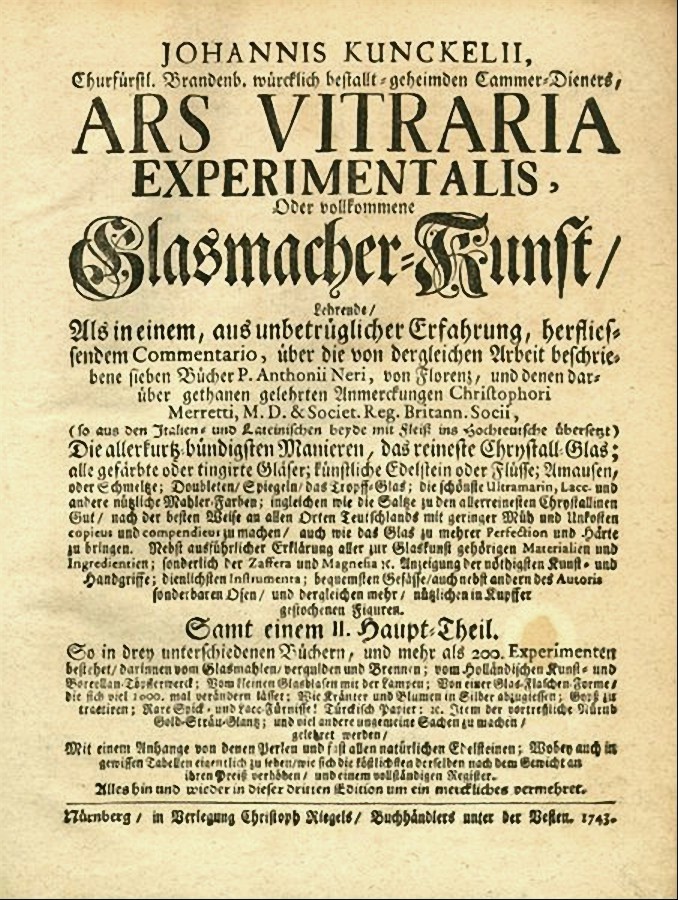
A gathering and mingling of early Kunkel families talks about our first notable figure, Baron Johann Kunckel von Löwenstern, a German chemist. Around 1678, he replicated Hennig Brand’s discovery of phosphorus isolation. Kunckel later managed the laboratory and glassworks in Brandenburg as a court chemist and apothecary.
Ars Vitraria ExperimentalisJohannes Kunckel, Ars Vitraria Experimentalis, 1679
The illustration by George Smith from his 1738 chapter “The art of blowing glass in miniature” (fig. 3) is not labeled alphabetically, but Johannes Kunckel’s 1679 engraving (fig. 4) is:
A — table around which four people may work at once
B — the lamp, filled with oil and a strong cotton wick
C—the hole where the tapered blowpipe is attached . . . so that the air is directed onto the acute and concentrated flame, producing a flame that will melt glass. Goldsmiths have a similar system for soldering metal.
D — bellows attached to pipes of tin that are hidden under the table
E — lever, attached to the foot pedal
F — ventilation hood
G — foot treadle for the bellows, pressed by the worker
Left: Probably engraved by Gottfried Spiller (1658–1728). Covered goblet with “Fruit Children,” before 1700. Gold ruby glass, H. 9 1/8 in. (23.1 cm). Focke-Museum, Bremer Landesmuseum für Kunst und Kulturgeschichte, Bremen (68.253). Center: Ruby glass flute with “AR” monogram, around 1715. German, Dresden. Gold ruby and transparent glass (blown, cut), H. 23 cm. Green Vault, Staatliche Kunstkammlungen Dresden (IV 228). Right:Covered goblet, 1725–35. German, Potsdam. Transparent dark gold ruby glass (blown, cut) 10 9/16 x 3 5/8 in. (26.9 x 9.2 cm). Corning Museum of Glass, Corning, New York, Bequest of Jerome Strauss (79.3.318) Gold ruby glass was perfected through alchemist and glassmaker Johann Kunckel’s experimentation under the patronage of Frederick William, Elector of Brandenburg, at the elector’s glassworks in Potsdam. Its name comes from the addition of colloidal gold to the glass before melting, a complex operation that required the skills of both alchemist and glassmaker. Displayed in a Kunstkammer, glass pieces served as signs of the alchemical knowledge required to produce them.
~ ~ ~ ~ ~ ~ ~ ~ ~ ~ ~ Continue Reading If You’re Interested in the Kunkle Line.
Our Kunkles trace back to my grandmother, Hilda Leonore Kunkle. However, I don’t have any personal stories to share as I didn’t know my dad’s family. I gained most of my knowledge later in life through my siblings, letters from my Aunt Elva (Hilda’s daughter), and documented facts and history shared by others.
Hilda married Glen Henry Logan in 1921 in Indiana County, Pennsylvania. Her father was Charles J. Kunkel. You’ll notice how the name is interchangeable with the -el and -le. He married Carrie Morrison in 1892. Charles lived most of his life in Westmoreland, Pennsylvania, until his wife died in 1937. He then moved to Michigan to live with his daughter, Hilda, and her family until his death in 1948 at the age of 82.
Charles’ father was Michael Kunkle. He also grew up in Westmoreland, Pennsylvania. In 1860, Michael married his neighbor, Esther “Hettie” Hawk. They were Lutherans, and Michael worked as a carpenter before becoming a farmer for the rest of his life. Michael passed away at the age of 80 in 1918 in Westmoreland.
Michael’s father was Daniel. They lived on Michaelsburg Plantation, a 336-acre estate owned by a family member. His family was among the First Families in Hempfield Township.
Some family stories were recorded in the History of Westmoreland County, Pennsylvania by Boucher, John Newton; Jordan, John W. (John Woolf), 1840-1921, joint editor. Publication date 1906. Publisher New York, Chicago, The Lewis publishing company. Contributor Allen County Public Library Genealogy Center
Daniel married Mary Elizabeth Kepple, and they had a son named Michael. They moved from Westmoreland to Indiana, Pennsylvania, where he worked as a railroad lock tender. Unfortunately, Elizabeth passed away about 10 years later. After her death, he married Catherine Iseman in 1844, but she died of cancer in 1850. In 1852, Daniel married Sarah, whose last name is unknown. It is still unknown when Daniel passed away, but it is confirmed that he was alive at least until 1870, as he is listed in the census at age 66 and still working for the railroad.
I’ve been putting off delving into the Kunkel family, but now things are more interesting. The first names in the family often begin with Johann for boys and Anna or Maria for girls. I’ve had to redo my Kunkle family tree twice because I initially followed the wrong line. However, thanks to the help of other researchers, Vernon Cook and James Kunkle, I am now back on track.
Daniel’s father is Johann Jacob Kunkel (Gunckel), Jr. It is in this generation that the Kunkel and Gunckel names are interchangeable. He married Elizabeth Schaeffer in 1789 and had 10 children. My records indicate that he was a farmer, and his cause of death was “gravel.” After researching old terms for the cause of death, “gravel” seemed to refer to the modern equivalent of kidney stones. He is buried in Brush Creek Evangelical Lutheran Church Cemetery.
Johann Jacob’s father is Johann Jacob Gunkel, Sr. His father is our immigrant ancestor of this family. He was born in Breitenburg, Germany in 1746, and they immigrated in 1749 when Jacob was only 3 years old.
Tom writes, One of the first known settlers in Pine Grove area after the French and Indian War, 1689-1763, Great Britain Battles France over unsettled territories in N. America, was Jacob Gunkel. He was located on the site of the Eagle Hotel in 1771. Here, he laid claim to a tract of two hundred acres of land, which he subsequently purchased from John and Richard Penn, proprietors of the Colony of Pennsylvania, which included the site of the present borough of Pine Grove. The convergence of several roads on Gunkel’s plantation made it an excellent location for a tavern, and soon after he purchased the land, he erected a log building, Gunkel’s Tavern, which he kept till 1810 and then he removed to a farm about a mile south from the borough were he died in 1813. His property was located next to the property of his daughter Eva and husband Johannes Loffler.
Another source states he “kept a house of entertainment, and in 1795 opened a store which he kept until 1810. (Source: History of Schuylkill Co, PA, by W. W. Munsell & Co, – 1881). On May 21, 1810, Jacob Gunckel of Pinegrove Township, Berks Co, PA, yeoman, and Susannah, his wife, sell to John Gunckel, yeoman, for 255 pounds, land containing 235 acres, part of the larger tract of land called “Gunckel’s Farm.” (Deed book 24, page 488).
Cemetery records for St. Peter’s (Gunkle’s) Union Church of Pinegrove Township, Schuylkill County include the following references: Jacob Gunkel; born September 28, 1746; died September 2, 1813 Eva Lefler; born Mar 25, 1809; died Jun 21, 1841 Johannes Leffler; born Jul 5, 1764; died Aug 16, 1849; son of Gottfried, Mahanoy Twp., Northumberland Co. Eva Lofler (nee Kunkle); w/John; died Jan 26, 1857; 83y 11m 15d
Gunkel’s Cemetery, located across the street from St. Peter’s Lutheran Church, contains a memorial plaque that reads: Site of the 1st Reformed-Lutheran Church 1782-1817 Donated by Jacob & Susanna Gunkel
Joh. Jacob’s father was Johann John Gunkel, born in 1722 in Breitenborn, Germany. John Gunckel married Anna Margarethe Lorentz and arrived in America in 1749 with his young son. In the book “Naturalizations of Foreign Protestants in the American Colonies,” there is the following: “John Gunckel of Bethel Twp., Berks County, Pennsylvania, became a citizen 20 September 1761.” These naturalizations were performed at the Philadelphia County, PA Courthouse. https://archive.org/stream/naturalizationso24grea#page/75/mode/2up/search/gunckel
Johann has often been confused with Johann Michael Gunkel, who was the same age. They were first cousins from Breitenborn and used similar names for their children. They also attended the same church. By the way, Johann (John) also had a brother named Johann Jacob. Talk about confusing!
John is also our Revolutionary War ancestor. His SAR Patriot number is P-171729. The John Gunckel of Bethel Township, who performed Revolutionary War service and from whom we are descended, was enrolled in 1777-1779 in the First Class, Captain Valentine Shoufler’s Seventh Company, First Battalion, Lancaster County Militia. He was assessed 26 pounds in fines, according to the evidence of an undated list of Class Fines. (Pennsylvania State Archivist, Military Accounts (Militia), Records of the Comptroller General, at the Division of Archives and Manuscripts) Larry Patrick Cornwell, 138085, has a SAR-approved supplemental under this John Gunckel. Larry served as the Genealogist General of the National Society, Sons of the American Revolution from 2011-2014 (www.sar.org)
John died in 1795 at the age of 73.
John’s father was Lorentz Gunkel, born in Breitenborn, Germany. He immigrated to the US in 1751 on the ship the “Duke of Bedford” with wife and one child, from Rotterdam, and last from Portsmouth, England. Port of entry was Philadelphia, PA, on a Saturday. Records show that Lorentz settled first in Northampton Co, PA, and later pioneered in Allegheny & Westmoreland Counties, PA. He was a Revolutionary War soldier and a pensioned veteran. *(Record Sources: 1804, pg 335 (Supp. 1983) aud 9041, pg 459 (From Flörsbach, Germany).
Lorentz wed Anna Catharina Gundlach in 1709. It’s uncertain who the “young child” who immigrated with them is. However, it could be our ancestor, Johann Jacob, as he was born in 1746.
Lorentz’s father was Hans Gunkel, who was born in Neuhütten, Spessart, Germany, in 1636. He was known as a Catholic man. He married Margareth N. and worked in a “glass house.” They later moved to Breitenborn, where Hans was invited by Heinrich Gundlach, the headmaster of the Breitenborn Works, to recruit glass makers from all over the country in the 1670s and 1680s.
When I originally published this post, a cousin replied, introducing himself. He also stated, “I do not believe that anyone actually lived in a “Glass House” I believe that this is simply a misinterpretation of the translation of Neuhutten. The Huts of glass were simply the buildings that were constructed… or the kilns… that were used to make the glass. These kilns were made of bricks so they could be brought to new areas where the resources (forests) were over-exploited to the point that they had to move to continue to be able to make glass. When they relocated to the area of NeuHutten they simply called it that “New Huts”.”
Hans Kunkel was a skilled glassblower, and many Kunkels were known for their glassblowing skills all over Europe at that time. Gundlach, an entrepreneur, made efforts to recruit the most talented glassblowers to come to Breitenborn. It is impressive that Hans Kunkel was still very productive in the 1680s. For instance, between January 4, 1684, and November 26, 1685, at around 50 years old, he produced 42,300 drinking glasses of various types and earned 91 fl. 16 alb (the equivalent of the dollar in those days). In addition to blowing glass, he occasionally attended the furnace, an important task for maintaining proper temperatures during the melting process.
During the winter months, the furnace stayed cold. The production period was 9 months per years – max. During the winter months, most of the works the people were also engaged in was cutting the firewood (beech and oak) for the furnace which did eat up a lot during the production period. So additionally they had another income. There were over 20 men permanently assigned to the fire wood cutting and handling, plus the seasonal ones. Hans Kunkel, for example, made 83-1/2 Clafter (7’x7’x3′) and earned 25 fl. additionally in 1689.
Despite all the hard work, Hans Kunkel lived to be nearly 100 years of age. There is a lot more similar data available, basically showing production figures, earnings, how they were paid (normally 50% cash, and the other in natural things, like grain, flour, etc. and the beverages, like beer and brandy were also brewing there.)
(Above Source: – “Heinrich P. Göbel” – Germany Researcher. (1994)
Hans’ father was Johann Michael, born in Glasshouse, Germany about 1600. He married Anna Katharine Naumann. He died in 1676. There is not much else known about him.
The Kunkels were already living in Neuhutten before the Thirty Years War. It seems that Neuhutten and that part of Germany were already in the Lutheran camp. The Kunkels all seemed to have been born, married, and died in “The Glasshouse” in Neuhutten.
Joh. Michael’s father was Johannes Jurg, born about 1565. He married Elisabeth Christina Houser.
The Kunkel family still live primarily in the Spessart Mountain range area, which is a mostly wooded region in the heart of Germany. There is a historical mention of an early Glasshouse in the Spessart area dating back to 22 August 1349. During that time, the area was under the jurisdiction of the Archbishop of Mainz.
The Union Letter (Bundesbrief) of 1537 (or the Federal Charter or Letter of Alliance) lists two KUNKELs, namely Jurge (George) and Hentze Kunkel, and in a later revision dated 24 February 1559, again two KUNKELs – George and Friedrich Kunkel. There are links, as glass-making was only carried down by the same families.–Janet and Robert Wolfe Genealogy, “Notes for Johann Jurg Kunkel and Elisabeth Christina Houser” Webpage: www.umich.edu/~bobwolfe/gen/mn/m6413x6414.htm Email address: JanetRobertWolfeGenealogy@gmail.com Go to the Genealogy Page for Johann Jurg Kunkel Go to the Genealogy Page for Elisabeth Christina Houser Go to the Kunkel surname index. Go to the Houser surname index. Go to the Home Page for Janet and Robert Wolfe Genealogy
Much research is still needed to fill out all the missing information; however, I have been told that genealogy records beyond this point are next to impossible to find due to all the wars that took place in this country. The Thirty Years War (1618-1648) destroyed many church records throughout Germany. So many records have been destroyed, and finding a cemetery with headstones that can be read after 500 years would be impossible.
All Kunkels do not accept the “dweller by deep water” definition of the name. Other research has yielded another possibility for its origin: It seems to derive from the Old High German name “KUHN,” meaning “wise.” (In this case, such a compliment would make it acceptable.) GUNKEL probably refers to living in deep water. In German, KUNKEL means the part of a spinning wheel called the distaff. A staff on which fibers such as flax or wool are wound before being spun into thread.
As you study the descendants of these families, you will find that intermarriages were rather common. Men had limited ways to meet eligible mates and could usually not go farther than they could walk or ride horseback to court. When there were family get-togethers, they met women who just happened to be related in one way or another. (James E. Kunkle- 2000)
Joh. Jurg’s father was Hans. Hans was born about 1530 in Glasshouse, Germany. He married Anna Catharina Wolfgang in 1554. Hans Kunkel of Neuhutten was called “Schwarzkoph” in the Parish records. Meaning “Black Forest.”
Some show Claus Kunkle, born 1490, as Hans’ father, and Conrad, born 1460, as Claus’ father, but I do not have sources to back these up.
The Coat-of-Arms of the Kunkel, Kunkle, etc., family is recorded in Rietstap’s Armorial General (Pg. 1144)
This link is one of James’ first works on the Kunkles and contains a lot of interesting information, from their Coat of Arms to their superstitions to their culture, customs, and rituals. Conkle/Kunkle File #1
While I couldn’t find exact Kunkel glass other than the original Johann’s, I did find some drawings of the glassblowers’ working areas in that century.
Glass blowing, from a Book of Trades, 1542 (engraving), German School, (16th century) / Private Collection / The Stapleton Collection / The Bridgeman Art Library
There is still much to learn about certain individuals in this family, and I hope to contribute to James and Wallace’s wonderful work. RIP, guys! You left a wonderful legacy for all of us.
Glass furnace, with workers. Georg Agricola (German, 1494–1555). In De re metallica [Berckwerck Buch, Frankfurt-am-Main, 1580, p. cccxc]. Rakow Research Library, The Corning Museum of Glass (66820). Photo: The Corning Museum of Glass. Read more at https://www.cmog.org/article/lamp.
If you need research assistance, do not hesitate to contact me.
Your Family
Tree Research Specialist
As an Amazon Associate, I earn from qualifying purchases.




![FIG. 39. Glass furnace, with workers. Georg Agricola (German, 1494–1555). In De re metallica [Berckwerck Buch, Frankfurt-am-Main, 1580, p. cccxc]. Rakow Research Library, The Corning Museum of Glass (66820). Photo: The Corning Museum of Glass.](https://i0.wp.com/i.pinimg.com/564x/4e/49/5e/4e495ec5a072d9bb33f6f130891e9660.jpg?w=840&ssl=1)
You must be logged in to post a comment.