The company he founded is called Sonoco today, a global provider of packaging products and services. (Not to be confused with Sunoco) He also founded Coker University (which was Welsh Neck High School, then the Coker College for Women, now Coker University).
~
Wouldn’t he be proud to know that his 5th cousin, 2x removed, Jeanne Wescott (my grandfather’s sister), attended Coker College in 1943? (Jeanne’s grandmother and James were 5th cousins.)
~
Just a year after he married his wife, the Civil War began and James fought in the Ninth South Carolina Infantry. He rose to the rank of major before getting hurt at Lookout Mountain, Georgia, shattering his leg in 1863. In that battle, he was captured by Union troops. He was released after 10 months.
~
From the fields of Hartsville, SC to the battlefields of Chickamauga, his journey transformed agriculture and education, leaving a legacy that shaped industries and communities alike.
~
Watch the video to witness the extraordinary life of James who wore many hats—farmer, soldier, and industrialist—who, despite the scars of war, cultivated a legacy of innovation and education that endures to this day.
~
In 2002, he was inducted into South Carolina’s Hall of Fame. CHStoday
~
~
“He was able to hire so many people in desperate straits after the war that he just uplifted the progress of everybody, black and white, urban or rural. He also was a leader in racial and social progress,”
Founded in 1899, Sonoco Products Company is a United States-based international provider of diversified consumer packaging, industrial products, protective packaging, and packaging supply chain services and the world’s largest producer of composite cans, tubes, and cores. Wikipedia Stock price: SON (NYSE) $60.71 +0.07 (+0.12%) Dec 30, 4:00 PM EST – Disclaimer Headquarters: Hartsville, SC Subsidiaries: Sonoco ThermoSafe, MORE CEO: R. Howard Coker (Feb 2020–) Number of employees: 21,000 (2017) Revenue: 5.237 billion USD (Fiscal Year Ended December 31, 2020) Founder: James Lide Coker Founded: May 10, 1899
As an Amazon Associate, I earn from qualifying purchases.
I received a copy of a letter from the Gunn Memorial Library and Museum, written in 2008 by Marlene Flanders, a former aide to Mrs. Verna Logan, who passed away in 1987. In the letter, she mentioned a story she had heard about the Rising Sun Inn, also known as The Logan Homestead, which allegedly harbored an “interracial couple”: a Cherokee Indian man and a white woman. I was intrigued by this account, as I had not come across it before. This blog post tells the story.
Letter written in 2008 by Marlene Flanders, former aid to Mrs. Verna Logan., who died in 1987.
The Beginning: Two Lives, Worlds Apart
In 1803, a boy named Killekeenah Oowaite was born into the Cherokee tribe in New Echota, Cherokee Nation (now Georgia, USA). His upbringing was steeped in the traditions of his family, including his father Dutse Oowaite, and his mother, the daughter of High Cherokee Chief Attaculcullah. Their family name was eventually shortened to Watie. Two years later, in Cornwall, Connecticut, Harriet Ruggles Gold was born into the prominent Gold family, whose legacy was rooted in strong Christian values and community leadership.
Education and Encounter
At 18, Killekeenah met Elias Boudinot, a Revolutionary War figure, a friend and counselor to George Washington, and former President of the Continental Congress, who saw potential in the young Cherokee man. Boudinot sponsored Killekeenah’s education, sending him to the Foreign Mission School in Cornwall, where he adopted the name Elias Boudinot. It was here that he met Harriet Gold, whose family often hosted students from the school.
Their friendship deepened into love, but the cultural and racial norms of the time set them on a path fraught with opposition and challenges.
The Challenges of Love
In 1822, Elias returned to the Cherokee Nation due to illness but remained in contact with Harriet and her brother Franklin through letters. By 1824, their correspondence revealed a deepening relationship. When Harriet shared her intentions with her parents, they vehemently opposed the union. The Gold family, known for its standing in Connecticut, was divided. Harriet’s brothers-in-law, both ministers, argued it was her Christian duty to prioritize the mission school’s reputation over her personal happiness.
Harriet, however, stood firm in her convictions. Despite public outcry and even the burning of an effigy depicting Harriet, Elias, and an ally, Mrs. Northrop, Harriet’s resolve did not waver. (Elias’ cousin, John Ridge also attended the Mission School, where he met Sarah Northrop, the daughter of the school’s steward. The two became romantically involved and wed in January 1824.)
The Honeymoon at the Logan Homestead
After enduring months of familial and societal pressure, Harriet’s immediate family softened their stance. In May 1826, Harriet and Elias married at the Gold Homestead and spent their wedding night at the Logan Homestead, which was fortified and protected by Captain Logan and his armed men. This act of defiance by Captain Logan ensured the couple’s safety during a time of heightened tension.
The couple left Connecticut the next day, embarking on a 47-day journey to the Cherokee Nation in Georgia.
A New Life and Tragic Loss
Settling in New Echota, Elias became the editor of the Cherokee Phoenix, the first tribal newspaper in the United States. It was printed in English and Cherokee, using the Cherokee syllabary created by Sequoyah. In her family letters, Harriet described a good life, and that she had been warmly welcomed upon her arrival. Harriet gave birth to six children, but tragedy struck during her seventh pregnancy. In May 1836, Harriet’s child was stillborn, and she passed away three months later at the age of 31. She was buried in New Echota, and Elias erected a tombstone made from marble brought from Connecticut—a testament to her enduring connection to her roots.
Elias Boudinot, formerly known as Killekeenah Oowaite
The Aftermath
The Cherokee Nation’s land was increasingly encroached upon by settlers, culminating in the infamous Trail of Tears. Elias’ eventual support of the Treaty of New Echota, which advocated for Cherokee relocation, marked him and others as traitors in the eyes of many. In 1839, Elias was assassinated for his controversial stance.
Harriet and Elias’ children were sent back to Connecticut, where they were raised by Harriet’s sister Mary Brinsmade. The boys, William, Frank, and Elias, attended The Gunn School in Washington, Connecticut, while the girls were cared for by their aunt.
Legacy of the Logan Homestead
The Logan Homestead, a witness to this extraordinary love story, remains a symbol of courage and resilience. Harriet and Elias’ union defied societal norms, blending two distinct cultures in an era resistant to change. Captain Logan’s decision to protect the couple during their wedding night speaks to the power of individual acts of bravery in shaping history.
Harriet’s grave stands as a poignant reminder of a woman who followed her heart, defied convention, and left an indelible mark on both her family and history.
Threatened by Georgia soldiers for championing Cherokee nationalism yet executed by his own people for treason, Elias Boudinot left a complex legacy.
1800 Photograph of the grave of Harriet Ruggles Gold Boudinot, New Echota, Gordon County, Georgia
Acknowledgments
Special thanks to Stephen Bartkus, previous Curator of the Gunn Historical Museum, and Sarah Griswold, previous Curatorial Assistant, for their invaluable contributions to the previous research by Mark Oliver*.
Gunn Memorial Library and Museum Archives. (Special thanks to Amy Campanaro and Corinne Tabolt.)
Correspondence of Harriet Gold and Elias Boudinot. To Marry an Indian: The Marriage of Harriett Gold and Elias Boudinot in Letters, 1823-1839. United States, University of North Carolina Press, 2006.
Historical records from the Foreign Mission School, Cornwall, CT.
“[Photograph of the grave of Harriet Ruggles Gold Boudinot, New Echota, Gordon County, Georgia].” 1800/1994. January 25, 2025. https://dlg.galileo.usg.edu/vang/do:gor379.
Have you ever heard someone dismiss family history research as a hobby for “old people”? While it’s true that some may associate genealogy with dusty archives and microfilm reels, this couldn’t be further from the truth. In fact, there’s a growing fascination with ancestry across all ages.
Shows like “Finding Your Roots” and “Genealogy Roadshow” have sparked a national interest in uncovering our heritage. DNA testing has also become increasingly popular, offering a new avenue for piecing together our family stories.
But DNA is just one tool in the genealogist’s toolbox. Traditional methods, like collecting vital records such as birth certificates, marriage licenses, and obituaries, remain the cornerstone of genealogical research. These records can provide a wealth of information about our ancestors’ lives, from their places of birth and occupations to their migration patterns and relationships.
Sometimes, traditional research methods reach a dead end, especially when faced with immigration records, name changes, or missing documentation. That’s where genealogical societies come in. These local organizations are treasure troves of historical resources, often staffed by passionate volunteers eager to help you climb over your brick walls. And their fees are often surprisingly affordable!
If you’re curious about your ancestry but lack the time or resources to delve into research yourself, there are family history research specialists like myself available to help. Whether you need a comprehensive family tree compiled or simply guidance on where to begin your research journey, I can tailor a package to fit your needs.
So, if you’ve ever wondered about your roots, don’t be discouraged by the perception that genealogy is a niche hobby for the elderly. The past is waiting to be explored, and there are many resources available to help you on your journey. Visit my website at www.loganalogy.com today to learn more and begin your own adventure into family history!
Thanks for reading, Marlee L. Logan
Private message me at m.me/Loganalogy
As an Amazon Associate, I earn from qualifying purchases.
Johann Henrich Heilig, my 6th great-grandfather, was born in 1700 and married Susanna De Wees Rittenhausen in 1729. Susanna’s family was prominent in early American industry, particularly in the Rittenhouse paper mills, which I’ve written about previously. If you’re a descendant or admirer of the Rittenhouse legacy, I recommend exploring the Rittenhouse Family Descendants and Friends Facebook page and learning about their efforts to preserve this rich history. The Rittenhouse Town Board of Directors actively maintains the historic Homestead House (built in 1707), the surrounding village, and a barn constructed during the WPA era.
Henrich’s origins remain debated among historians. Earlier accounts suggest he was born in Hannover, Germany, while newer research points to Baden-Wuerttemberg. What we do know is that Johann arrived in Philadelphia in 1720 aboard the Polly. Since passenger lists weren’t required until 1727, his exact journey is pieced together through indirect evidence.
By April 11, 1747, Johann was officially naturalized as a resident of Pennsylvania, meeting the colonial requirement of seven years’ residency. By this time, he was known as Henry—a clockmaker by trade. Clockmaking was a respected profession during the 18th century, vital for navigation, surveying, and precise timekeeping.
Henry and Susanna initially settled in Cheltenham but later purchased land on the borders of Pennsburg and Upper Hanover Townships in Montgomery County in 1749 and 1750. This property, acquired from surveyor William Parsons (an associate of the Penn family), remained in the family for generations. Passing from Henrich to his son George, and later to George Jr., the land was eventually sold to the Hoch family in the 1860s. Remarkably, the Hoch family still owns the house today—a living testament to centuries of stewardship.
Before 1684, the Lenape Indians roamed the hills and fished the streams of the land on either side of the Perkiomen Creek. In 1684, the Indians lost this land when William Penn purchased it for reportedly “two watch coats, four pairs of stockings and four bottles of cider.” In time, Pennsylvania Germans settled in the area. Around 1840, the area now known as Pennsburg began to appear like a village. The hub comprised a general store, a carpenter and blacksmith shop, and several houses. Most of the land was owned by the Heilig Brothers. They owned and resided in the oldest house in Pennsburg, located at Seminary and Fourth Streets. The Heilig Brothers took it upon themselves to refer to this village as “Heiligsville.” Residents had their ideas, and out of loyalty to the then Pennsylvania Senator, James Buchanan, wanted to name the area Buchanansville.
As the village grew, a meeting was held in 1843 at the Hilleg family store to decide on a permanent name and layout of boundary lines. After a week-long, bitterly contested battle, it was finally decided to name the village “Pennsburg” after William Penn.
i. Heinrich Heilig, b. 1722, ii. Jurg George Heilig, b. 1720; d. 1796, Upper Hanover Township., iii. Johannes Heilig (Source: Willbook I – 1796, 149-150.). iv. Anna Maria Heilig (Source: Willbook I – 1796, 149-150.), m. Michael Slonaker., v. Susanna Heilig (Source: Willbook I – 1796, 149-150.), b. 1726; m. Henry Deany.
Johannes or John changed the surname to Highley. The other children kept the German spelling of Heilig.
This notation appears on a locally sold postcard by Len Hillegass of the Heilig House: “The Heilig House at 313 W. 4th Street is considered the oldest house in Pennsburg. Wounded and ill Colonial Soldiers were cared for there by the very compassionate Heilig family during the Colonies’ fight for independence from British rule during the American Revolution.” Album by Reid Heilig You can see other pictures of the house at https://imageevent.com/heilig/heiligheritage/heilighousepennsburgpa?n=1&z=2&c=4&x=0&m=24&w=0&p=0.
Henry was a clockmaker. He passed down the art of his clockmaking skills to his children and nephews. One of the most famous was David Rittenhouse, an avid astronomer; he built complicated astronomical clocks and orreries, or planetary models, that kept time and predicted celestial events.
David Rittenhouse tall case clock. 1984.0416.007.
Henry is listed in the U.S., Craftperson Files, 1600-1995.
With hand made brass works in the German style, it consists of 19 bells, a wooden cylinder with pins that activate 19 hammers to play tunes, a bone wave to switch tunes. Iron frame is dovetailed together. You can read more about each piece on Reid Helig’s site at https://imageevent.com/heilig/hheiligclock/themusicmechanism
Henry was buried along with his wife in the mostly Rittenhouse family cemetery, Methacton Mennonite Cemetery. Click here for a partial list of burials with links to tombstone photographs. Henrich’s and Susannah’s are below. This cemetery is located in Worcester Township, Montgomery County, PA.
Henrich Heilig .. Died May 14, 1775 .. Aged 74 year 11 Mo 12 daysSusannah Rittenhouse .. Departed This Life December 13, 1769 .. Aged 71 YearsThe interesting thing about Susannah’s tombstone is that it shows her maiden name as “Rittenhouse.” However, this would be the correct person calculating the birth year by her age at death.
A wonderfully thorough history is written by Linton E. Love, a descendant of the Rittenhouse family. In it are the descendants of Henry and Susannah. Linton has created a database extending from the 17th century up to the 21st century from Claus to his 12,810 descendants as of March 2005!
Johann Henrich Heilig’s story is one of perseverance, skill, and enduring family ties. From his arrival in Philadelphia to the land that remains in familial care, his legacy is woven into the fabric of American history. Whether as a skilled clockmaker or as part of the Rittenhouse connection, his contributions remind us of the resilience and dedication of early immigrants. By reflecting on his life, we not only honor his journey but gain inspiration for preserving our own family stories for generations to come. Do you have a Heilig clock? You might!
As an Amazon Associate, I earn from qualifying purchases.
A billboard advertising Strawberry Hill is displayed on the corner of North 6th Street and Central Avenue on Friday, Sep. 30, 2022, in Kansas City, Kansas. Emily Curiel ecuriel@kcstar.com
A Serendipitous Encounter with the Past
My journey into the world of genealogy has been filled with unexpected twists and turns, leading me down fascinating paths and uncovering hidden stories. One such discovery was the neighborhood of Strawberry Hill, a vibrant and historic community in Kansas City, Missouri.
The Stephanz Family Connection
My initial encounter with Strawberry Hill came about while researching the Stephanz surname in my family tree. In my blog post about Mathias Paul Stephanz, Jr., I mentioned that he resided at the rear of 411 Sandusky Avenue. This seemingly insignificant detail sparked my curiosity and led me on a deeper dive into the history of this particular address.
Unveiling the Past: The Chops and Wolfs
As I delved further, I discovered that the Stephanz family had neighbors with the surnames Chops and Wolfs (or Volf). Intriguingly, these families also shared a connection to 411 Sandusky Avenue, having lived in the same house at different points in time. This revelation piqued my interest even more, prompting me to explore the history of Strawberry Hill in greater detail.
A Fortunate Discovery: Don Wolf’s Blog and Book
While exploring the rich history of Strawberry Hill, I stumbled upon a treasure trove of information: Don Wolf’s blog and book. Don Wolf, a descendant of the Wolf family who were once neighbors to 411 Sandusky Avenue, had dedicated himself to preserving the history of Strawberry Hill. His work provided invaluable insights into the neighborhood’s past, including stories about the Chops and Wolfs, as well as other families who had called Strawberry Hill home.
Click on the photo to purchase “Croatian Love Story.”
The Heart of Strawberry Hill
Through Don Wolf’s writings and other historical resources, I began to piece together the vibrant tapestry of life in Strawberry Hill. I learned about the neighborhood’s diverse community, its rich cultural heritage, and its significant contributions to the history of Kansas City.
A Legacy of Resilience and Community
As I continued my research, I was struck by the resilience and community spirit that defined Strawberry Hill. Despite facing numerous challenges throughout its history, the neighborhood has persevered, maintaining its unique character and cultural identity.
A Personal Connection to History
My journey into the heart of Strawberry Hill has not only deepened my understanding of my family history but also provided a valuable connection to the broader historical narrative of Kansas City. It is a reminder that every place, every street, and every house has a story to tell, and that by exploring these stories, we can gain a deeper appreciation for the past and the people who shaped it.
Most of the children attended St. John the Baptist Catholic School. I found another interesting blog with photos of Strawberry Hill. One of the pictures I like the most is of his mother walking with groceries – one picture is before the highway, and the other is after. Croatian History.
Strawberry Hill History & Culture “Situated in the heart of downtown Kansas City, Kansas, Strawberry Hill is a Slavic American community with a rich and unique history. It is one of overcoming obstacles and pulling together as a community to thrive and carve out a new home in the Heartland.
During the late 1800s, immigrants from Eastern Europe, a large number of them from Croatia, settled along the riverfront in an area known as “The Patch.” Most of these residents worked in the meat packing industry connected with the livestock exchange.
In 1904, a great flood destroyed many of these homes, forcing residents to move uphill from the river. Many of these immigrant families were forced to build their homes from materials salvaged and recycled from the homes destroyed in the flood and could only afford a narrow parcel of land, giving rise to the modest sized homes in close proximity to each other that dominate Strawberry Hill’s streets and avenues. The wild strawberry vines that covered the hillside gave the new community its name.
Over time, many families chose to grow their homes as their savings and income allowed. Some of the elaborate or stately Victorian homes in Strawberry Hill began as single story homes, or even shot-gun houses, while some of these modest houses have been preserved and retain their cottage size and style. The original paver sidewalks connect the turn-of-the-century folk houses, many of which retain their turned spindle work, stained glass windows, and, above all, their welcoming front porches.
Tragically, in 1918 the Spanish Flu arrived on The Hill. The tightly packed neighborhood exacerbated the spread of the deadly diseased which killed many adults in their 20’s and 30’s, leaving behind many orphans and widowed single parents. In 1919, St. John the Baptist Catholic Church purchased the Cruise-Scroggs home on 4th Street and opened an orphanage to help the orphaned children. It continued to operate as an orphanage until 1988, after which it became today’s museum and cultural center.
In 1957, 219 homes were destroyed to make way for the I-70 bridge. 1st street, 2nd street, 3rd street, and parts of 4th street were destroyed as well as the sections of neighborhood avenues that intersected these streets. Members of our association witnessed the destruction of their childhood homes and lost a portion of their heritage for the sake of the viaduct that connects Kansas City, Kansas to Kansas City, Missouri. St. John’s Park was created in the process of the construction and features a spectacular view of the Kansas City, Missouri skyline.
As recently as 2016, pedestrian trails have been improved as a part of the Riverfront Heritage Trail. This system of trails and pedestrian bridges now allows residents to travel by bike or on foot from Strawberry Hill to Kansas City, Missouri or the nearby Kaw Point Park, among other destinations realized by the extensive network of sidewalks and trails. The pedestrian bridge beneath I-70 near 3rd and Armstrong stretches across the river and features sculptures by a local artist.
The unique history of Strawberry Hill is one of perseverance, hard work, and surviving tragedies as a community. Whether natural disasters, epidemics, economic hardships, or certain destruction in the name of progress…our people have pulled together and weathered the hardest of circumstances. We have built a vibrant and beautiful community from the rubble and continue to thrive as an organized neighborhood that advocates for the preservation of our historic homes and the safety and well being of all residents–regardless of race, gender, age, class, religion, sexual orientation, disability, or political preference.
Our neighborhood association invites you to become a part of our bustling community!”
One of the best depictions of Strawberry Hill is by the artist Marijana Grisnick. Check out these links for her fascinating paintings and a glimpse of where our ancestors grew up.
My unexpected discovery of Strawberry Hill has been one of the most rewarding experiences of my genealogical journey. It has opened my eyes to the rich history that surrounds us and the power of personal stories to connect us to the past. As I continue to explore the depths of my family tree, I am grateful for the serendipitous encounters that have led me to this fascinating corner of history.
I encourage you to embark on your own genealogical journey and uncover the hidden stories within your own family history. You never know what fascinating discoveries await you. And if you have any stories or insights to share about Strawberry Hill, please feel free to leave a comment below. Let’s work together to preserve the rich history of this vibrant community.
As an Amazon Associate, I earn from qualifying purchases.
Minnie Baylor Cofer’s roots trace back to her parents, Robert Emmett Cofer and Martha Ann Davis—my third great-grandparents. While much of their story comes from scattered records and family notes, they were both born in Virginia and married at 23 in Norfolk.
Martha Ann Davis: A Life of Privilege and Transition
Martha was the third of eleven children, coming of age during the tumultuous Civil War era. By 1863, President Lincoln had issued the Emancipation Proclamation, and battles like Chancellorsville raged nearby. Martha’s granddaughter, Elizabeth Cofer Reed, recalled stories of her grandmother’s privileged upbringing: a private finishing school education, her own carriage with two horses, and never dressing herself until adulthood. Despite this sheltered life, Martha later worked as a professional nurse, as listed in the 1900 census at age 59—quite an accomplishment for a woman of her time.
Martha lived until 78, passing away from heart disease, and was laid to rest beside her husband in Cedar Grove Cemetery, Norfolk City, Virginia.
In my estimate, this is about 1918.The MyHeritage tool estimated this picture to be take circa 1920.
Robert Emmett Cofer: A Skilled Tradesman
Robert was one of ten children, later gaining four half-siblings after his father remarried. Growing up in Surry County, Virginia, Robert learned the craft of carriage making as a teenager, later becoming a wheelwright—a trade that was invaluable to the Confederate Army.1 After 43 years of marriage, Robert succumbed to dysentery at 67.
The Cofer Family’s Antebellum Roots
Robert’s father, Isaac Cofer, owned a plantation in Surry County with a fluctuating number of enslaved individuals, peaking at fifteen by 1860. Following the Civil War, Isaac filed a claim for the loss of his enslaved worker, John, highlighting the entanglement of family history with America’s dark past.
Isaac’s wealth diminished significantly by 1870, and he passed away a few years later. His second marriage to Sarah Jones (possibly related to his first wife, Mary C. Jones) adds another layer to the family tree puzzle.
Isaac’s father, Reverend Joseph Cofer, was a Baptist minister and a patriarch of thirteen children. His first wife, Jerusha Lancaster, died young, leaving behind ten children, while his second wife, Martha Wrenn, added three more. Joseph’s plantation was substantial, with 25 enslaved individuals and connections to significant events like the crafting of samplers commemorating family deaths.
Innovations and Legacy
Isaac’s half-brother, Thomas Wrenn Cofer, stands out for his inventive spirit. During the Civil War, Thomas patented the Cofer revolver, a weapon used by the Confederate Army. 2Today, these rare firearms fetch thousands of dollars and are a testament to the family’s historical imprint.
Tracing Back to England
The Cofer line extends to John Coker, who arrived in America in 1635 aboard the Plain Joan.3 He earned his land through the headright system and eventually settled in Surry County, Virginia.4 Records tie the family to influential figures, including Richard Bennett Jr., and suggest English origins in Dorsetshire.
The video below shows an old grist mill owned by the Wrenn family, which stood on Route 677, north of Smithfield. The video is made from scans of a roll of medium format film taken in the late 1960s with a Yashica Model “D” camera. The mill was demolished in 1989 after a pickup went off the road and crashed into it.5
The below article was something I found in my research while writing this blog. A person from my Isle of Wight Facebook page owns the book and supplied the missing page 90 in order for me to complete my notes.
The book title is In the Neatest Manner: The Making of the Virginia Sampler Tradition By Kimberly Smith Ivey
Southampton, Surry, and Isle of Wight Counties Unity A. Delk and Elizabeth M. Cofer worked almost identical samplers to honor the deaths of their respective parents, Wiley Jones Delk and Jerusha Lancaster Cofer (figs. 123 and 124). An earlier sampler, worked by Unity’s older sister, Martha, is not shown here; it commemorates their father’s death. In 1824, four years after the death of Wiley Delk, his widow, Martha Wren Delk, of Southampton County, married Joseph Cofer, a Baptist minister from the Isle of Wight and Surry Counties. One year earlier,Joseph’s first wife,
Figure 123 – Sampler by Unity A. Delk, dated Sept. 5, 1834; attributed to Isle of Wight County, Virginia. Figure 124 – Sampler by Elisabeth M. Cofer, age sixteen, dated 1834, attributed to Isle of Wight County, Virginia.
I found this information on the Colonial Williamsburg website about a sampler created by Elizabeth M. Cofer that includes the exact date of Jerusha’s death.6 It would be wonderful to have this, and I am thrilled to have found it! The sampler was passed down in the family to Mary Wrenn Cofer Ballard and was donated to Colonial Williamsburg by her husband, Mr. L. W. Ballard.
A Living History
The Cofer legacy is a tapestry of privilege, hardship, and resilience. From Martha’s cherished stories to the craftsmanship of Robert and Thomas, every thread connects to the broader narrative of Virginia’s history. Artifacts like Elizabeth M. Cofer’s 1834 sampler—now at Colonial Williamsburg—offer tangible links to these ancestors, reminding us of the enduring impact of their lives.
Filby, P. William, Meyer, Mary K., Passenger and immigration lists index: a guide to published arrival records of about 500,000 passengers who came to the United States and Canada in the seventeenth, eighteenth, and nineteenth centuries. 1982-1985 Cumulated Supplements in Four Volumes Detroit, Mich.: Gale Research Co., 1985, Print (ISBN 0-8103-1795-8) ↩︎
As family historians, we’re no strangers to challenges. Our work requires patience and dedication, often navigating through countless records in search of a missing piece to the puzzle. While it’s all part of the journey, there are a few common mistakes and oversights that can hinder progress for beginners and seasoned researchers alike. Let’s explore some of these pitfalls and how to sidestep them, making your genealogy journey smoother and more accurate.
1) Unsourced Family Trees One of the biggest challenges in online research is coming across family trees that lack sources. Without citations, notes, or records to back up the information, it becomes nearly impossible to verify the accuracy of those entries. To avoid this, always make a habit of adding sources—whether it’s a census record, a photo, or even a story passed down from relatives. It helps others (and yourself) to understand where the information originated.
2) Incoherent Information Mistakes happen, but spotting impossible scenarios—like a person giving birth after their death—can feel confusing. Double-checking dates and cross-referencing records can prevent these errors from slipping in. Always remember, consistency is key in genealogy.
3) Duplicate Children When researching large families, especially in the 1800s, it’s important to verify children’s birth dates and names. Variations in nicknames across records (like Maggie for Margaret or Polly for Mary) can cause confusion, so be mindful of these when reviewing census records.
4) Unresponsive Genealogy Contacts It’s always exciting to connect with distant relatives online, but don’t be disheartened if you don’t get an immediate response. While it can be frustrating, remember that people may have busy schedules. A gentle follow-up message is okay, and patience is key.
5) Recycling Unverified Facts It’s tempting to adopt information from other family trees, but it’s important to verify facts before incorporating them into your own. Always take a moment to check records and sources; this will ensure that your family tree remains accurate and reliable.
6) Unlabeled Photos Photographs of ancestors can be priceless treasures, but unlabeled images can cause confusion. When sharing family photos, be sure to include as much detail as possible—dates, names, and locations. Even if some details are unclear, adding context helps future researchers.
7) Irrelevant Records It’s easy to misinterpret a record that seems to match an ancestor, but always consider the geographical and chronological context. If your ancestor spent their life in one place, it’s unlikely they have records in a far-off country without explanation. Keep track of family movements to avoid such missteps.
8) Mythical Surname Coats-of-Arms Be cautious when it comes to purchasing coats-of-arms tied to your surname. Remember, coats-of-arms are granted to specific individuals, not entire families. It’s always worth researching the actual lineage behind such claims.
Genealogy is an exciting adventure, filled with moments of discovery and connection. While it’s natural to encounter challenges along the way, approaching your research with a discerning eye and a commitment to accuracy will ensure that the stories you uncover are as authentic as the ancestors who lived them. Whether you’re just starting out or diving deeper, keeping these common pitfalls in mind will help make your family history journey all the more rewarding.
As an Amazon Associate, I earn from qualifying purchases.
For most of us, Pennsylvania played an important role in our ancestors’ history. Pennsylvania has been a destination for a wide range of immigrants, including Europeans, African Americans, and others. These individuals were drawn to the state because of its significant role in the nation’s development and its diverse industries. During the colonial period, Pennsylvania’s religious freedom attracted various ethnic and religious groups, such as Quakers, Mennonites, and Amish. Welsh Quakers settled in what are now Montgomery, Chester, and Delaware counties, while German immigrants developed their own dialect and eventually became known as the Pennsylvania Dutch.
Pennsylvania experienced substantial industrial growth, particularly in steel production, coal mining, and oil fields. This led to a large influx of European immigrants seeking employment, including individuals from Ireland, Germany, Italy, Poland, Scandinavia, Russia, and Slovakia. Moreover, the state played a pivotal role in the Civil War and served as a primary entry point for many immigrants.
The Pennsylvania Historical & Museum Commission was created in 1945 and is responsible for the collection, conservation, and interpretation of Pennsylvania’s historic heritage. Not only do they oversee the state archives, which you can visit in person or online, but they also have a wonderful museum section. These museums encompass Daniel Boone (he was born in Pennsylvania), the lumber industry, the mining industry, the railroads, and many others. They even have a “village & farming” museum. You can visit these in person or online as well.
In addition, check out PA History 2 G0, a series of videos produced by the PHMC, with funding from the Institute of Museum and Library Services. These short videos introduce you to Pennsylvania’s state-owned historic sites and museums as they explore the varied stories that make up the commonwealth’s rich history. Still, they have an online collection of historical objects, archaeological artifacts, and natural history specimens.
Pennsylvania’s rich history is deeply intertwined with the stories of our ancestors, who found in this state a place of opportunity, freedom, and growth. From the religious sanctuaries of the colonial era to the booming industries that shaped the nation, Pennsylvania has been a beacon for diverse communities and a witness to pivotal moments in American history. As we explore the state’s historic sites, museums, and archives, whether in person or online, we not only honor our heritage but also gain a deeper understanding of the challenges and triumphs that have shaped the lives of those who came before us. The Pennsylvania Historical & Museum Commission continues to preserve and share these stories, ensuring that the legacy of our ancestors remains alive for generations to come.
Image Depicting Pennsylvania’s Rich History and Industrial Heritage. OpenAI, 2024.
I want to emphasize that all the research mentioned below was conducted by other individuals, and I simply discovered their work. Fortunately, our relatives were very supportive and willing to share their findings with me.
James E. Kunkle, a retired US Navy officer who resided in Colorado, passed away in 2017 at the age of 90. I had been corresponding with him since 2012. He and Wallace M. Kunkel (also deceased) have compiled the following history of the Kunkel families, which is available at the Family History Library, among other works authored by James, and at the Library of Congress. I have put a link to it here. A gathering and mingling of early Kunkel families
Wallace’s grandmother began the genealogy work in the late 1940s, spending long hours at her typewriter. She created genealogy books for her seven grandchildren as Christmas presents in the 1960s. Wallace, his daughter Mary, and his grandchildren have continued this work. When Wallace was alive, he collaborated with James on this historical project. It’s poignant that yesterday (I originally wrote this blog on April 8, 2018.) marked the anniversary of his passing. Wallace was also known as “Mr. Sawdust,” a skilled furniture maker and the founder of the “Mr. Sawdust School of Professional Woodworking.”
“At least forty families of Protestant Kunkels immigrated to America from Germany between 1728 and 1770. Some of the Catholic families of Kunkels immigrated to the United States after the War of 1812. Many of the early Kunkel families settled in Pennsylvania. Today, Kunkels live in Pennsylvania, Maryland, Ohio, Wisconsin, Illinois, Indiana, Minnesota, and throughout the United States. The surname is spelled Kunkel, Kunkle, Gunkel, Gunkle, Konkel, Konkle, and other variant spellings.” -J.E. Kunkle & W.M. Kunkel, 1995 (415 pages of history).
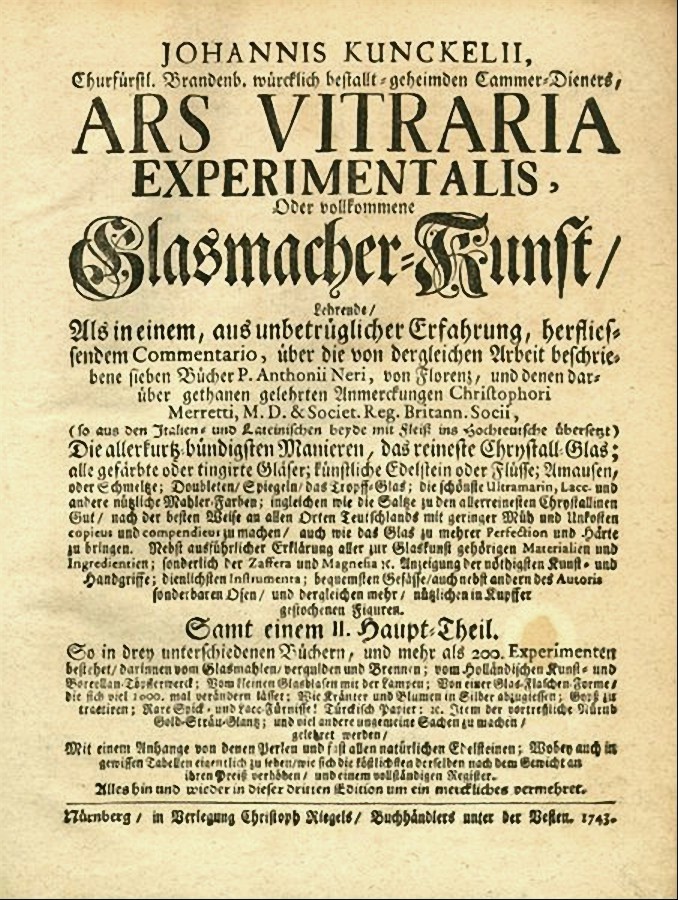
A gathering and mingling of early Kunkel families talks about our first notable figure, Baron Johann Kunckel von Löwenstern, a German chemist. Around 1678, he replicated Hennig Brand’s discovery of phosphorus isolation. Kunckel later managed the laboratory and glassworks in Brandenburg as a court chemist and apothecary.
Ars Vitraria ExperimentalisJohannes Kunckel, Ars Vitraria Experimentalis, 1679
The illustration by George Smith from his 1738 chapter “The art of blowing glass in miniature” (fig. 3) is not labeled alphabetically, but Johannes Kunckel’s 1679 engraving (fig. 4) is:
A — table around which four people may work at once
B — the lamp, filled with oil and a strong cotton wick
C—the hole where the tapered blowpipe is attached . . . so that the air is directed onto the acute and concentrated flame, producing a flame that will melt glass. Goldsmiths have a similar system for soldering metal.
D — bellows attached to pipes of tin that are hidden under the table
E — lever, attached to the foot pedal
F — ventilation hood
G — foot treadle for the bellows, pressed by the worker
Left: Probably engraved by Gottfried Spiller (1658–1728). Covered goblet with “Fruit Children,” before 1700. Gold ruby glass, H. 9 1/8 in. (23.1 cm). Focke-Museum, Bremer Landesmuseum für Kunst und Kulturgeschichte, Bremen (68.253). Center: Ruby glass flute with “AR” monogram, around 1715. German, Dresden. Gold ruby and transparent glass (blown, cut), H. 23 cm. Green Vault, Staatliche Kunstkammlungen Dresden (IV 228). Right:Covered goblet, 1725–35. German, Potsdam. Transparent dark gold ruby glass (blown, cut) 10 9/16 x 3 5/8 in. (26.9 x 9.2 cm). Corning Museum of Glass, Corning, New York, Bequest of Jerome Strauss (79.3.318) Gold ruby glass was perfected through alchemist and glassmaker Johann Kunckel’s experimentation under the patronage of Frederick William, Elector of Brandenburg, at the elector’s glassworks in Potsdam. Its name comes from the addition of colloidal gold to the glass before melting, a complex operation that required the skills of both alchemist and glassmaker. Displayed in a Kunstkammer, glass pieces served as signs of the alchemical knowledge required to produce them.
~ ~ ~ ~ ~ ~ ~ ~ ~ ~ ~ Continue Reading If You’re Interested in the Kunkle Line.
Our Kunkles trace back to my grandmother, Hilda Leonore Kunkle. However, I don’t have any personal stories to share as I didn’t know my dad’s family. I gained most of my knowledge later in life through my siblings, letters from my Aunt Elva (Hilda’s daughter), and documented facts and history shared by others.
Hilda married Glen Henry Logan in 1921 in Indiana County, Pennsylvania. Her father was Charles J. Kunkel. You’ll notice how the name is interchangeable with the -el and -le. He married Carrie Morrison in 1892. Charles lived most of his life in Westmoreland, Pennsylvania, until his wife died in 1937. He then moved to Michigan to live with his daughter, Hilda, and her family until his death in 1948 at the age of 82.
Charles’ father was Michael Kunkle. He also grew up in Westmoreland, Pennsylvania. In 1860, Michael married his neighbor, Esther “Hettie” Hawk. They were Lutherans, and Michael worked as a carpenter before becoming a farmer for the rest of his life. Michael passed away at the age of 80 in 1918 in Westmoreland.
Michael’s father was Daniel. They lived on Michaelsburg Plantation, a 336-acre estate owned by a family member. His family was among the First Families in Hempfield Township.
Some family stories were recorded in the History of Westmoreland County, Pennsylvania by Boucher, John Newton; Jordan, John W. (John Woolf), 1840-1921, joint editor. Publication date 1906. Publisher New York, Chicago, The Lewis publishing company. Contributor Allen County Public Library Genealogy Center
Daniel married Mary Elizabeth Kepple, and they had a son named Michael. They moved from Westmoreland to Indiana, Pennsylvania, where he worked as a railroad lock tender. Unfortunately, Elizabeth passed away about 10 years later. After her death, he married Catherine Iseman in 1844, but she died of cancer in 1850. In 1852, Daniel married Sarah, whose last name is unknown. It is still unknown when Daniel passed away, but it is confirmed that he was alive at least until 1870, as he is listed in the census at age 66 and still working for the railroad.
I’ve been putting off delving into the Kunkel family, but now things are more interesting. The first names in the family often begin with Johann for boys and Anna or Maria for girls. I’ve had to redo my Kunkle family tree twice because I initially followed the wrong line. However, thanks to the help of other researchers, Vernon Cook and James Kunkle, I am now back on track.
Daniel’s father is Johann Jacob Kunkel (Gunckel), Jr. It is in this generation that the Kunkel and Gunckel names are interchangeable. He married Elizabeth Schaeffer in 1789 and had 10 children. My records indicate that he was a farmer, and his cause of death was “gravel.” After researching old terms for the cause of death, “gravel” seemed to refer to the modern equivalent of kidney stones. He is buried in Brush Creek Evangelical Lutheran Church Cemetery.
Johann Jacob’s father is Johann Jacob Gunkel, Sr. His father is our immigrant ancestor of this family. He was born in Breitenburg, Germany in 1746, and they immigrated in 1749 when Jacob was only 3 years old.
Tom writes, One of the first known settlers in Pine Grove area after the French and Indian War, 1689-1763, Great Britain Battles France over unsettled territories in N. America, was Jacob Gunkel. He was located on the site of the Eagle Hotel in 1771. Here, he laid claim to a tract of two hundred acres of land, which he subsequently purchased from John and Richard Penn, proprietors of the Colony of Pennsylvania, which included the site of the present borough of Pine Grove. The convergence of several roads on Gunkel’s plantation made it an excellent location for a tavern, and soon after he purchased the land, he erected a log building, Gunkel’s Tavern, which he kept till 1810 and then he removed to a farm about a mile south from the borough were he died in 1813. His property was located next to the property of his daughter Eva and husband Johannes Loffler.
Another source states he “kept a house of entertainment, and in 1795 opened a store which he kept until 1810. (Source: History of Schuylkill Co, PA, by W. W. Munsell & Co, – 1881). On May 21, 1810, Jacob Gunckel of Pinegrove Township, Berks Co, PA, yeoman, and Susannah, his wife, sell to John Gunckel, yeoman, for 255 pounds, land containing 235 acres, part of the larger tract of land called “Gunckel’s Farm.” (Deed book 24, page 488).
Cemetery records for St. Peter’s (Gunkle’s) Union Church of Pinegrove Township, Schuylkill County include the following references: Jacob Gunkel; born September 28, 1746; died September 2, 1813 Eva Lefler; born Mar 25, 1809; died Jun 21, 1841 Johannes Leffler; born Jul 5, 1764; died Aug 16, 1849; son of Gottfried, Mahanoy Twp., Northumberland Co. Eva Lofler (nee Kunkle); w/John; died Jan 26, 1857; 83y 11m 15d
Gunkel’s Cemetery, located across the street from St. Peter’s Lutheran Church, contains a memorial plaque that reads: Site of the 1st Reformed-Lutheran Church 1782-1817 Donated by Jacob & Susanna Gunkel
Joh. Jacob’s father was Johann John Gunkel, born in 1722 in Breitenborn, Germany. John Gunckel married Anna Margarethe Lorentz and arrived in America in 1749 with his young son. In the book “Naturalizations of Foreign Protestants in the American Colonies,” there is the following: “John Gunckel of Bethel Twp., Berks County, Pennsylvania, became a citizen 20 September 1761.” These naturalizations were performed at the Philadelphia County, PA Courthouse. https://archive.org/stream/naturalizationso24grea#page/75/mode/2up/search/gunckel
Johann has often been confused with Johann Michael Gunkel, who was the same age. They were first cousins from Breitenborn and used similar names for their children. They also attended the same church. By the way, Johann (John) also had a brother named Johann Jacob. Talk about confusing!
John is also our Revolutionary War ancestor. His SAR Patriot number is P-171729. The John Gunckel of Bethel Township, who performed Revolutionary War service and from whom we are descended, was enrolled in 1777-1779 in the First Class, Captain Valentine Shoufler’s Seventh Company, First Battalion, Lancaster County Militia. He was assessed 26 pounds in fines, according to the evidence of an undated list of Class Fines. (Pennsylvania State Archivist, Military Accounts (Militia), Records of the Comptroller General, at the Division of Archives and Manuscripts) Larry Patrick Cornwell, 138085, has a SAR-approved supplemental under this John Gunckel. Larry served as the Genealogist General of the National Society, Sons of the American Revolution from 2011-2014 (www.sar.org)
John died in 1795 at the age of 73.
John’s father was Lorentz Gunkel, born in Breitenborn, Germany. He immigrated to the US in 1751 on the ship the “Duke of Bedford” with wife and one child, from Rotterdam, and last from Portsmouth, England. Port of entry was Philadelphia, PA, on a Saturday. Records show that Lorentz settled first in Northampton Co, PA, and later pioneered in Allegheny & Westmoreland Counties, PA. He was a Revolutionary War soldier and a pensioned veteran. *(Record Sources: 1804, pg 335 (Supp. 1983) aud 9041, pg 459 (From Flörsbach, Germany).
Lorentz wed Anna Catharina Gundlach in 1709. It’s uncertain who the “young child” who immigrated with them is. However, it could be our ancestor, Johann Jacob, as he was born in 1746.
Lorentz’s father was Hans Gunkel, who was born in Neuhütten, Spessart, Germany, in 1636. He was known as a Catholic man. He married Margareth N. and worked in a “glass house.” They later moved to Breitenborn, where Hans was invited by Heinrich Gundlach, the headmaster of the Breitenborn Works, to recruit glass makers from all over the country in the 1670s and 1680s.
When I originally published this post, a cousin replied, introducing himself. He also stated, “I do not believe that anyone actually lived in a “Glass House” I believe that this is simply a misinterpretation of the translation of Neuhutten. The Huts of glass were simply the buildings that were constructed… or the kilns… that were used to make the glass. These kilns were made of bricks so they could be brought to new areas where the resources (forests) were over-exploited to the point that they had to move to continue to be able to make glass. When they relocated to the area of NeuHutten they simply called it that “New Huts”.”
Hans Kunkel was a skilled glassblower, and many Kunkels were known for their glassblowing skills all over Europe at that time. Gundlach, an entrepreneur, made efforts to recruit the most talented glassblowers to come to Breitenborn. It is impressive that Hans Kunkel was still very productive in the 1680s. For instance, between January 4, 1684, and November 26, 1685, at around 50 years old, he produced 42,300 drinking glasses of various types and earned 91 fl. 16 alb (the equivalent of the dollar in those days). In addition to blowing glass, he occasionally attended the furnace, an important task for maintaining proper temperatures during the melting process.
During the winter months, the furnace stayed cold. The production period was 9 months per years – max. During the winter months, most of the works the people were also engaged in was cutting the firewood (beech and oak) for the furnace which did eat up a lot during the production period. So additionally they had another income. There were over 20 men permanently assigned to the fire wood cutting and handling, plus the seasonal ones. Hans Kunkel, for example, made 83-1/2 Clafter (7’x7’x3′) and earned 25 fl. additionally in 1689.
Despite all the hard work, Hans Kunkel lived to be nearly 100 years of age. There is a lot more similar data available, basically showing production figures, earnings, how they were paid (normally 50% cash, and the other in natural things, like grain, flour, etc. and the beverages, like beer and brandy were also brewing there.)
(Above Source: – “Heinrich P. Göbel” – Germany Researcher. (1994)
Hans’ father was Johann Michael, born in Glasshouse, Germany about 1600. He married Anna Katharine Naumann. He died in 1676. There is not much else known about him.
The Kunkels were already living in Neuhutten before the Thirty Years War. It seems that Neuhutten and that part of Germany were already in the Lutheran camp. The Kunkels all seemed to have been born, married, and died in “The Glasshouse” in Neuhutten.
Joh. Michael’s father was Johannes Jurg, born about 1565. He married Elisabeth Christina Houser.
The Kunkel family still live primarily in the Spessart Mountain range area, which is a mostly wooded region in the heart of Germany. There is a historical mention of an early Glasshouse in the Spessart area dating back to 22 August 1349. During that time, the area was under the jurisdiction of the Archbishop of Mainz.
The Union Letter (Bundesbrief) of 1537 (or the Federal Charter or Letter of Alliance) lists two KUNKELs, namely Jurge (George) and Hentze Kunkel, and in a later revision dated 24 February 1559, again two KUNKELs – George and Friedrich Kunkel. There are links, as glass-making was only carried down by the same families.–Janet and Robert Wolfe Genealogy, “Notes for Johann Jurg Kunkel and Elisabeth Christina Houser” Webpage: www.umich.edu/~bobwolfe/gen/mn/m6413x6414.htm Email address: JanetRobertWolfeGenealogy@gmail.com Go to the Genealogy Page for Johann Jurg Kunkel Go to the Genealogy Page for Elisabeth Christina Houser Go to the Kunkel surname index. Go to the Houser surname index. Go to the Home Page for Janet and Robert Wolfe Genealogy
Much research is still needed to fill out all the missing information; however, I have been told that genealogy records beyond this point are next to impossible to find due to all the wars that took place in this country. The Thirty Years War (1618-1648) destroyed many church records throughout Germany. So many records have been destroyed, and finding a cemetery with headstones that can be read after 500 years would be impossible.
All Kunkels do not accept the “dweller by deep water” definition of the name. Other research has yielded another possibility for its origin: It seems to derive from the Old High German name “KUHN,” meaning “wise.” (In this case, such a compliment would make it acceptable.) GUNKEL probably refers to living in deep water. In German, KUNKEL means the part of a spinning wheel called the distaff. A staff on which fibers such as flax or wool are wound before being spun into thread.
As you study the descendants of these families, you will find that intermarriages were rather common. Men had limited ways to meet eligible mates and could usually not go farther than they could walk or ride horseback to court. When there were family get-togethers, they met women who just happened to be related in one way or another. (James E. Kunkle- 2000)
Joh. Jurg’s father was Hans. Hans was born about 1530 in Glasshouse, Germany. He married Anna Catharina Wolfgang in 1554. Hans Kunkel of Neuhutten was called “Schwarzkoph” in the Parish records. Meaning “Black Forest.”
Some show Claus Kunkle, born 1490, as Hans’ father, and Conrad, born 1460, as Claus’ father, but I do not have sources to back these up.
The Coat-of-Arms of the Kunkel, Kunkle, etc., family is recorded in Rietstap’s Armorial General (Pg. 1144)
This link is one of James’ first works on the Kunkles and contains a lot of interesting information, from their Coat of Arms to their superstitions to their culture, customs, and rituals. Conkle/Kunkle File #1
While I couldn’t find exact Kunkel glass other than the original Johann’s, I did find some drawings of the glassblowers’ working areas in that century.
Glass blowing, from a Book of Trades, 1542 (engraving), German School, (16th century) / Private Collection / The Stapleton Collection / The Bridgeman Art Library
There is still much to learn about certain individuals in this family, and I hope to contribute to James and Wallace’s wonderful work. RIP, guys! You left a wonderful legacy for all of us.
Glass furnace, with workers. Georg Agricola (German, 1494–1555). In De re metallica [Berckwerck Buch, Frankfurt-am-Main, 1580, p. cccxc]. Rakow Research Library, The Corning Museum of Glass (66820). Photo: The Corning Museum of Glass. Read more at https://www.cmog.org/article/lamp.
If you need research assistance, do not hesitate to contact me.
Your Family
Tree Research Specialist
As an Amazon Associate, I earn from qualifying purchases.
So, witches run in my family. Why doesn’t that surprise me?
Susanna (née Clark) was the wife of Josiah Rootes (1613-1683). Josiah Rootes, originally from Great Chart, Kent, England, was a passenger on the Hercules of Sandwich, under the command of Captain John Witherley. The ship was bound for “the plantation called New England in America” in the spring of 1634/5. Josiah, along with his mother and brother, migrated to America and was instrumental in founding the Beverly Church.
Josiah had taken the oath of allegiance and supremacy at Great Chart and received his certificate from Robert Gorsham, curator of Great Chart, on 20 March 1634/35. The Hercules of Sandwich is probably the same as the Hercules of Dover mentioned by Winthrop as being here in the summer. ~~Samuel G. Drake, Result of Some Researches Among the British Archives for Information Relative to the Founders of New England: Made in the Years 1858, 1859 and 1860 (n.p.: H.W. Dutton and Son, Printers, Transcript Office, 1860; reprint Baltimore: Genealogical Publishing Co., 1963), 84.
On June 25, 1678, Josiah made a sworn accusation of thievery against William and Elizabeth Hoar. He claimed the family had stolen (clothing, apples, wood, and hay) from him for nearly twenty years, and he had only just discovered proof – in the form of Goody Hoar’s apron.
When several neighbors came under suspicion of receiving stolen goods from Mr. Hale’s maid, Margaret Lord, Josiah Rootes complained to the court in a written statement that “for neare twenty years together we haue ben Aflicted by hauing owr goods stollen At sundri time And we not Abell To make due profe haue ben forsed To sufer owr seuellfes To be wrownged in estat And name: And god by his prouidens hauing latlie discouered sum of Theas wokes of darknes wee Judg yt. To be owre duty To speake in vindicasion of Truth and Conuictccion of sine…. He deposed in Salem Court that same month, aged about 65, and again, aged about 60, as did his wife “Susanah Roots, aged about forty-eight years…”
Their son, Jonathan Rootes, aged about thirteen years, affirmed…” Among those who testified were Abigell Stone, Jr., Abigall Ston, Jr., John Lovet, Jr., and Bethiah Lovet (Sussanah’s daughter).”
That same day, Susanna first appears on record: Susanah Roots, aged about fifty-three years, Mary, wife of Heugh Woodbery, aged about forty-eight years, and Sarah Roots, aged about twenty-four years, deposed that about two months ago they saw Mary, wife of Samuell Harres and Tabitha Slew carry a parcel of small linen into Samuell Harris’ house.
Five years later, in the spring of 1683, Josiah Rootes passed away. He named Susanna as the executrix of his will and stipulated, “…my loveing wife Susanna [have] the use & improvement of all my small estate, what ever untill such time, as my son Jonathan cometh to the age…” and if she did not remarry, “[Jonathan] shall pay unto her, his said mother eight pounds, [yearly] duerring the terme of her widdowhood, or her natural life, and let her have the use of the west end of my now dwellinghouse, of a bed, beding, her firewood brought to the doare [door].”
For the period, this is an appropriate provision for a wife who worked land, maintained a household, bore and nurtured six children. Josiah’s specification that Susanna have the sunny west-facing room with cozy bed and fire burning is lovely and fitting after 40 years of toil at his side. –Poor Irish & Pilgrims. New World Shoots from Old World Roots.
Inventory of the estate of Josiah Roots of Beverly, who deceased June 3, 1683, taken by Samuel Corning, sr., and Andrew Elliott: one coverlaide, lOs.; 1 bed ticking, iSs.; coverlaide, ili.; 4 yards of red Cloth at 6s. per yard, 21i. 4s.; 7 yards of Lining Cloth, ili. 8s.; 4 yards of Dowless, 8s.; 4 yards and 1-2 of kerzey, ili. 6d.; New England money, 71i. 8s.; old England money, 16s., 81i. 4s.; 2 yards of broad Cloth, ili. 2s.; 1 yard & 1-2 of broad Cloth, 18s.; 2 yards and 1 quarter of Red Cloth, 155.; 1 Carpet, lOs.; 11 yards of sarge, 21i. 4s.; 7 yards of white Cotten, 14s.; 1 Chest, 2s. and his woolling wearing Cloths, 51i. 5s.; and his wearing Linning, ili. lOs.; 61i. 17s.; 6 yards of kerzey, ili. 16s.; 4 yards and a quarter of kerzie, 31i. is. 6d.; 3 yards of Lining Cloth, 55. & 1 hatt, 45. 9s.; 8 pair of sheets for beding, 41i.; bed and its belongings, 41i. lOs.; 1 bed and 2 bed steads with other furniture, 5 li.; 1 bed with its furniture, 21i. lOs., and other Lumber, 31i.; 3 chests, ili. 2s.; 1 Table and 3 Joint stooles, 1 Table, 18s.; Cushions, 6s.; 1 Little Table, 4s. 21i. lOs.; 2 Chairs, 3s.; pewter, 21i.; brass & Iron, ili. 13s., 31i. 13s.; I Cart & wheels, plowghs & plowgh tackell, 41i.; 1 sled & 4 axes, 6s.; 3 hoes, 3s. 9s.; barrell, Tubs and other Lumber, 12s.; 3 other Tubs, 2s. & 2 spades, 55. 7s.; 1 horse, 2li. lOs.; parcel of shingles, ili. 55., 31i. 155.; 10 thousand of shingle nailes, ili. 105.; 2 oxen, 71i. & 4 Cows at 121i., 19 Ii., 2 Steeres, 41i. los.; 19 Sheep & Lambs at 3 Ii. 19s., 81i. 9s.; houses, land and orchard, 2601i.; 6 Acres of meadow, 301i.; 5 swine, lOs. per, 21i. lOs.; total, 3841i. 19s. Several debts, 191i. 8s. 3d.
In his will dated 15 May 1683, Josiah Rootes, “of the town of Beverly,” leaves his entire estate to his son Jonathan, after settling legacies for his other children, Bethiah, John, and Thomas. He entrusts the management of his estate to his wife Susanna, whom he appoints as executrix until Jonathan reaches adulthood. After Jonathan comes of age, he is responsible for his mother’s support as long as she remains unmarried.~~ George Francis Dow, Records and Files of the Quarterly Courts of Essex County, IX: 66. 67.
On June 26, 1683, Susanna Roots, now a widow, renounced her role as the executor of her husband’s will in a Salem court. She stated that she had “many weaknesses and infirmities of old age” and, therefore, could not serve as executor.
The court appointed John Hill and Nehemiah Grover to bring in an inventory as soon as possible, and the inventory was sworn to on 6 July 1683. (Andrew Elliot, who would, in 1692, accuse Susanna Rootes of witchcraft, was one of the appraisers).~~ George Francis Dow, Records and Files of the Quarterly Courts of Essex County, VIII: 66, 6
Nine years later, as she approached her 70th year, she found herself being taken to Boston and thrown into jail with irons on a charge of witchcraft, which carried a sentence of death.
Accusing neighbors of theft in a close-knit community is a serious matter. It’s possible that friends of William and Mary Hoars, Mary Harres, and Tabitha Slew held a grudge against the Rootes family, or they might have been jealous of the Rootes’ wealth, leading to the accusations.
(Warrant for Arrest of Susannah Roots )
Salem May 21-1692
To the Constables of Beverly.
Whereas Complaint hath been this day made before us, by Sergent Thomas Puttnam and John Puttnam: both of Salem village yeomen against Susannah Roots of Beverly widdow for sundry acts of witchcrafft by her Commited on the bodys of Mary wallcott Abigal williams Marcy Lewis Ann Puttnam and others.
You are therfore in their Majesties names hereby Required to apprehend and forthwith bring before us Susannah Roots of Beverly widdow, who stands charged with Committing Sundry acts of witchcraft as aboves’d to the wrong and Injury of the bodys of the above-named Persons, in order to her Examination Relateing to the aboves’d Premises faile not Dated Salem May the 21’st 1692
John Hathorne
Jonathan. Corwin
[Pbar ]r order of the Govener & Councell
To the Marshall of Essex or his Deputy vera Copia attest
May 21 — 1692
*Geor: Herrick Marshall of Essex
I doe apoint mr Jonathan Biles to bee my Lawffull Deputy to serve this warrant
*Geo: Herrick Marshall of Essex
(Reverse) I have prosecutted the within written warant and have apprehended the person of the within mentioned Suzannah Roots and Brought her befour awthority. 23: may 1692
An information if it might be any help in the examination of the person before you goode Roots I being in the house of Mr Laurence Denni’s some time since she was suspected for what shee is now before you & there was Likewise Leonard Austen of our Town of Beverly s’d Austen then s’d that he thought she was a bad woman, his reason was that he Living in the house with s’d Roots not Long since and when he went to prayer at any time with his wife & thought s’d Roots would acompany them in s’d Duty but Did not at any time but would withdraw & absent herselfe: & further when my self were gone to bed & she unto her bed. she would rise in the night & we Could hear her talk in the roome below I lying in the Chamber over s’d roome as if there #[there] were: 5: or six persons with her more s’d Austen might speak if caled thereunto as far as know more concer[n]ing Roots
Susannah was eventually released, but while she was in prison, her grandson John Lovett III visited her and gave the following deposition about his conversation with Dorcas Hoar, another prisoner:
The depersision of John Lovet aged about 25 years this deponant tetifieth & say that he the s’d deponant sume time in June last past went into the prisan to see my gran mother then goodee hore asked me the s’d. deponant whether I knew of any witnesses that would Come in or be brought in against hear.&.I the s’d deponant told her I did not know of any and then the s’d. hore asked me whether goodman witreg would not Come in against her about his Cow I the s’d debonant tould the s’d whore I did believe he Would the s’d whore replyed she did not know that he had ara Cow, furder saith not
Supposedly Susannah was released due to insufficient evidence but died less than a month later. Susannah ended up in the care of Ambrose Gale after Josiah died since she had no known family members who survived her. However, the arrangement was not without a business-like aspect. In June of 1684, the court ordered that Susannah’s inheritance should be given to Gale to reimburse him for expenses. It was agreed that with the transfer of her assets, Gale would care for her for the rest of her life. (Note: Susannah was the mother of Ambrose Gale’s deceased son-in-law, Thomas Rootes, husband of Elizabeth Gale. Not much is known about how she died. Maybe her decline in health and the conditions in jail made her too weak.
A student essay submitted in the UK states an interesting theory:
“Some of the witches like Susannah Roots were also accused for entertaining people late at night or adultery, but just because they did those kinds of things did not mean they were looking for power or attention from the whole town, but from the people they did it with. What we know now that did not know then is that the accused must have had been sick in some way or form. We can conclude this with the fact that the symptoms of witchery are the same symptoms as the Encephalitis Epidemic that accrued in the early 1900s to the mid-1900s.” https://www.ukessays.com/essays/history/salem-witch-craft-hysteria-history-essay.php


 (Jeanne’s grandmother and James were 5th cousins.)
 In 2002, he was inducted into South Carolina’s Hall of Fame. CHStoday




![FIG. 39. Glass furnace, with workers. Georg Agricola (German, 1494–1555). In De re metallica [Berckwerck Buch, Frankfurt-am-Main, 1580, p. cccxc]. Rakow Research Library, The Corning Museum of Glass (66820). Photo: The Corning Museum of Glass.](https://i0.wp.com/i.pinimg.com/564x/4e/49/5e/4e495ec5a072d9bb33f6f130891e9660.jpg?w=840&ssl=1)


You must be logged in to post a comment.